
a great article by @thisismissem@hachyderm.io on going beyond binary approach to federation...
" > However, we've been presented with a false dichotomy here: we don't need to operate in a world where we either allow everything until blocked, or block everything until we allow it. There are other ways that we can look at federation management. Some of these include Consent Based Federation, where a moderator or administrator has to review and approve a server before accepting federation (or denying it), or models that resemble a firewall on a computer or server: you'd don't just have to accept or deny federation, but you can also apply filters to the federation between your server and another."
writings.thisismissem.social...



we are looking into your #Go #Activitypub library to implement federation in #LAUTI
One thing we need to do is implement the #FEP 8a8e by @linos@graz.social
Do you have time for a quick call to get an overview?
@linos@graz.social We got a first version implemented at codeberg.org/Klasse-Methode/...
Reviews by anyone with #activitypub knowledge is highly appreciated 🙏

The paper Governing Together: Toward Infrastructure for Community-Run Social Media by @s0hw@hci.social @andresmh@hci.social and colleagues at hci.princeton.edu (which we will discuss at #FediForum today) takes on a tension at the heart of decentralised social media. The fediverse promises to empower communities to govern themselves and set norms in their own context, on their own terms. But communities can't actually govern in isolation. Their members talk across boundaries, bad actors hop between servers, and the rules one community sets can directly undermine another's. The authors call these "governance frictions."
Their argument is that we've spent a lot of design effort looking inside communities, like improving moderation tools and onboarding, but almost none on what they call inter-community governance: the infrastructure that lets communities coordinate, share information, and manage their relationships with each other.
To explore what that infrastructure could look like, they ran four design workshops with 24 Fediverse admins, moderators, and developers. Participants imagined ideal tools, and the authors synthesized those ideas into six concrete challenges, like making governance decisions visible, sharing nuanced information about issues, controlling who you share what with, and minimizing barriers to adoption.
The synthesis lands on three design principles:
Modularity: communities need a shared vocabulary, like a "Governance Nutrition Facts" label, so they can read each other parsimoniously.
Polycentricity: communities should sit in overlapping "trust bubbles," not one global network, so they can have nuanced, evolving relationships.
And forkability: communities should be able to copy and adapt each other's governance structure and rules, preserving autonomy while reducing labor.
The big takeaway: decentralisation alone isn't enough. If we want community-run social media to actually work, we need to design the connective tissue between communities, and the design principles here may apply well beyond the Fediverse, to any platform where multiple communities coexist.
Today at #FediForum we'll have a discussion with some of the co-authors of the academic paper Governing Together: Toward Infrastructure for Community-Run Social Media. There's no better time to read this paper!
If you're attending #FediForum let's have a discussion tomorrow around this open access paper: Governing Together: Toward Infrastructure for Community-Run Social Media which argues that decentralized platforms like the Fediverse focus on governing within communities, but ignore the frictions between them. From workshops with 24 Fediverse community organisers, they identify six design challenges (visibility of governance decisions, collating issue information, controlling what's shared and with whom, enabling new inter-community relationships, customising governance, and minimizing adoption barriers) and propose three principles for "inter-community governance": modularity (shared vocabulary, like governance nutrition labels) and forkability (copy and adapt others' governance structure or rules), and polycentricity (overlapping trust bubbles instead of one global network, i.e. archipelagos).
Decentralisation and autonomy alone aren't enough, communities need connective tissues to interconnect them beyond just technical federation (a mycelium network if you like 😊)
If you're interested and are able to read or peruse it ahead of time that will help us have a more grounded and potentially productive discussion based on it...


@henningtillmann
Sehr gute Gedanken! Das trifft bei mir aus offene Ohren.
Ich versuche seit ein paar Monaten, Informationen zu Neuigkeiten, Terminen, Infrastruktur und Angeboten unseres Dorfs und der Kommune besser zugänglich zu machen. Aber es ist schwer. https://schandelah.de/
Dabei setze ich auf Open Source und Dezentralisierung. Neuigkeiten und Termine werden von Vereinen, Institutionen und Parteien aggregiert. Das funktioniert nur mäßig, nicht alle bieten RSS. Termine werden gar nicht als iCal angeboten. Alle tun sich schwer mit der eigenen Website.
Als IT-Architekt denke ich in Fähigkeiten und Schnittstellen. Kalender, Diskussionen, Marktplatz, Dorfflohmarkt, Karten, Mangelmelder, Belegungspläne, Bürgerbeteiligung etc.
Ich träume vom Open Source #CommunityOS für all das, habe bisher aber nicht viel gefunden. Es gibt einzelne Bausteine wie @lauti für Kalender. Aber wenig und schon gar keine Integration.
Hast du Ideen in diese Richtung?
@mrkslrnz@digitalcourage.social @henningtillmann@d-64.social
Du bist nicht alleine mit deinen Wünschen, wir hören sowas immer wieder in Gesprächen mit Communities. In die Richtung was du suchst könnte @Bonfire sein. Bonfire Social ist bisher nur Microblogging, aber das Community Flavor bekommt gerade ein Gruppen-Feature und die Roadmap sieht noch viel mehr vor. Außerdem arbeiten wir gerade an einer Integration von LAUTI in Bonfire, damit sind dann auch Veranstaltungen abgedeckt.
Wenn du interesse hast das Gruppen Feature auszuprobieren, sag Bescheid.
we are looking into your #Go #Activitypub library to implement federation in #LAUTI
One thing we need to do is implement the #FEP 8a8e by @linos@graz.social
Do you have time for a quick call to get an overview?


@Bonfire @reclaimthetech I've been watching this project for a while but I have no sense of your rate of progress. Your website still shows a 2025 copyright and your news posts have no date on them. I'd like to have a better sense of progress before committing to setting up an instance if possible?
I love the concept, I just don't want to head into a dead end.

@reflex@retrogaming.social ah blogposts have date at the end of the page, we'll move at the top for clarity, but we're alive and thriving... will share more of our ongoing work at the next @fediforum@mastodon.social if you are interested 😊
Resisting the Monoculture of the Mind, Donna Haraway in conversation with Laura Flanders
lauraflanders.org/donna-hara...

@elettrona@poliversity.it ouch! though today at 19.00 we will hold a workshop online for preparing the structure and priorities, we can share the link via DM if you can make it...
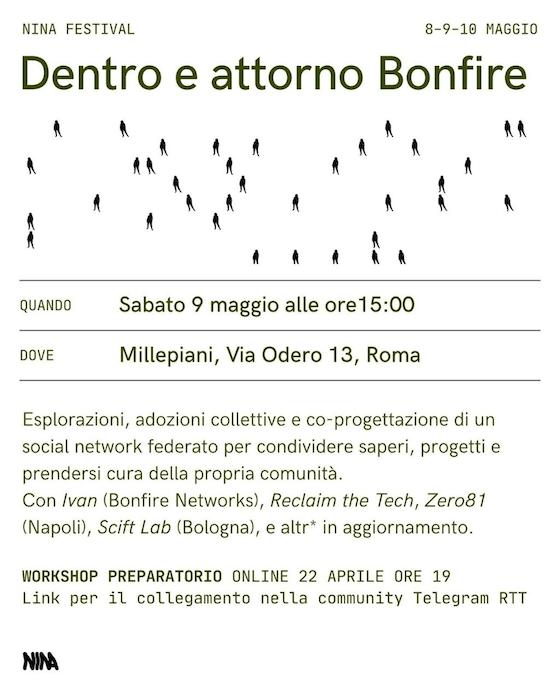
On Saturday May 9th in Rome, as part of the Nina Festival, we're hosting a workshop to think with Bonfire, exploring and co-designing federated digital spaces for caring for our communities.
Together with @reclaimthetech@mastodon.uno, Zero81, Scift Lab and more.
📍 Millepiani, Via Odero 13, 3pm
If you're in (or near) Rome, come join us!


@netvor@masto.nu @Bonfire@bonfire.cafe Yeap, zig had been on my short list to learn for a while now and that is one of the main reasons (along with comp time and solid cross compilation).
@mavnn@bonfire.mavnn.eu @netvor@masto.nu zig is also very easy to use within an elixir app (even mixing zig code inline within an elixir module: hexdocs.pm/zigler/Zig.html

There was a website that held a library of common elements of modern UI/web app design, assessed for their attentional harm or addictive qualities. I don't remember if it had these exact items, but you would find things like "infinite scroll" and "notification badges" on there, along with research and recommended best practices.
Does anyone know what it is I'm thinking of?
@spencer@motley.club There's this website, but it's the reverse, cataloguing patterns that they consider to be prosocial: prosocialdesign.org/


@strypey@mastodon.nzoss.nz @mavnn@bonfire.mavnn.eu we did some changes to improve feed performance, you can find the edit button in "advanced" - after opening the 3 vertical dots more menu
Appena presi 2 biglietti per i Casino Royale il 28 Maggio al Monk (Roma) - Sempre più vicino Reloaded Tour, un album che ascolto ininterrottamente da buoni 20 anni...

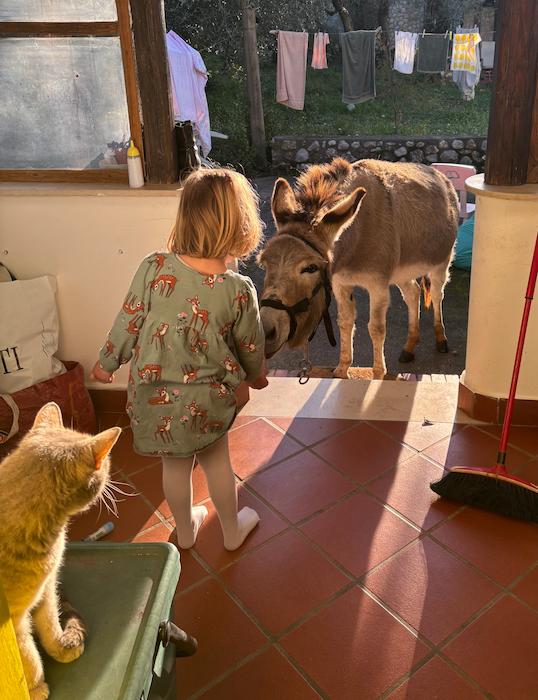
Had guests this morning ....
@orchun@hachyderm.io Oh, weird. I wonder what's causing that one? I don't know if @bonfire@indieweb.social might be interested in knowing that is happening.
Thanks for reporting! It looks like Mastodon picked up the hashtag link to preview, will look into it.
Oggi prima giornata di Aurora tutta sola al Maneggio, anche primo vero giorno di primavera 🌱
Mentre tornavamo a casa assieme, abbiamo messo "Colori" di Piotta e Remo Remotti, o come lo chiama rory, quello scemotto di remo remotti... momenti preziosissimi
@Quenti@framapiaf.org @liaizon@social.wake.st @klasse_methode@chaos.social @ButterflyOfFire@mstdn.fr wow, this is very interesting. Feel free to start the translation, then it will be available in the next version.

Are there any plans for integration with RSS feeds? Besides of group support (in the works) and some sort of BlueSky integration (which could be skirted with RSS feeds), that's one of the few things I'd be missing to move from Friendica.
@csolisr@hub.azkware.net Bonfire provides RSS/Atom for feeds and users: docs.bonfirenetworks.org/rss... (we want to add the same for thread comments next)
And we've prototyped an extension for following RSS/Atom feeds just like you do ActivityPub actors within Bonfire, some feedback on the approach would be useful: github.com/bonfire-networks/...
