
Not sure why this dross, dated Dec 1, seems to be circulating now (and why it didn't cross my feed a month ago), but wow what a terrible essay.
https://bigthink.com/the-present/the-rise-of-ai-denialism/
A few comments, in a short 🧵>>
Discussion
Not sure why this dross, dated Dec 1, seems to be circulating now (and why it didn't cross my feed a month ago), but wow what a terrible essay.
https://bigthink.com/the-present/the-rise-of-ai-denialism/
A few comments, in a short 🧵>>
First, it displays a certain kind of intellectual laziness of a type I've seen before: Arguing against "pundits", "influencers" and "voices", without naming a single person whose specific arguments the author is arguing against.
>>
@emilymbender "someone has said something about something. You know who and what it was, right?"
@emilymbender
In other words, it's a perfect example of #EveryAccusationIsAConfession 😂 which is typical of all the AI Tech Bros - accuse the others of being "lazy" because you yourself can't come up with a valid argument for your own pro-AI position. i.e. resort to ad hominems to hide your own lack of a valid argument 🙄
"By any objective measure, AI continues to improve at a stunning pace."
No one ever said "The iphone is improving all the time any moment now everyone will want one"
I mean... WHEN will we get there? This "it's getting better" line is a huge tell for me.
I do think there is a danger of just hoping AI goes away, it won't. We will need regulations and to think about its place.
When you bring that up this kind of guys says "nooo no... it will get better. Please no!"
@futurebird @emilymbender I don't understand what you're talking about.
ChatGPT has 800M weekly active users. It is one of the fastest growing products in history.
https://openai.com/index/1-million-businesses-putting-ai-to-work/
The company has revenue around $10B/year.
The product works for people. They use it and benefit from it. It's not "any day now". It's now.
This allows Rosenberg to caricature the position he is refuting while making it hard for the reader to dispel the caricature, since the original is not pointed to.
>>
@emilymbender another aspect of this is it allows him to position the "origin" of the strawman argument he is constructing as a reaction to the apparent quality of the system outputs instead of the fundamental ethical, environmental, and commercial criticisms of LLMs in general.
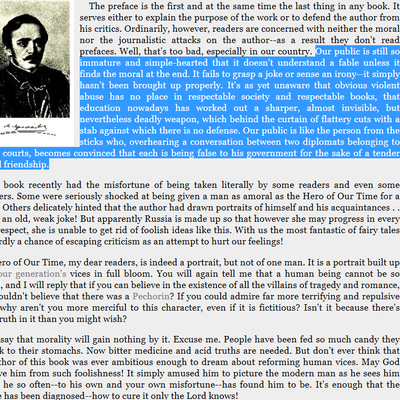
Second, he cites Ayn fucking Rand with (apparently) a straight face.
>>
@emilymbender well there’s a red flag
@emilymbender Good grief 🤦♂️
@emilymbender I was trying to see his perspective until that happened. Then I laughed at him and myself and turned off my phone. 🤣
@emilymbender That's a 1950 First of May parade in Moscow of red flags.
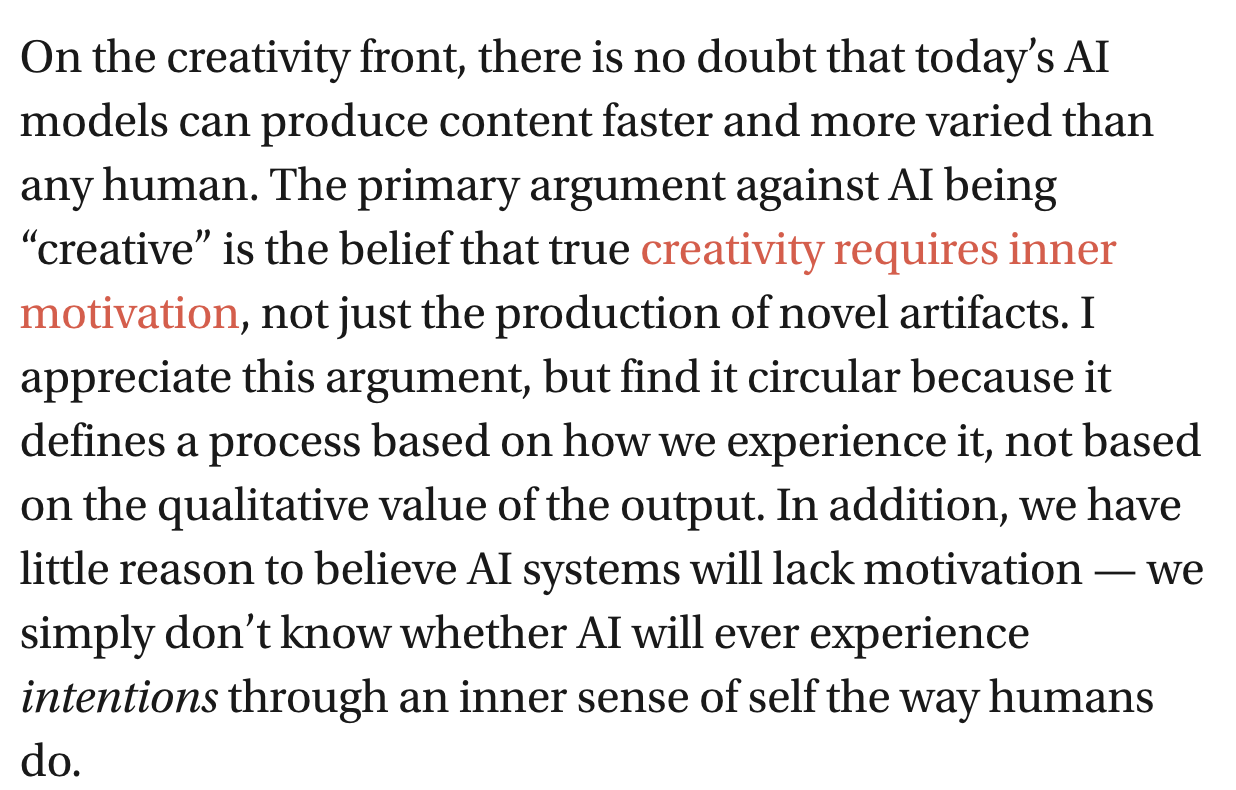
He also conflates the form of language (and art) with the actual thing: "produce content" as if output for which no one has accountability (and which represents no one's communicate intent) has any value in the world.
>>
@emilymbender what's missing? Intuition. Insight. Inspiration.
https://berryvilleiml.com/2025/02/26/revisiting-letter-spirit-thirty-years-later/
@emilymbender
Rosenberg seems full of pompous crap; thanks for reading & responding to his crappy article so we don’t have to. 🙏🏻 Like others in this thread I too wonder who he’s writing for. 😐 No one we know, that’s for sure.
@emilymbender The part about this way of thinking that offends me as a musican and an artist is that it assumes the purpose of art is to create aesthetically "beautiful" things or output.
The purpose of art is to communicate the perspective of the artist, and machines do not and cannot have perspective or communicate.
I will concede that some people may believe they find value or meaning in machine generated output, but some people find patterns in random strings of numbers, too.

When I type, I am limited by the keys on the keyboard and I am biased towards symbols that represent letters, then punctuation and digits. The number of space characters is high. In contrast, if I cat /dev/random to a file, the output will be far more varied (it will contain a roughly even distribution of all possible byte values) and much faster than I can type. If speed and variety are the things to optimise for, I have a machine that can generate such content far faster than any LLM.
Experience is central -- no art has any "qualitative value" without experience. Now, people can attribute meaning to synthetic images, but that is also an experience. But as UW's Gabriel Solis once put it so well: writing, art, performance -- these are ways of being human *together*.
>>
@emilymbender Decades of under-funding of arts education. A constant focus on the end result, not the journey that led to it.
As sad as I am about the general ignorance about what makes art art, I can't say I'm surprised.
The words, the pixels, the sound waves aren't the art. The art is in the experience of the artist and the audience, together.
>>
@emilymbender This statement seems similar to Searle's Chinese Room thought experiment, substituting "experience" for Searle's "understanding". (I'm neither agreeing nor disagreeing, but trying to understand; Searle's thesis, like so many philosophical discussions, seems to depend on the definitions of terms; and I find myself unsure whether I agree or disagree with Searle.)
@emilymbender Not pointed out frequently enough! "Art" can be shorthand for "a work of art", emphasis on "work". Art requires the work that goes into the "content".
On that note, another thing that grinds my gears is when the word "content" is used to obfuscate when someone really means "copy". If the goal of producing text is to persuade (as opposed to connecting, something impossible with LLMs), then the thing is copy, not content.
As Marcel Duchamp has so nicely shown already more than a century ago.
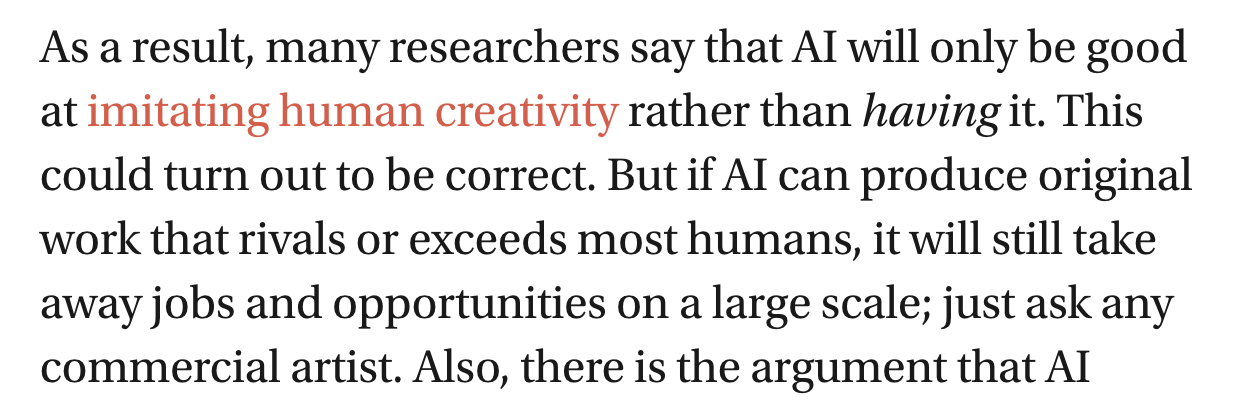
Meanwhile, Rosenberg also consistently displaces accountability: "AI" hasn't done anything. Companies have amassed large collections of stolen art and used them to produce systems with which they and others can create synthetic images.
>>
@emilymbender such a key distinction that seems to get easily lost in the anthropomorphizing
Other companies, who would have previously hired artists, are taking advantage of cheaply produced synthetic images which are only cheap because they are based on stolen art + heavily subsidized by venture capitalists sustaining this bubble.
>>
@emilymbender Yeah, my nephew is a talented graphic artist who has built a career on doing book covers, etc., but I wonder how he's coping now that AI is taking over. Publishers will no doubt save a buck with AI slop if they can.
@emilymbender the "AI" narrators for blogs, articles, and even books really get to me as well.
While bad, at least the Stocking Frames initially hit one sector and a couple adjacent ones.
"AI" is Stocking Frames on both steroids and growth hormones, attempting to wipe out multiple sectors.
Glad to have you and others leading the charge for resistance.
And also unwittingly subsidized by ordinary people paying higher electricity prices when data centers move in:
>>
Meanwhile, note the logical leaps here: People creating art based on their experience of others' art is not equivalent to what happens with the large image models munging pixels together. And what is the evidence that "AI" systems will have "sparks of inspiration"?
>>
I apologize for this brain dump. It's just how I think about AI for my work.
I have my own interpretation of why AI can't produce 'art' or be 'creative' and perhaps its complementary to the human model where the artist fine tunes their communication of experience to an audience where they can't know exactly how it will be consumed but can empathise - what experiential filters apply; something an AI so far as I know couldn't do!
A generative AI, as far as I understand it is merely directly derivative, driven by stolen 'pixels' in what would be virtually infinite combinations but for the simplifying constraints of pattern recognition and its metadata.
I suspect (or at least personally think that) human creativity has a couple of interesting and closely related creativity capabilities. I have no academic basis for any of this, it's just my way of making some sense of it.
Over time, a human moves slowly from having very limited raw sensory input; warmth, sound, light, &c. in the womb to post birth, where the senses pick up more detail. That sensory data is all we have, that's it! Everything thereafter is a house of cards. Light resolves itself into the conception of 'edge'. Different edges resolve to 'shape' and 'orientation' and different shapes together build to 'complex shapes'. Shapes, colour, texture, smell, etc resolve to objects. Much further down the track certain sound combinations can be associated with object conceptions and so the development of naming & abstraction begins. The house of cards starts to strengthen its foundations with experience. The longer this goes on, the firmer the base gets and the greater the complexity of the abstractions. Abstractions build on more abstractions, until we have complex views, like opinion, judgment, teenage moods, bigotry, religion, &c.
The second related idea I think is that our abstractions aren't rigidly tied to a particular input stack and our creativity could conceivably be related to the human capability to bridge between dramatically different experiences that have a pattern with some commonality.
The idea of seeing an animal's eyes in the beam of headlights resolved to a ubiquitous design for a road safety device was an analogous leap.
Seeing The Fighting Temeraire being towed to the scrapyard lead Turner to paint an oil painting that captured subject, mood & light &c. that communicated effectively the pathos and beauty of the circumstance.
Abstraction allows us to find that commonality and use it as a derivative for a new idea. I don't think AI can do that. It could make something emulating Turner's art but it couldn't itself recognize the opportunity from scratch or best means or anticipate the character of the consumer.
Just to reiterate, this is a story, it's not fact or truth, it's just a speculative model I've constructed that hangs together for me. I'm just sharing it to see if it resonates with anyone else.
And finally, this argument about "denial" is really an argument for defeatism (in everyone else, Rosenberg seems to be welcoming the future he paints).
>>
@emilymbender
It's sad that the author does this blend of silliness while raising some important points at the same time, but I guess that's how the AI hype works. The risks of AI being applied to so many aspects of our lives, the manipulation possibilities, and the 'identity crisis' (against which I have my own arguments) are mentioned, but then it feels like he's humanizing AI and obfuscating the companies, as the public has been brainwashed to do for decades... Apparently he's an advocate for regulation, so why promote this stereotyped thinking (well, he's a CEO, nvm...)? The whole article is very misleading in this sense. If he's worried about the huge amount of behavioral data that can be gathered for profit, why not mention who's doing the gathering and profiting? Also, I personally find it funny when men feel hurt by cognitive skills being better in software. Like, yeah, bro, calculators have beaten us at arithmetic a long time ago, and most of us are glad they did. You could have gotten over that by now. The fake antagonism of humans against machines is so tiresome. Thanks for this interesting thread
@emilymbender
Yes! The future is in-person. The future is human. The future is crafted. The future is community. The future is potlucks. The future is nature. The future is soulful. The future is messy.
There's no reason to accept a soulless, online-only future. And there's certainly no way human consciousness will ever be digitised - we are our bodies. No computer, no matter how complex, will ever be human. Only humans can be human.
If Rosenberg had actually cited the people he's arguing against, and made it possible to click through and see their words, I'm pretty sure what you'd find is not denialism, but resistance.
It is important to remember that the future is not yet written. The arts, journalism, science, education, medicine, and our chances to be human together are all worth fighting for --- and not surrendering to the maw of Big Tech.
/fin
@emilymbender It's a bit of a desperate article isn't it?
The Ayn Rand... whooo boy, says it all really.
Who are these articles written for I wonder.
@emilymbender Anyone who uses Ayn (asshole) Rand as a justification for anything, should be shot out of a cannon into an alligator-infested swamp.
@emilymbender We call it slop because it’s slop. There is no added value just discounted production of inferior quality knock offs. I’ll make a prediction: people will start to die because organisations have relied on “AI” to build critical systems without sufficient checking and testing by humans.

Install bonfire.cafe
Get the full app experience