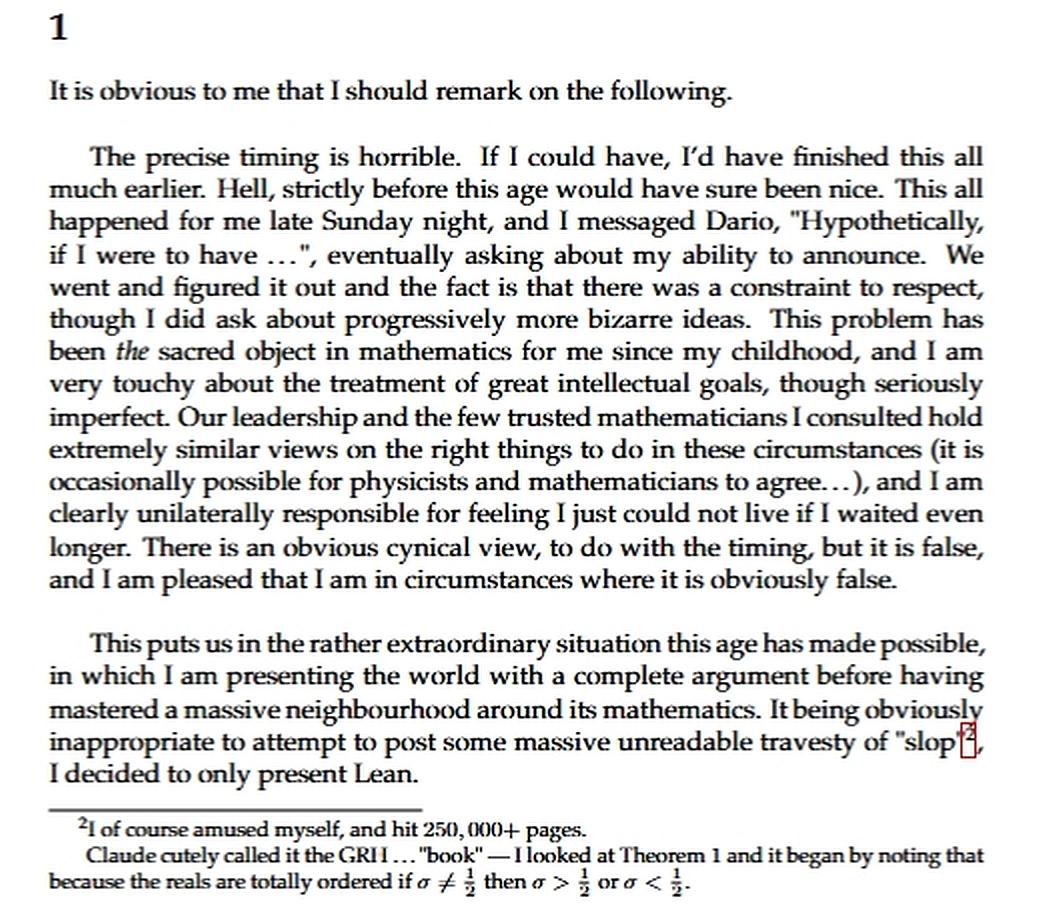

Meanwhile, Levent Alpöge, claims to have used Claude to prove the Riemann Hypothesis after a month and two weeks of work:
He's already used Claude to settle the Jacobian conjecture, the Caratheodory conjecture, and the question about the existence of complex structures on the 6-sphere. He's also done plenty of AI-unassisted work on number theory. His PhD advisor at Princeton was Manjul Bhargava, a Fields medalist and expert on elliptic curves, which play a role in the new claimed proof. He has a postdoc at Harvard.
None of this means the proof is correct! Just worth looking at.
Unfortunately there's nothing to see yet, since Alpöge has chosen to release the proof only in Lean. He believes wrestling down the argument to human-readable form will take a lot of time. Claude produced a 250,000-page monstrosity! But Alpöge thinks it can be vastly shortened, and plans to do this.
From the very short sketch he has released, the argument seems extremely tricky and technical, far harder for me to make sense of than Masullo's. Alpöge admits even he can't follow the details. He says he started out working with Claude, but Claude got ahead of him and left him in the dust.
This is the perfect human-vs-machine drama, so I'm sure it will become quite a soap opera. But I'm happy that the ideas in Masullo's 940-page paper seem extremely different from those sketched by Alpöge. I don't get the sense that either has borrowed or stolen ideas from the other.
Number theorists will have a great time figuring out if 0, 1, or 2 of these proofs are correct - but more importantly, there should be some good math to be learnt here either way.
(2/2)