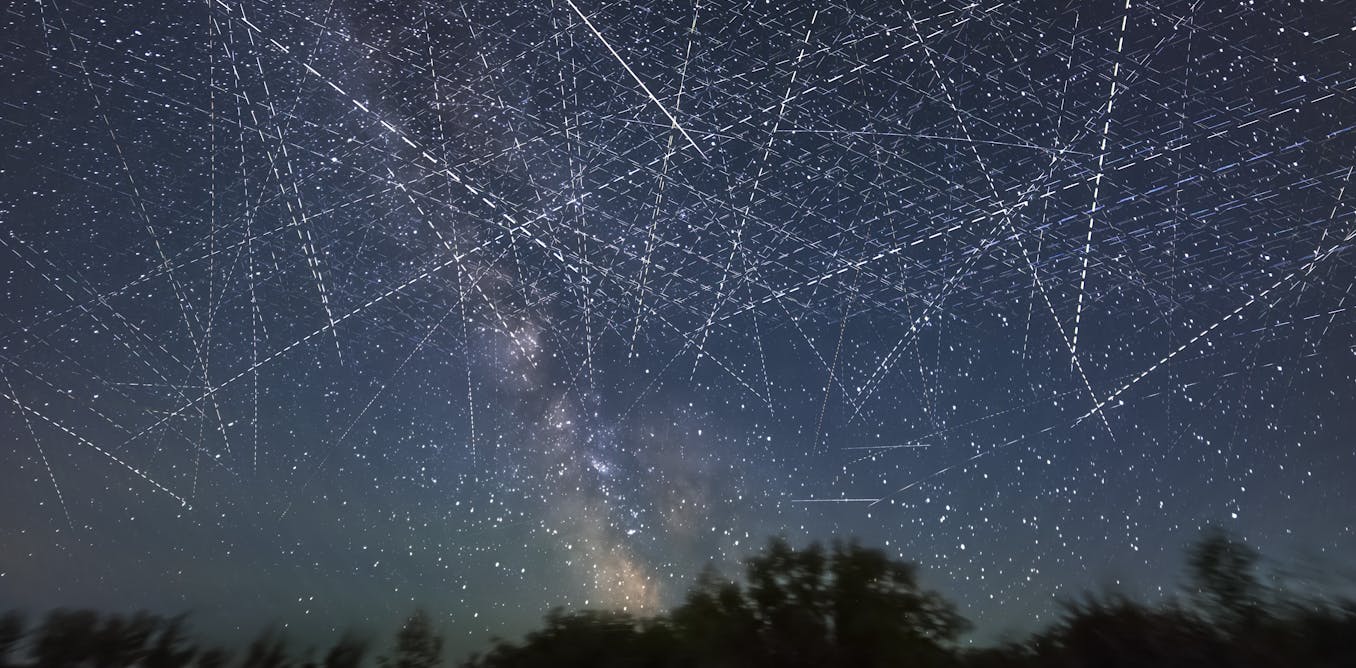

Last month, SpaceX applied to the US Federal Communications Commission (FCC) for permission to launch
one million more satellites for untested “AI data centres”.
That sheer number isn’t the only issue.
SpaceX’s Starlink V2 “mini” satellites happen to weigh about 800 kilograms (kg)
– roughly the mass of a small car
– with later versions expected to reach around 1,250 kg.
The planned V3 satellites are larger still, comparable in scale to a Boeing 737 airliner.
Rocket launches already contribute to climate change and ozone depletion.
Scaling them up to deploy a million aircraft-sized satellites would push upper-atmosphere heating and ozone loss
far beyond previous estimates,
with the steady burn-up of dead satellites compounding the impacts.
This comes as burnt satellite dust is already being found in the atmosphere.
In 2023, scientists studying aerosols in the upper atmosphere found metals from re-entering spacecraft.
Just recently, lithium has been detected from the uncontrolled re-entry of a Falcon 9 rocket.
This is just a fraction of what is to come if planned megaconstellations go ahead
– and SpaceX is far from the only player.
Other operators worldwide have already asked for a combined total of over one million satellites.
All the while, the full environmental consequences remain poorly understood because satellite builders rarely disclose what their spacecraft are made of.
https://theconversation.com/a-new-space-race-could-turn-our-atmosphere-into-a-crematorium-for-satellites-276366