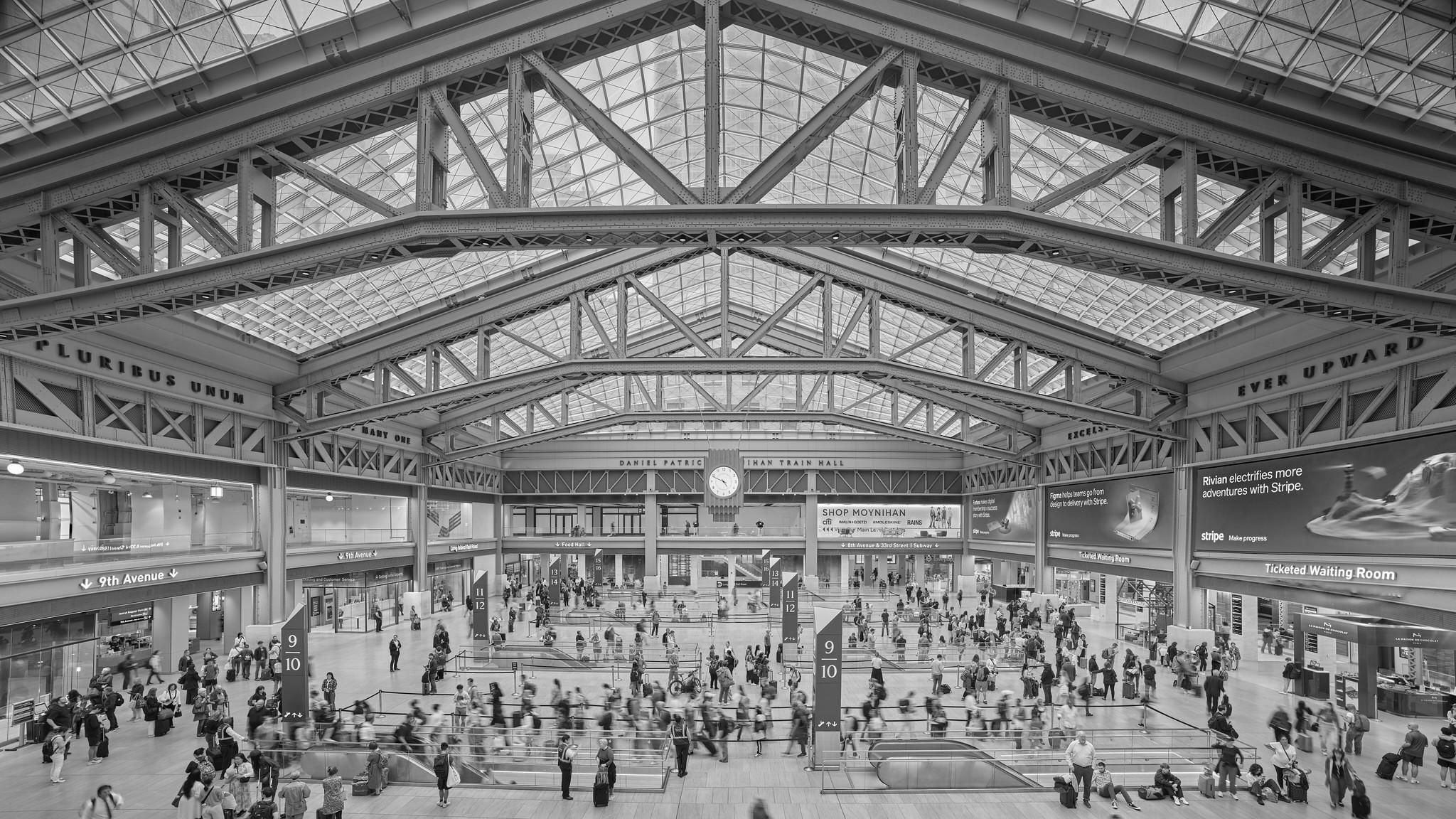

Moynihan Train Hall, Pennsylvania Station, NYC, 2025
All the pixels, now boarding at https://www.flickr.com/photos/mattblaze/54499376593
Discussion
Moynihan Train Hall, Pennsylvania Station, NYC, 2025
All the pixels, now boarding at https://www.flickr.com/photos/mattblaze/54499376593
@mattblaze I’m guessing you have read Moynahan’s Senate committee report on government secrecy from the early ‘90s. IIRC, the author of the history section republished it with the name “Secrecy,” co-authored with Moynahan.
Composite image made Rodenstock 32mm/4.0 HR Digaron-W lens (@ f/6.3) lens, Phase One IQ4-150 digital back (@ ISO 50, 1/4 sec), Cambo WRS-5005 camera (Shifted vertically +/- 15mm, horizontally +/- 23mm). Stitched composite of 4 images, cropped to 16:9 and 240MP.
Captured here four years after opening, Moynihan Train Hall is a new annex (repurposed from the Post Office) to the otherwise dungeon-like remnants of the old Penn Station, which has been buried under Madison Square Garden since 1963.
Many of the design elements of the new hall pay deliberate homage to the lost original, befittingly grand, Penn Station, including especially the prominently exposed steel beams.
There are no seats in the main hall, though there are smaller ticketed waiting areas to the side, as well as a substantial food court. The lack of a "big board" is deliberate, to discourage crowding in any particular area (there is instead a collection of smaller train status monitors spread throughout the hall).
Moynihan Hall occupies part of what had been New York's main post office building, a block west of the original Penn Station. It was situated over the tracks, with access to platforms, to facilitate Railway Post Office mail delivery, which was common into the 1970's. After the post office moved its sorting operations elsewhere, it was relatively straightforward to repurpose it as an extension of the adjacent railroad station, which is why it only took the better part of 50 years to do.
Adding the Moynihan Hall was a welcome improvement to Penn Station, but didn't address the main problem, which is insufficient capacity for the number of trains that run through it. There aren't enough tracks, the platforms are too narrow, and the tunnels entering and leaving the station have too limited capacity. These more fundamental constraints will be much harder to solve, because the underground area around the station is already heavily crowded.

Install bonfire.cafe
Get the full app experience