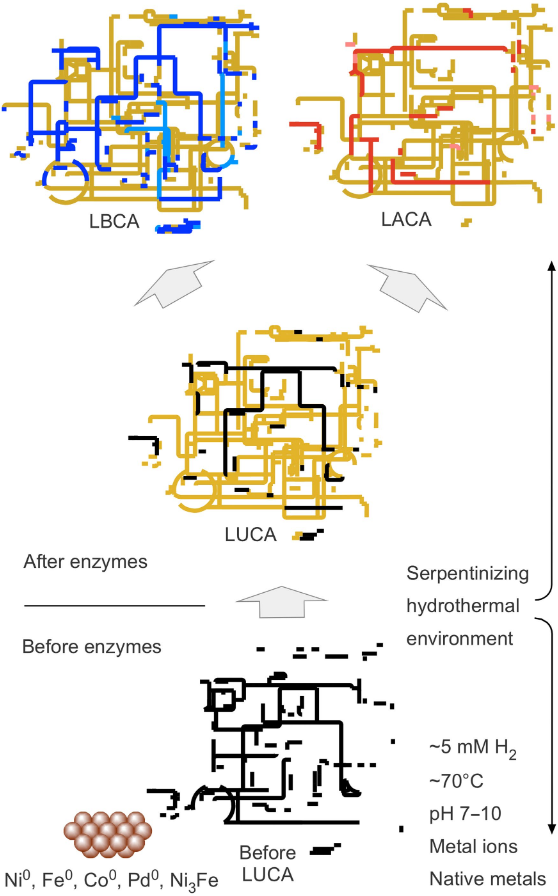
Bit hard to understand diagram of reaction catalyzed by enzymes, or by metals in the environment of LUCA.
Fig. 7. Assembly of metabolism at a phosphorylating hydrothermal vent. Maps
prepared with iPath (see Materials and Methods) show reactions catalyzed by en-
zymes present in lUcA (gold) and lineage-specific additions in lBcA (blue) and in
lAcA (red). lighter-shaded reactions in lAcA and lBcA indicate enzymes in gray
areas of Fig. 1B. Black lines denote reactions that are either (i) present as enzymatic in
lUcA, lBcA or lAcA and can be catalyzed by native or divalent transition metals (see
fig. S8 and table S4) before enzymes (lower panel) or that are (ii) present as enzy-
matic in either lBcA or lAcA, but not in lUcA, and can be catalyzed by native or di-
valent transition metals in lUcA. catalysis is provided by enzymes and native metals
(symbolized at bottom left), which catalyze one-electron transfer, hydride transfer,
h2 activation, cO2 reduction, c1 transfer, formate synthesis, acetate synthesis, pyru-
vate synthesis, aldol condensation, decarboxylation, amino acid synthesis, and ami-
nation (see fig. S8), in addition to phosphite activation and phosphorylation (Fig. 4).