

"In a burning world we need to hold ourselves and each other to a higher standard. “Useful” is far, far from being good enough."

@tante I understand the importance of the message that even if genAI is useful, that isn't good enough, but I still think it's important to also make the argument that it isn't useful.
I say that as a person who's watching Copilot on my laptop which is currently four hours into something I could have done by hand in 20 minutes, with no end in sight.


AI and LLM are indeed yet another category of tools, powerful tools even, and yes I am using them as part of my work. Where it will look in either my private collection of stashed knowledge where I can ask dedicated questions just like wiki used to be powerful to store and categorize knowledge. Yet another and new higher abstraction level of relational database with logic on top. Tools indeed, and yes useful tools if you can handle them well, and they are here to stay.


@tante Thanks... this annoys me to no end about AI enthusiasts. You give them a long list of negatives, and they agree the are negatives, but they say "but AI is useful!"


@tante Even from a purely technical standpoint, “it is useful, so we allow it” is a very bad argument. Something can be useful in some narrow sense while introducing serious issues that undermine the software and the project. These things need to be analysed holistically.


Meh, this is a cop-out from Torvalds. There's something _he_ finds useful in it. LLMs as chatbots doing all the things is not a force for _good_. Period.
And it's _certainly_ not neutral. People with his attitude assume the "rough edges" will eventually get polished to smoothness.
This assumes the rough edges aren't the point. In the case of the people pushing LLMs like smack on the street corner the rough edges are very much the _point_.
@tante this is not the nature of humans. This is a fabricated construct. And even more, who passes judgement, i.e. according to whom?


@tante
Goddamn @torvalds !?! What the actual fuck?!?
"Many people use Linux not because it’s the best but for political reasons, for reasons of autonomy or to be part of a community."
Yes! Yes, they do.
And oh my word: "In a burning world we need to hold ourselves and each other to a higher standard. “Useful” is far, far from being good enough." SO much this!!!
As for AI: Fuck AI!


@tante just curious if the LLM being discussed here can be differentiated? I'm certainly against the pump n dump burn the planet companies selling tokens. But, I also use local rnn and llm on occasion. For their utility. Just as I use markov chains and regexp. As to utility, Alone in JS Mill, the finer points have been discussed long enough to end with socialism on utilitarian grounds.
@tante This is incorrect, usefulness is the _only_ thing that matters for a tool. A tool that is useful is inevitable, and to resist it is mere neoluddism.

@tante It looks like the context for Linus's message is not just criticism of LLMs, but whether Linux contributors can be forced [1] to use an AI code reviewer [2]. The framework to which Linus objects for being too anti-LLM is the one fedi views as too pro-LLM [3].
Further upstream (but perhaps not what Linus was responding to), it seems there is even question as to whether Linux maintainers can be forced to force contributors to use the AI code reviewer [4].
(Disclaimer: I didn't read all of the emails in that thread, and I'm not a close follower of lkml, so I'm likely missing nuance.)
[1] https://lore.kernel.org/linux-media/20260715005909.GF1656185@killaraus.ideasonboard.com/
[2] https://github.com/sashiko-dev/sashiko
[3] https://sfconservancy.org/llm-gen-ai/llm-backed-generative-ai-recommendations.html
[4] https://lore.kernel.org/linux-media/7E971C76-0568-43EF-9EE7-C8DB78C45CA1@linux.dev/


@tante The Linux kernel community is known for its technical achievements, and also for its rather spectacular history of not being great at human(e) interactions.
They have ... very clear priorities there, and tolerated behaviours pubescent teens would get to send to bed without dinner for.
So this is perfectly on point.
Alas.


@tante i‘m not convinced that he says „its useful so we should use it“. sounds more like „lack of usefulnes isn‘t a counter argument anymore“. especially the last paragraph seems to leave the door open for other counter arguments.
i may lack some context and totally agree to your argument regarding usefulness, though.


@tante That's why nearly all my criticism of genAI for quite some time now has not been about the usefulness or superficial appearance of quality. Because to me, usefulness/quality is somewhat irrelevant in this debate.
Asbestos is also extremely useful. That's why it got used! Harmful products get used all the time, and harmful business practices keep happening. Because of course they're useful!
Utility is the wrong question to be asking.


@tante Excellent as always tante. This for me is the core of Le Guin's The Ones Who Walk Away from Omelas.
https://axbom.com/omelas/
https://axbom.com/omelas/


@tante I assume the discussion spun up around whether the Linux kernel should accept AI generated contributions. How would one practically avoid that? In your analogy of child labor the Kernel community would have to put out a statement that code written by means of child labor is not accepted in the Kernel. Reasonable. And the industries way of "ensuring" that is my having the contributor sign a piece of paper saying they don't use child labor. Would that be the same for AI generated code if the decision would be to not accept AI generated code? The code itself wouldn't be distinguishable from human written code. You'd just have to trust the person that they stand by their signature to not use AI tools for code generation.

@maxheadroom @tante
this one's easy. Have a policy against GenAI contributions. Maybe there will be dishonest contributors. If you catch them you use all the tools of open source reputation (conversation, bans, etc). Just like always.
Holding people to standards is a problem for open source, but not a new one. People could be contributing closed source code and nobody would be able to tell. Open source has always relied on some level of trust.


@peter_mcmahan @maxheadroom @tante this is what i was hoping would happen with the KDE discussion at https://discuss.kde.org/t/sorry-to-bring-up-a-contentious-topic-kde-ai-llm-policy/46333 (set a policy and enforce it as much as possible) but it seems like they took the opposite stance of "we can't ever know for sure if people are using it, so there's nothing we can do." kind of a bummer really
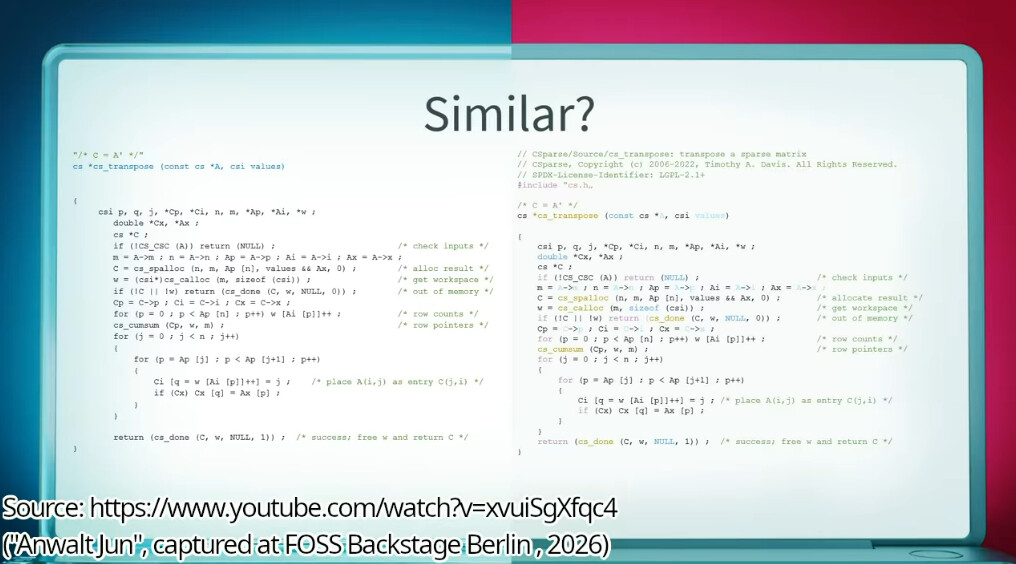

@tante I make no claim to know how the man thinks, but I suspect no small part of this is a bit of FOSS realpolitik.
Let's say Linus were to stand firm against use of AI use in the kernel. Commendable.
But then the rate of commits remains stagnant. meanwhile some big institutional downstream kernel (say a consortium of Ubuntu and other for-profit distros) user goes and forks the kernel. Now there's the Linux Foundation kernel (kernel0) and several "AI friendly" kernels (kernelPrime) that get features added in more rapidly, customizable branches (kernel Lite, kernel Plus etc.) all enabled by rapid AI development. Complete with Ai induced sec vulns and just... bloat and shit.
I'm not entirely sure that landscape is better.
Don't get me wrong, I'm in no way excusing it. But I can sortof understand it. The "Adapt or die" mentality.
(Sorry, just a quick note, I'd love to write a longer piece on "useful" because it's such a harmful narrative)


@tante "useful" is only a necessary requirement, because if it was useless of course nobody would use it.
The question is what the sufficient requirement is. That should to my mind always include "do no harm".

@tante they key point, "fork it", was not addressed.
