
Wow some terrible reporting about Google's latest horrible ideas about how to distort information access in the name of "convenience" (or something):
https://techcrunch.com/2026/05/19/google-search-as-you-know-it-is-over/
A short thread
🧵>>
Post
Wow some terrible reporting about Google's latest horrible ideas about how to distort information access in the name of "convenience" (or something):
https://techcrunch.com/2026/05/19/google-search-as-you-know-it-is-over/
A short thread
🧵>>
@emilymbender i'm fucking weepi ng
Information-gathering agents are an evolution of Google
i have never observed google demonstrate any behavior that struck me as evidence of them gathering any form of information
Links will become an afterthought
that reminds me how they own the w3c and use it to ensure no one who has ever created a webpage will ever be able to show it to anyone without exposing them to the most openly broken cryptography i've ever seem
There’s little time left for publishers to adapt.
openly gloating
which will eventually be free
that's right. we will all be free. that's a cryptographic guarantee
5 years ago (2021) Google researchers Metzler et al put out a preprint talking about how LLMs would change information access ("Rethinking Search"). It was full of TERRIBLE ideas, and Chirag Shah and I wrote a reply ("Situating Search"):
https://dl.acm.org/doi/10.1145/3498366.3505816
>>
We followed a couple of years later with further arguments about, inter alia, protecting the information ecosystem:
https://dl.acm.org/doi/10.1145/3649468
While Nora Lindemann was writing about similar ideas:
https://link.springer.com/article/10.1007/s00146-024-01944-w
>>
But all the academic papers in the world showing why something is a bad idea won't stop companies from doing it, if it's profitable and/or fits into their quasi-religious beliefs that "AI" is the future, alas.
So let's look at what Google is up to now, or at least says they are, via TechCrunch as stenographer:
>>
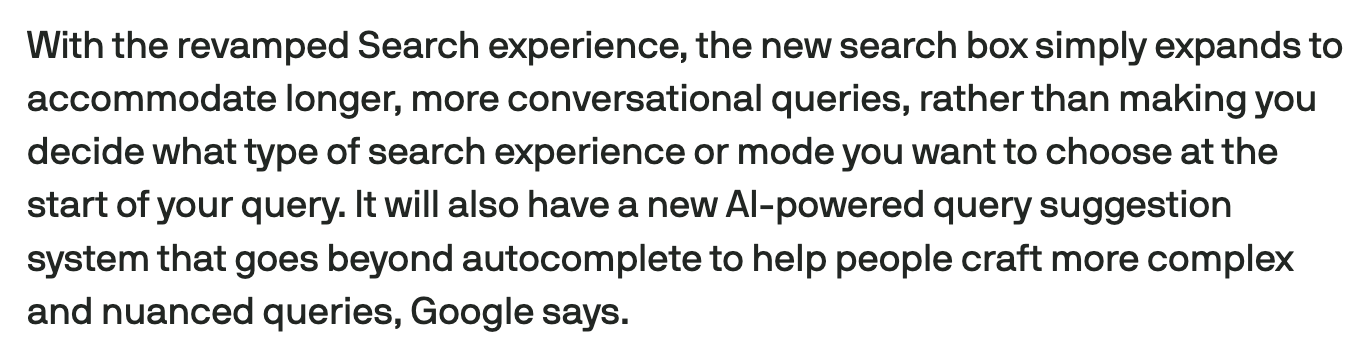
Not satisfied to cut people off from the important sense-making of looking at information in its context and finding and navigating different perspectives (what "AI overviews" do), Google also wants to tell you what to search for:
>>
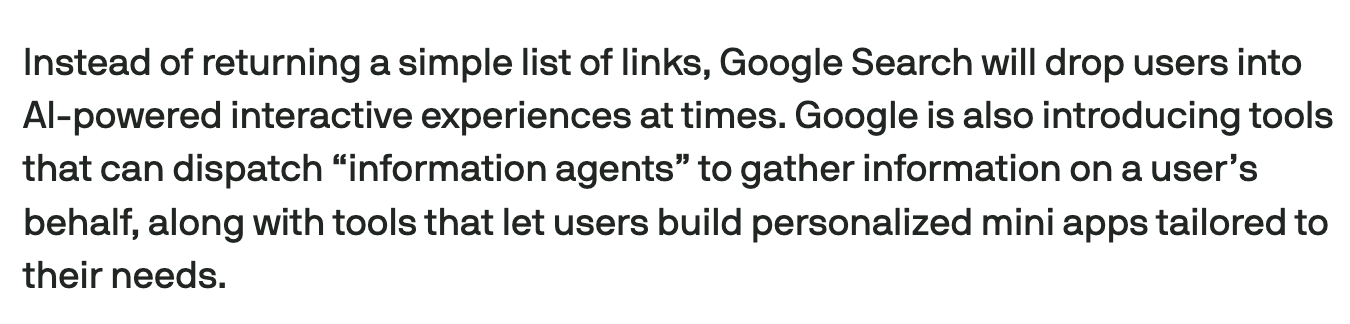
How infantilizing --- you thought you were looking to find something that someone else wrote on the web. But woah! Now you've been "dropped into" an "interactive experience". Yeah, Google can just fuck right off with that.
>>
Look, I hate pointy-clicky interfaces as much as the next Gen-Xer (let me use the keyboard, dammit) but it is so weird to reduce the important, and importantly effortful, work of navigating the information ecosystem to the apparent drudgery of clicking on links that are (*shudder*) blue!!!
>>
Here is where it really starts to show that this journalist is just lightly paraphrasing a press release. "Links will become an afterthought," will they? What is your evidence for that confident statement about the future?
>>
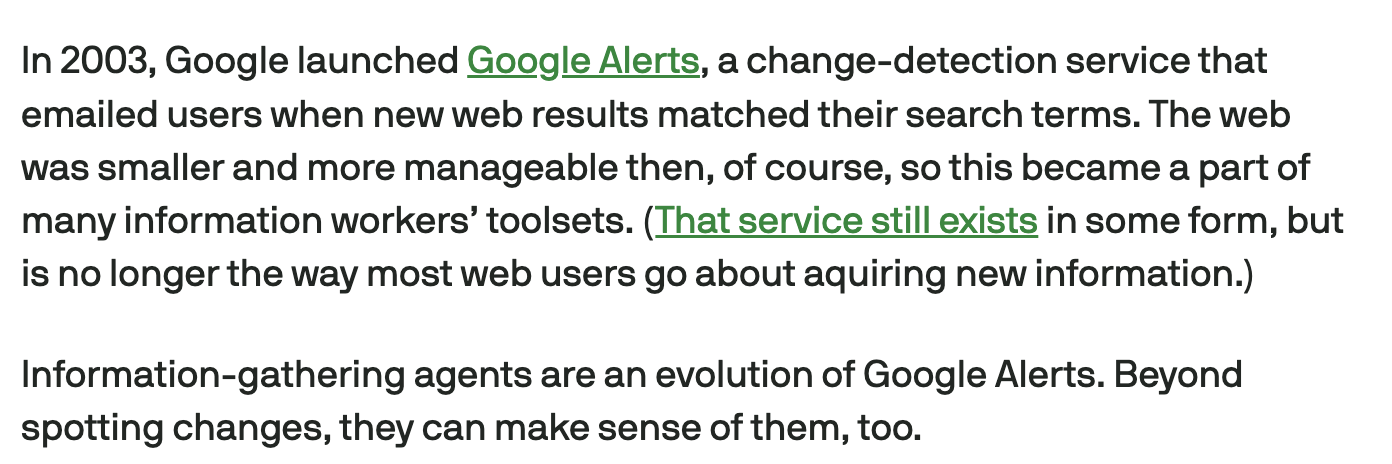
Spot the magical thinking here. No, the "AI" isn't making sense of anything. It's making papier-mache of the input, and preventing the use from doing the sense-making.
Also, is that the Pokemon sense of "evolution"?
>>
To expand just a little bit: the point of a Google Alert was to gain access to things that people were saying about a topic that you were tracking, which you otherwise might not turn up. And every (blue, even!) link that you clicked on brought you to a web page you could examine to get a sense of who was writing, in what context, and why.
>>
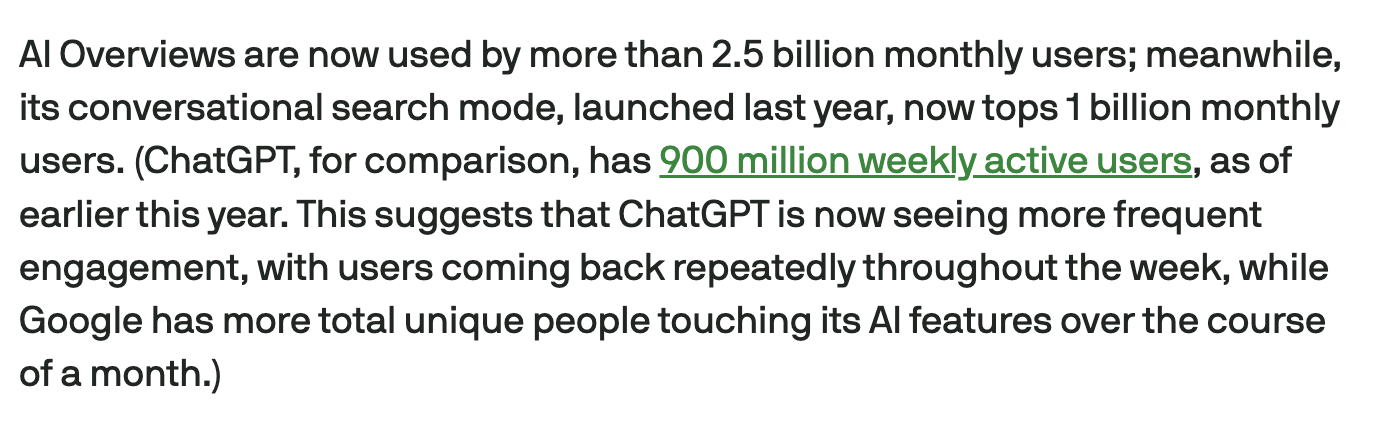
More stenography here. Google starting shoving the "AI Overviews" into query results as an opt-out situation. That is, you have to take action to have them not pop up. I don't doubt they are *shown to* 2.5 billion monthly users, but that doesn't mean they are used by as many or desired by them.
>>
The comparsion to ChatGPT in the above screencap also really shows the PR origins of this piece. Google is clearly very very concerned about losing their advantage in this market to OpenAI.
>>
NO NO NO NO NO! Flashy polished looking webpages that no one has accountability for run absolutely counter to the common good when it comes to a health information ecosystem AND an informed public.
(Also, "Antigravity"? Yeah, you want us to think this is very cool science fiction and/or magic. Not buying it.)
>>


Install bonfire.cafe
Get the full app experience