
The Trump–Xi summit.
I'm Isaac Saul, and this is Tangle: an independent, nonpartisan, subscriber-supported politics newsletter that summarizes the best arguments from across the political spectrum on the news of the day — then “my take.”
Are you new here? Get free emails to your inbox daily. Would you rather listen? You can find our podcast here.
Today’s read: 15 minutes.
🇨🇳As tensions between the countries rise, U.S. President Donald Trump and Chinese President Xi Jinping held a meeting in Beijing last week. Plus, a reader proposes a solution to prevent gerrymandering.Isaac’s message to college students.
On the last stop of his whirlwind college speaking tour, Executive Editor Isaac Saul implored students at St. Olaf College to “choose decency.” In this divided country, Isaac said, “be one of the fair ones. Be curious. Be open-minded. Be willing to say you’re wrong. Don’t treat politics like a team sport but as an opportunity to explore your own views, challenge your beliefs, and adopt new principles and ideas if you find them compelling.” To share what he’s been saying to America’s college students over the past five weeks, we published Isaac’s whole speech on Friday. You can read it here.
If you want to read Isaac’s speech in full — and access all future Friday editions, Sunday editions, and ad-free daily newsletters — become a Tangle member today for just $6/month!
SPONSORED by incogniDon’t wait to become a victim. Take control of your identity.
Over 422 million people had their personal data exposed last year alone. And the easiest targets? People whose info is still floating around online.
Incogni tracks down and removes your personal details from over 420+ data broker sites, people-search pages, public records, and more — automatically. They periodically check if your information appears on the data broker sites and remove it, so you get total peace of mind.
With their unlimited plan, you can go even further. Google yourself and send them any link you find with your info on it. Their privacy team will assist you in getting it wiped.
Stop making it easy for identity thieves. Lock down your personal data before criminals take advantage of it. Remove your data now — 55% off with code TANGLE!
Get the deal!Quick hits.
- President Trump warned that Iran would “get hit much harder” if the country’s leaders do not offer a more favorable deal to end the war. (The negotiations) Separately, on Sunday, a drone strike sparked a fire on the edge of a nuclear power plant in the United Arab Emirates in what authorities are calling an “unprovoked terrorist attack.” (The strike)
- The U.S. Supreme Court rejected a request by Democratic officials in Virginia to use a new congressional map recently approved by voters but struck down by the Supreme Court of Virginia. (The rejection)
- Senate Parliamentarian Elizabeth MacDonough rejected $1 billion of Secret Service security for a new White House ballroom from being included in a recent $72 billion Republican funding package. MacDonough ruled the ballroom security funding violated the Byrd rule for including non-budgetary items during reconciliation. (The removal)
- The World Health Organization has declared a public health emergency after an Ebola outbreak caused 350 reported cases and 88 deaths in Uganda and the Democratic Republic of Congo. (The outbreak)
- Sen. Bill Cassidy (R-LA) failed to advance to a runoff in the Republican primary for his Senate seat; instead, Louisiana Treasurer John Fleming and Trump-endorsed U.S. Rep. Julia Letlow will face off on June 27. Cassidy’s loss follows a Trump-backed effort to oust him over public breaks from the president. (The primary)
Today’s topic.
The Trump–Xi summit. On Friday, President Donald Trump departed China after a two-day summit with Chinese President Xi Jinping, in which the leaders discussed trade deals, diplomatic relations, the Iran war, and other issues. Trump and Xi each spoke favorably about the other and emphasized their interest in a mutually beneficial relationship between the countries, though the two sides did not mutually announce any major commitments. Trump’s state trip to China was the first U.S. presidential visit to the country since Trump’s 2017 visit during his first term.
The summit was held against the backdrop of rising U.S.–China tensions during Trump’s second term. In April 2025, Trump levied significant tariffs on Chinese imports, prompting China to impose export controls on rare earth materials; Trump and Xi later agreed to a trade truce in October. The Trump administration also placed strict export controls on the sale of advanced artificial intelligence chips to China.
Separately, the Trump administration has begun sanctioning Chinese actors for allegedly aiding Iran in its war with the United States. On April 24, the Treasury Department announced sanctions against a Chinese oil refinery for buying billions of dollars of Iranian oil. On May 8, the State Department sanctioned three “China-based entities” for “providing satellite imagery that enables Iran’s military strikes against U.S. forces in the Middle East.”
President Trump was accompanied on the trip by senior administration officials as well as business executives, including Nvidia’s Jensen Huang, Tesla’s Elon Musk, and Apple’s Tim Cook. According to U.S. Trade Representative Jamieson Greer, the executives had an opportunity to talk with President Xi regarding their businesses, though Greer said AI chip exports were not discussed. Xi reportedly indicated that China would increasingly open up to U.S. businesses.
Following the meeting, China agreed to buy 200 Boeing planes from the United States and President Trump said the countries had agreed to “fantastic trade deals.” The White House also announced that China has agreed to buy more American oil and agricultural products, but China has not confirmed its plans. Trump said that he and Xi agreed that the war in Iran should end and the Strait of Hormuz should reopen to commercial traffic; however, China did not address Iran in its post-summit comments, and the country’s foreign ministry released a statement during the summit that said the United States should not have started the war.
U.S. policy on Taiwan was also a notable point of discussion. After a closed-door meeting with President Xi and President Trump, a Chinese foreign ministry spokesperson summarized Xi’s position, saying, “If [the Taiwan question] is handled properly, the bilateral relationship will enjoy overall stability. Otherwise, the two countries will have clashes and even conflicts, putting the entire relationship in great jeopardy.” Trump told reporters that Xi asked him if the U.S. would intervene if China invaded Taiwan, to which Trump said he responded, “There’s only one person that knows that — you know who it is? Me.”
President Trump praised the Chinese president at several points during the summit. “You’re a great leader. Sometimes people don’t like me saying it, but I say it anyway, because it’s true,” he told him. “It’s an honor to be your friend.” Before departing, Trump invited Xi to the White House in September, and Chinese officials confirmed the president will visit the United States in the fall.
Today, we’ll share views from the left, right and foreign policy experts on the summit, followed by Executive Editor Isaac Saul’s take.
What the left is saying.
- The left says Trump has weakened the U.S.’s standing with China.
- Others called Trump’s position on Taiwan risky.
In Slate, Fred Kaplan said “Trump just gave Xi Jinping exactly what he wanted.”
“The best thing to say about the U.S.–China summit in Beijing on Thursday and Friday is that our allies’ worst fears didn’t come true. Aside from that, President Donald Trump failed to fulfill his fondest hopes for the meeting, while his host, President Xi Jinping, accomplished his own bedrock goals, though not much more,” Kaplan wrote. “Trump boasted to reporters after the summit that he and Xi had made ‘fantastic’ deals, but the only example he cited — Xi’s agreement to buy 200 jet planes from Boeing — was less than impressive. Boeing stock plunged by 4% because shareholders had anticipated that China would buy 500 planes.”
“Xi sees the United States as a declining empire… Trump’s praise of Xi — in the social media post and many more times during the summit itself, lauding the Chinese dictator as a ‘great leader’ and ‘really a friend’ — only reaffirmed Xi’s main goal in this summit: to solidify China’s standing as a peer power of the United States,” Kaplan said. “Xi, who cares little about friendship, was interested only in preserving his power, reinforcing China’s growing stature, and… ensuring that it can rise and flourish in a somewhat stable world. In that context of competitions, Trump flew home with little; Xi walked back to the palace, reassured.”
In Brookings, Ryan Hass wrote about “Trump’s dangerous Taiwan gamble.”
“During the run-up to U.S. President Donald Trump’s visit to Beijing, he remained ambiguous about his views on Taiwan. When asked in interviews, he regularly lamented that Taiwan ‘stole’ America’s semiconductor industry while adding a note of reassurance that there would not be a war in the Taiwan Strait under his watch. He would recount that he and Chinese President Xi Jinping shared an understanding about avoiding conflict over Taiwan,” Hass said. “The net effect of his comments was to suggest that his views on Taiwan independence were closer to Beijing’s preferences, that Taiwan had a greater responsibility to avoid provoking conflict, and that America’s security support for Taiwan was negotiable with China.”
“Beijing will seize on Trump’s recent comments to signal to Taiwan’s 23 million people that Trump cares more about his relationship with Xi than he does about them,” Hass wrote. “Trump is giving up credibility without extracting benefits from Beijing. This is not just a policy shift. It is a shift from deterrence to dealmaking in a domain where there is no deal to be made, beyond offering unilateral concessions that undermine deterrence. If Trump acts on his musings about treating Taiwan arms sales as a source of leverage, he would crater the confidence of America’s security commitments, not just in Taiwan but among America’s allies globally.”
What the right is saying.
- The right is mixed on the summit, with some glad that the U.S. did not concede to Chinese interests.
- Others think the summit is proof that American power is declining.
The Wall Street Journal editorial board wrote about “The good-news-is-no-news summit.”
“The main rule of presidential summitry with an adversary is first do no harm. By that standard President Trump’s Beijing parley with Chinese leader Xi Jinping this week was a success. It didn’t achieve much, but it also didn’t appear to give away anything notable to the wily dictator,” the board said. “Mr. Trump boasted about ‘fantastic’ Chinese purchases to come of U.S. soybeans and aircraft. But China didn’t confirm the sales… Mr. Trump also said the two now agree on Iran and the Strait of Hormuz, but there was no overt agreement from Mr. Xi.”
“The good news is that the President doesn’t seem to have granted Mr. Xi’s wish that the U.S. allow the sale of advanced computer chips to China. This is a Communist Party priority as it seeks to catch up with the U.S. on AI,” the board wrote. “But Mr. Xi promised Barack Obama that China would stop its cyber raids on U.S. companies and agencies, and China kept on stealing American secrets and embedding malware in U.S. systems. This attempt at AI arms control won’t amount to much unless the Trump team is as naive as Mr. Obama.”
In The American Conservative, Jude Russo argued “Trump’s visit to China emphasizes American strategic weakness.”
“Few would say that the first Trump administration was a total success, but at the level of theory there was a certain coherence to it. On the China side of things, Elbridge Colby articulated the line of thought in the 2018 National Defense Strategy… The U.S., Colby wrote, should boost its partnerships in the Indo-Pacific to prevent China from establishing hegemony in the region,” Russo wrote. “Corollaries were a deemphasis on the Middle Eastern theater, which is not enormously important for American interests, and a real defense buildup, particularly a naval buildup… We have spent the past decade twiddling our thumbs and have little to show for it.”
“So it’s difficult not to look at President Donald Trump’s visit to Beijing this week and feel kind of bummed out. Xi Jinping said that he doesn’t want an Iranian tollbooth in the Hormuz, which is good, I guess, but it’s embarrassing that the administration is treating China getting on board with our position as manna from heaven,” Russo said. “When the gang gets home and sleeps off the jetlag, well, we’re still going to be at war in a peripheral theater (one that looks like it hurts us more than it hurts China, by the way, whatever the big brains on Twitter are saying), a subpar navy, and a largely compromised economy. It’s hard not to feel that China is very serious, and we are not.”
What foreign policy experts are saying.
- Foreign policy experts observe how Trump’s visit differed from previous state visits to China.
- Some argue that Trump’s novel attitude toward China won’t get the results he wants.
In Foreign Policy, James Palmer said “The Trump–Xi summit was remarkably banal.”
“You could be forgiven, reading and watching the Chinese press this week, for entirely missing U.S. President Donald Trump’s visit to Beijing,” Palmer wrote. “As it turned out, the lack of dramatics on the Chinese side was appropriate. Trump’s visit was a snoozefest. Xi stuck to political banalities, speaking about familiar red lines: Taiwan, democracy and human rights, China’s ‘path and system,’ and China’s ‘development right,’ referring to its ability to move up the global economic ladder without being pushed down by Washington.”
“Yet previous U.S. presidential visits were met with far more fanfare in China’s tightly controlled media, even when little of consequence emerged. Why was Beijing so muted this time around? One reason is unpredictability. Other U.S. presidents visiting China have stuck to an agreed-on agenda and have been controlled and careful in their speech. No one expects this from Trump,” Palmer said. “Chinese leaders also sought validation through recognition from Washington. The United States was recognized as the global superpower, and China gained status in the eyes of its own citizens by portraying itself as a peer and a gracious host… China no longer needs that validation from the United States. Its global primacy is more than sufficiently established — not just as a manufacturing superpower but also as a technological and scientific giant.”
In Responsible Statecraft, Michael D. Swaine wrote “On China, Trump wants to be Mr. Nice Guy now.”
“It appears that the president does not look at China as a conventional security threat, and certainly not an existential one. Yes, Beijing poses an economic problem, perhaps even an economic threat, but a very manageable one that can produce a great outcome for both countries,” Swaine said. “He believes this can be achieved by working with his ‘great friend’ XJP in a kind of personalized G-2 relationship… He apparently thinks that if he can make some great deals with Xi on Taiwan, on trade, and technology, etc., the great power problem will be resolved, and he can take another step toward his long-coveted Nobel Peace Prize.”
“The problem with Trump’s novel treatment of the China–U.S. relationship is rather obvious, however. Great power relations are not real estate deals. Enduring, positive changes in those relations can only occur if leaders’ decisions reflect compromises involving deep-seated structural and political interests across their respective societies and polities,” Swaine wrote. “Given Trump’s general unpredictability and impulsiveness and Xi’s apparent unwillingness to rule on the basis of a genuine collective leadership structure, Trump’s desired personalized G-2 is unlikely to prove sustainable, or even achievable.”
My take.
Reminder: “My take” is a section where we give ourselves space to share a personal opinion. If you have feedback, criticism or compliments, don't unsubscribe. Write in by replying to this email, or leave a comment.
- Taiwan, mutual espionage, trade, and even China’s domestic practices are all fraught elements of the U.S.–China relationship.
- With the war in Iran, Trump doesn’t have a lot of leverage to change the relationship’s dynamic.
- Considering that, it’s not too surprising that nothing really happened at the summit.
Executive Editor Isaac Saul: Few topics leave me feeling as conflicted as the U.S.–China relationship.
Those conflicts appear, in broad strokes, in every element of the relationship. China is a country run by an authoritarian leader who is serving indefinitely, destroying any political opposition (sometimes disappearing them), and using a vast state-sponsored spy network to crush dissent. Yet there’s nothing wrong with the Chinese people, who are living under the thumb of that rule. China is an economic powerhouse whose relationship with us creates a great deal of prosperity and wealth. Yet that relationship also creates a dependency that makes our economy vulnerable. China has an advanced, modern military that could make us pay for any direct confrontation; yet that threat has mutually deterred both superpowers from an open conflict in places like the South China Sea.
Every facet of our relationship to China is a double-edged sword, a handshake between two sides holding weapons behind their backs.
Take Taiwan, a topic that dominated the summit. Xi has made it clear that addressing Taiwan is his top priority with U.S. policy, and his remarks once again left a lot of people worrying about an imminent Chinese takeover. During his administration, President Joe Biden made waves for saying unequivocally that we’d defend Taiwan with our military. I argued that we’d have little choice; Biden’s faux pas, rather, was making the subtext explicit. Of course, the U.S. would want to defend Taiwan — it’s too important as a supplier of U.S. semiconductors, in its position in the first-island chain, and as a democracy in defiance of Xi’s totalitarian regime. But there’s a reason you don’t say that kind of thing out loud. Open war with China would be catastrophic, for both China and the U.S., and promising it is chilling. Our conflict with Iran, which is orders of magnitude weaker in almost every imaginable way, is already dragging the U.S. and global economy. Imagine the impacts of a conflict between the world’s two economic superpowers — to say nothing of the potential death toll.
And Taiwan is far from the only sticking point. China has a longstanding policy of deploying hackers to come after American government and private entities. Xi once promised President Barack Obama the cyber incursions would stop, but they never did. If anything, the espionage is getting more audacious. We just found out the mayor of a Los Angeles suburb was actually a Chinese spy; former Rep. Eric Swalwell (D-CA) was infamously embroiled in controversy for his ties to a woman who ended up being a Chinese spy. Yet what do we expect? Our hackers are constantly going after China. Our spies are all throughout the country. Our espionage efforts are robust. It’s hard to blame a global power for returning the favor.
What about our trade relationships? On the one hand, China supplies the U.S. with cheap goods in abundance. From consumer electronics to kids’ toys to complex medical devices, our supply chain depends on cheaply manufactured Chinese goods. Today, we take this arrangement for granted and frequently overlook its benefits. On the other hand, China’s manufacturing behemoth has significantly contributed to the decline of our own industrial economy. We’ve become reliant on a global adversary to supply us with things our consumers want and need, creating an obvious vulnerability.
And of course there are tariffs, another vital element of trade. When President Biden slapped tariffs on Chinese automakers to try to keep their electric vehicles out of the U.S., I was deeply conflicted about the approach. Then President Trump significantly upped the ante, launching a full-on trade war to try to limit China’s economic influence and reinvigorate U.S. manufacturing. Imports from China have since fallen — in 2025, they totaled $308.4 billion, down nearly 30% from 2024.
The spirit of both administrations’ approach is appealing: Let’s protect our workers and our factories and our American-made goods. Let’s not welcome competition from a country that is overly subsidized and totally reliant on unethical labor practices to make those cheap goods. But what has the approach brought us? Are U.S.-made electric vehicles improving? Have our automakers caught up? What about the rest of the manufacturing sector? Are tariffs improving life for Americans? Are production costs staying controlled? Even if these outcomes are coming, they will take time and patience — but the signals for many of them are not particularly strong.
With all those elements to consider, I’m left wondering what, exactly, is set to change after the latest Trump–Xi summit. Trump claims we scored some groundbreaking trade deals and the relationship has never been better, but China is confirming exactly nothing. Much-hyped “soybean sales” have been hyped before, as the Wall Street Journal editorial board noted (under “What the right is saying”). The board also celebrated the “no-news summit,” which it framed as a good thing, and I suppose I can see the rationale.
After all, Trump is not negotiating from a place of strength. The U.S. economic sentiment is terrible; the war in Iran is deeply unpopular; and Trump’s tariffs have been on-again-off-again, with exceptions carved out in nearly every industry, and most global leaders have learned by now that they can fix their Trump-related issues with a phone call and some well timed flattery. With that backdrop, what could Trump have reasonably accomplished?
In short: I don’t think the president “gave Xi everything he wanted,” nor do I think we got much of anything. Trump the China hawk seems to have evolved yet again, and it’s not at all clear to me what his position really is on issues like Taiwan or tariffs. The administration will say that’s the point, but it wasn’t so long ago that a tough-on-China posture was the centerpiece of Trump’s foreign policy.
For now, the story seems to be that not much really happened at all — despite much hype, and despite the president’s envoy asserting some wins it’s hard to ascertain the veracity of.
Staff dissent — Managing Editor Ari Weitzman: I disagree with the interpretation that Isaac (and the punditry class in general) gave of Trump’s summit with Xi as unproductive. Yes, the complicated U.S.–China relationship has a lot of open questions that this summit didn’t shed any light on. And yes, summits like these often come with expectations of some larger redefinition. But given the dominance of the Iran war on the geopolitical scene at the moment, I think it’s actually quite significant that President Xi agreed that the Strait of Hormuz must remain open and Iran can’t develop a nuclear weapon. Given that China has been ambiguously encouraging the Iranians in the conflict, and that they’ve been hurt less than the Americans by the Hormuz blockade, Xi could easily have chosen to play hardball with Trump. Instead, he’s showing a desire to cooperate and avoid conflict between the superpowers. Trump gets the blame for instigating the war that stands in the way of progress in these other areas, but he should also get some credit for getting Xi to publicly commit to a cooperative posture.Take the survey: What do you think should be a president’s top priority in managing the U.S.–China relationship? Let us know.
Disagree? That's okay. Our opinion is just one of many. Write in and let us know why, and we'll consider publishing your feedback.
Your questions, answered.
Q: I’m just curious: Is there any movement to end gerrymandering nationwide with an interstate compact? There’s that National Popular Vote thing that’s supposed to be triggered when enough states adopt it to make it decisive in elections. Why not an agreement between states that, when all of the states adopt it, commits each state to promptly enacting an independent redistricting commission? And if any state thereafter opted out, the others would be free to opt out as well (but its terms would be triggered again if the threshold adoption requirements were again met).
— Julian from New York, NY
Tangle: That’s an interesting idea. For context, the National Popular Vote Interstate Compact is a bill any state can pass for itself that would pledge all of its electoral votes in a presidential election to the winner of the national popular vote, rather than the winner of its statewide vote. If a total number of states whose electoral votes reach 270 pass the same statewide bill, that would mean the winner of the popular vote would automatically win the Electoral College — effectively making that system obsolete.
You can read more about that initiative here, and you can also check out a Friday edition where we interviewed Democratic and Republican strategists about the idea here.
Your proposal is almost the opposite of that compact. Instead of asking states to join an agreement to trigger a de facto national change, you’re proposing something close to a kill switch, or mutually assured destruction. Essentially, a group of states all agree to pass laws that require only decadal, census-based redistricting managed by independent commissions, and if any state abdicates, then all states are free to.
Maybe that would work, but there are a couple reasons why it might not. First, any state that thinks its majority political party would gain an advantage if all states openly gerrymandered could simply break the pact whenever they felt the field was tilted in their favor. Second, it would be very difficult to get enough states to agree to such a pact. Passing a federal law would be much more straightforward.
And that initiative is having enough trouble as it is. Democrats have repeatedly introduced the Redistricting Reform Act, most recently in 2025, which would ban mid-decade redistricting and require every state to establish independent redistricting commissions. Currently, Senate Republicans have no incentive to pass such a bill — but the problem goes back much further. Rep. Zoe Lofgren (D-CA) introduced a version of the bill in eight consecutive Congresses, but it failed to advance out of committee because it lacked support from Democratic leaders. It’s possible the political calculation changes after the midterms, but until then, gerrymandering reform isn’t likely to grow past a patchwork of specific state-by-state regulations.
Want to have a question answered in the newsletter? You can reply to this email (it goes straight to our inbox) or fill out this form.
Numbers.
- 9. The approximate number of years since the last U.S. presidential visit to China.
- 1, 4, and 3. The number of times, respectively, that Presidents Bill Clinton, George W. Bush, and Barack Obama traveled to China on official duties over the course of their presidencies.
- 2. The number of times President Donald Trump has visited China as president.
- 129. The number of days until the next planned meeting between President Trump and Chinese President Xi Jinping.
- 27%. The percentage of Americans who have a positive view of China, according to a Pew Research Center survey conducted in March.
The extras.
- One year ago today we had just published a reader mailbag edition.
- The most clicked link in our last regular newsletter was our most recent episode of Suspension of the Rules.
- Nothing to do with politics: What will travel look like in 20 years?
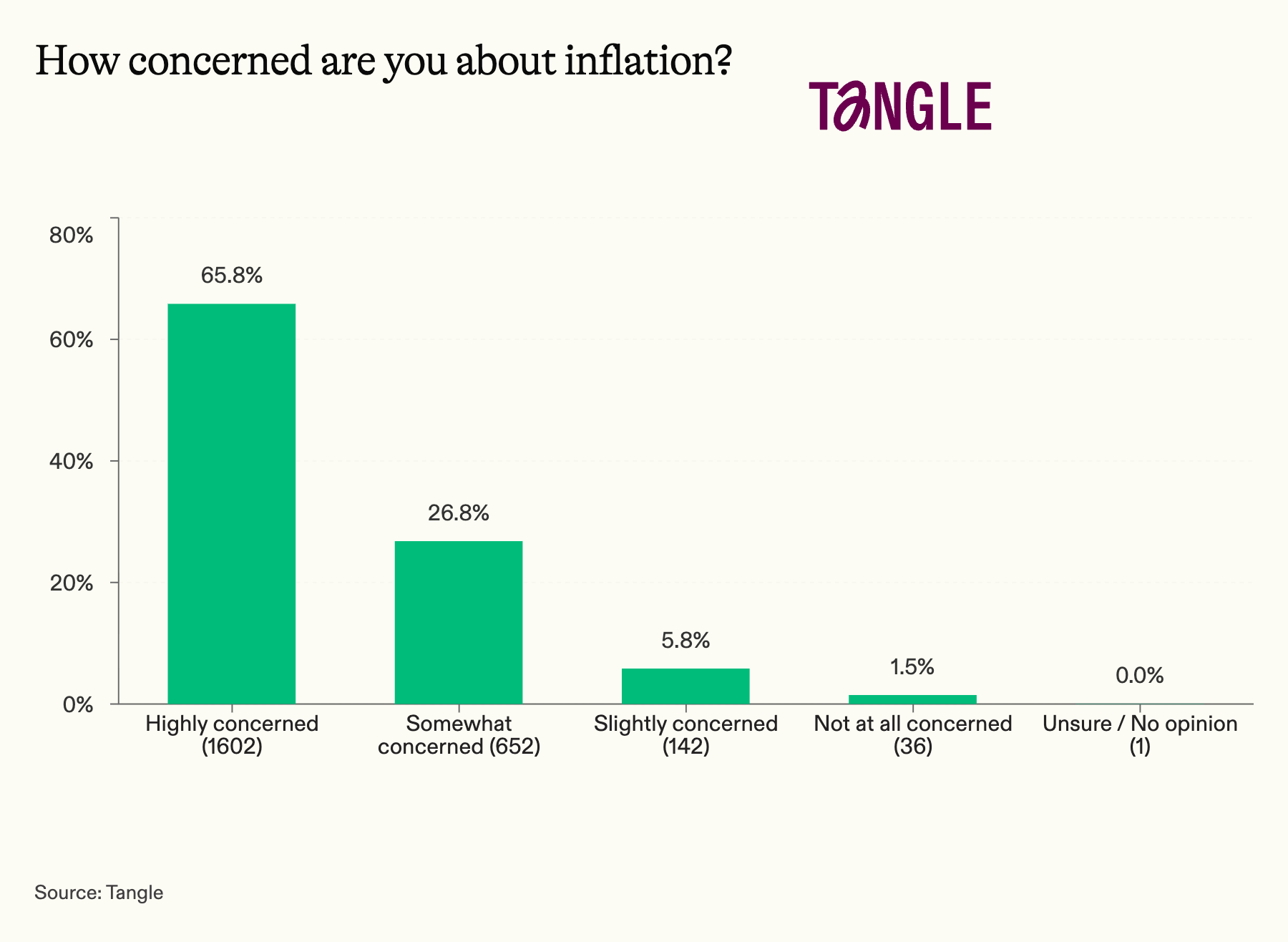
- Our last survey: 2,433 readers responded to our survey on inflation with 66% saying they are very concerned. “I am concerned that gas prices will not fall back to prewar levels after Iran hostilities,” one respondent said. “With Iran, the tariffs, and the impacts of inflation during Biden’s term, I hope inflation improves soon but am not optimistic,” said another.
Have a nice day.
When Ahmed, Nasir and Preston — ages six and seven — were each hospitalized at the same time in need of a new heart, they each experienced the anxiety and uncertainty of not knowing what was ahead for them. But over the course of nearly a year in the hospital together, they became best friends, leaning on one another for support as they waited for heart transplants. Then, in a rarity, all three received transplants within 10 days of one another. They’re now recovering well, and their friendships are as strong as ever. “I think these children teach us how to be grateful for what we have,” Dr. Joseph Spinner, a doctor on the boys’ care team, said. “It’s amazing that they can be so sick yet have such a positive attitude.” KHOU11 has the story.