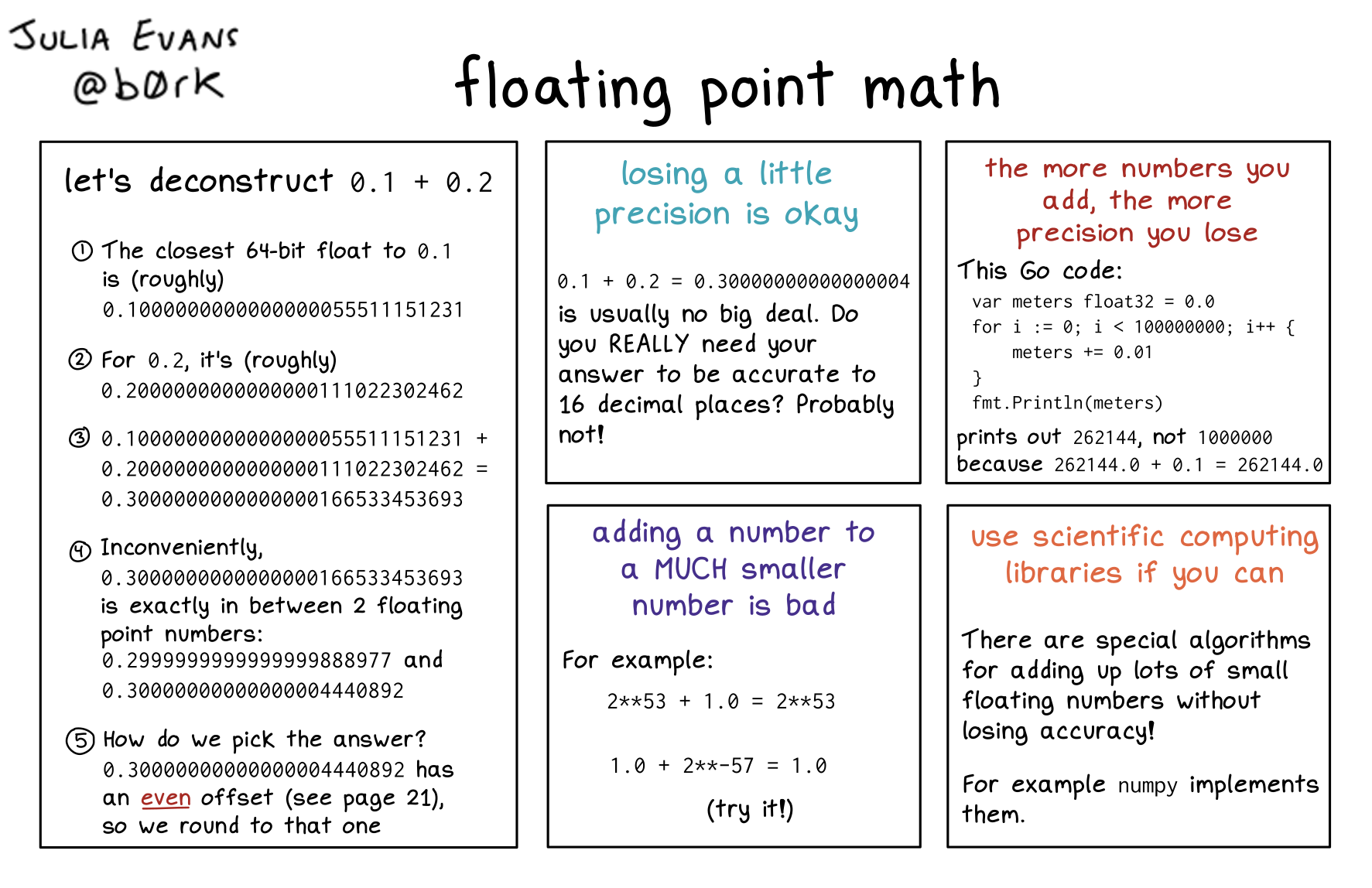
## floating point math
let's deconstruct `0.1 + 0.2`
1. O The closest 64-bit float to 0.1 is (roughly) `0.1000000000000000055511151231`
2. For 0.2, it's (roughly) `0.2000000000000000111022302462`
3. `0.1000000000000000055511151231 + 0.2000000000000000111022302462 = 0.3000000000000000166533453693`
4. Inconveniently, `0.3000000000000000166533453693` is exactly in between 2 floating point numbers: `0.2999999999999999888977` and `0.30000000000000004440892`
5. How do we pick the answer? `0.30000000000000004440892` has an even offset, so we round to that one
## losing a little precision is okay
`0.1 0.2 0.30000000000000004` is usually no big deal. Do you REALLY need your answer to be accurate to 16 decimal places? Probably not!
## the more numbers you add, the more precision you lose
This Go code:
`var meters float32 = 0.0 `
`for i = 0; i < 100000000; i++ { meters += 0.01`
`} fmt.Println(meters)`
prints out `262144`, not `1000000` because `262144.0+ 0.1 = 262144.0`
## adding a number to a MUCH smaller number is bad
For example:
2 xx 53 + 1.0 = 2 xx 53
1.0 + 2 xx -57 = 1.0
(try it!)
## Use scientific computing libraries if you can
There are special algorithms for adding up lots of small floating numbers without losing accuracy!
For example `numpy` implements them.