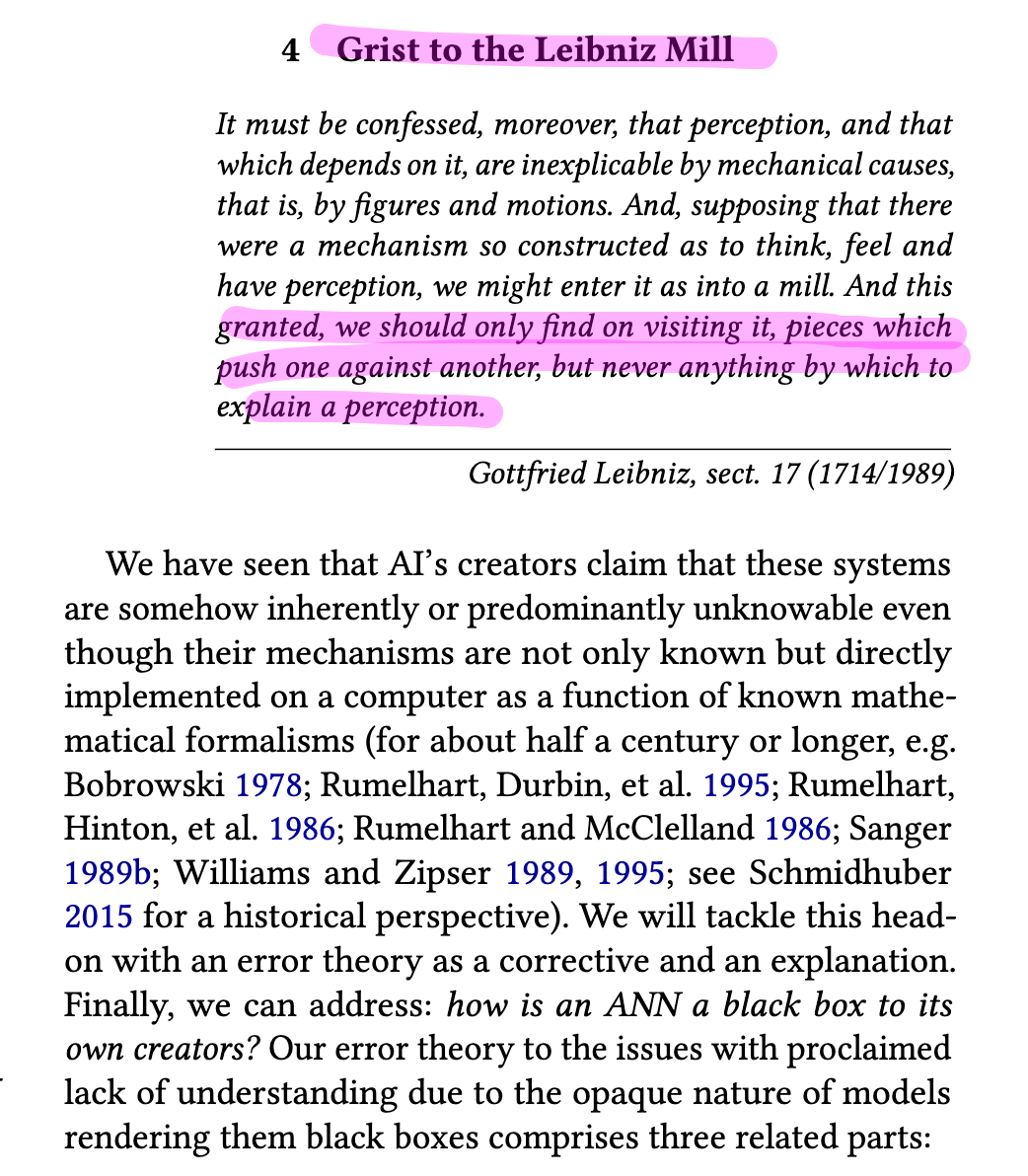
4 Grist to the Leibniz Mill
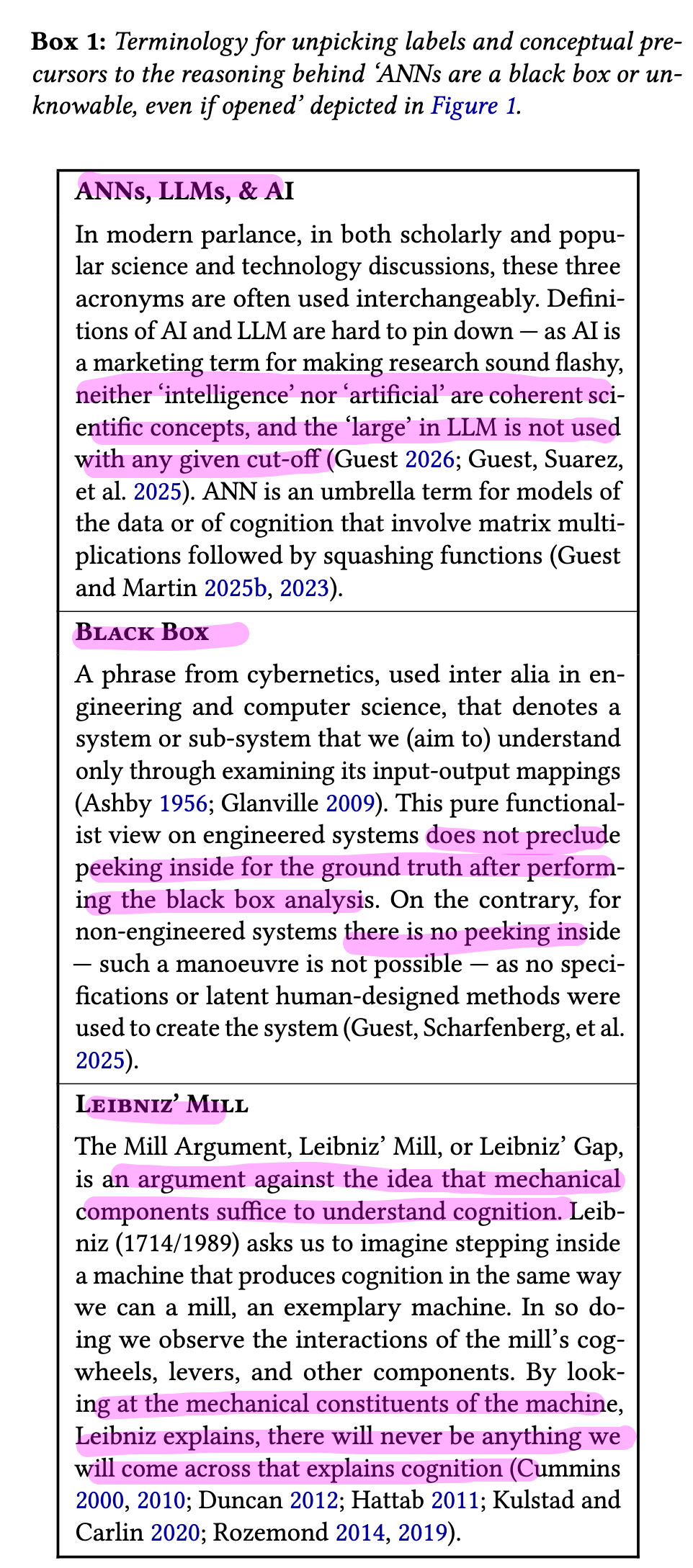
It must be confessed, moreover, that perception, and that
which depends on it, are inexplicable by mechanical causes,
that is, by figures and motions. And, supposing that there
were a mechanism so constructed as to think, feel and
have perception, we might enter it as into a mill. And this
granted, we should only find on visiting it, pieces which
push one against another, but never anything by which to
explain a perception.
Gottfried Leibniz, sect. 17 (1714/1989)
We have seen that Al's creators claim that these systems
are somehow inherently or predominantly unknowable even
though their mechanisms are not only known but directly
implemented on a computer as a function of known mathe-
matical formalisms (for about half a century or longer, e.g.
Bobrowski 1978; Rumelhart, Durbin, et al. 1995; Rumelhart,
Hinton, et al. 1986; Rumelhart and McClelland 1986; Sanger
1989b; Williams and Zipser 1989, 1995; see Schmidhuber
2015 for a historical perspective). We will tackle this head-
on with an error theory as a corrective and an explanation.
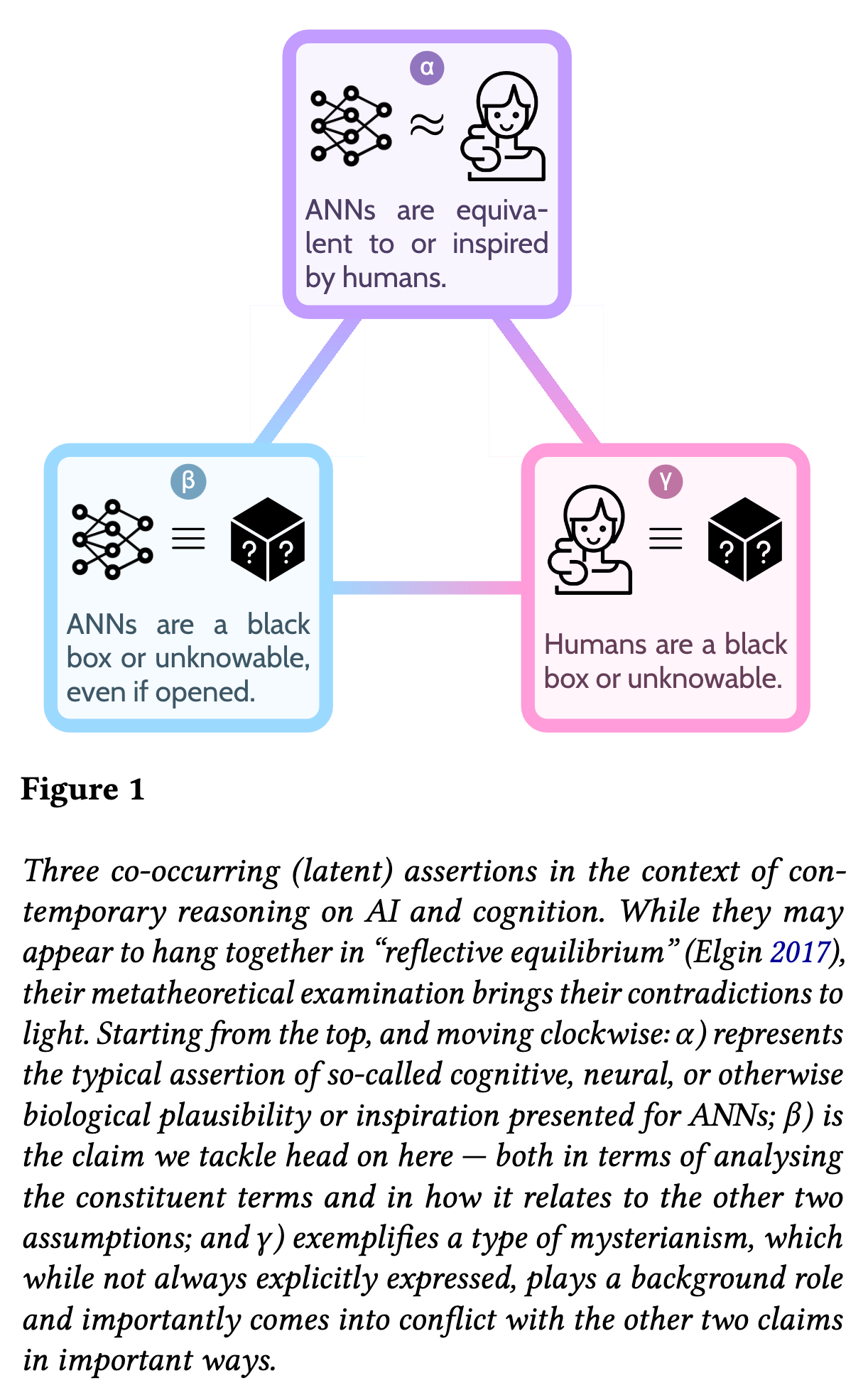
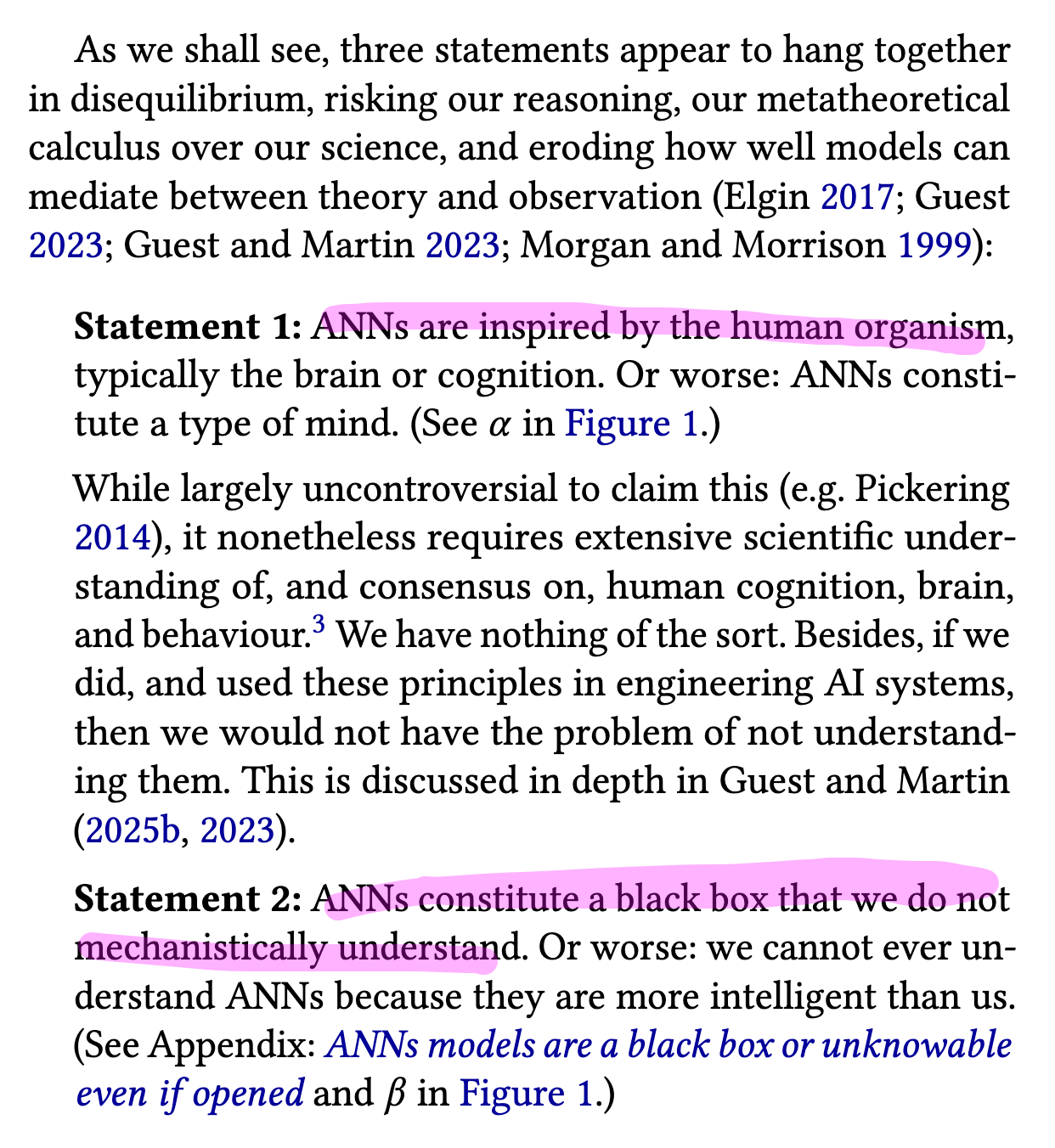
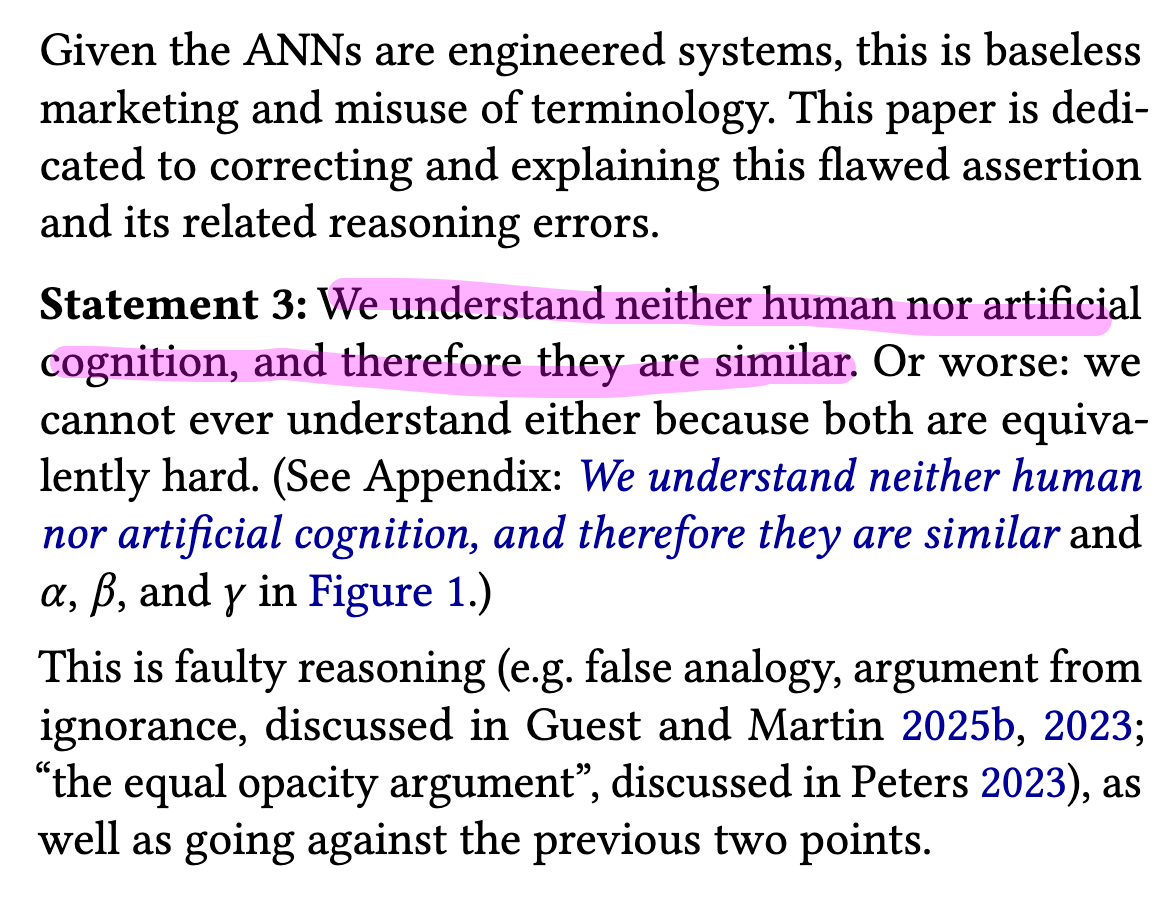
Finally, we can address: how is an ANN a black box to its
own creators? Our error theory to the issues with proclaimed
lack of understanding due to the opaque nature of models
rendering them black boxes comprises three related parts:



![These mystifying or obfuscatory metaphors about mecha-
nism (Christin 2020; Petrick 2020) bring to mind: “Any suffi-
ciently advanced technology is indistinguishable from magic.
(Clarke 1973, p. 21; also noticed by Penn 2022) For example,
these systems are described as: “powerful digital minds that
no one — not even their creators — can understand, predict,
or reliably control” (by a mix of CEOs and founders from
Elon Musk and Steve Wozniak, to academic experts in Al,
like Yoshua Bengio and Stuart Russell, in Pause Giant AI Ex-
periments: An Open Letter, Bengio et al. 2023). Others repeat
this same mantra, with OpenAI’s Bills et al. (2023) claiming
that:
we do not understand how [LLMs] work. [...] Our
explanations also do not explain what causes be-
havior at a mechanistic level, which could cause
our understanding to generalize incorrectly. To
predict rare or out-of-distribution model behav-
iors, it seems possible that we will need a more
mechanistic understanding of models. (emphasis
added, n.p.)](https://cdn.masto.host/scholarsocial/media_attachments/files/116/543/458/235/107/788/original/07e63c42a645b541.png)
![Even critical scholars repeat this, such as Jobin and Katzen-
bach (2023):
we are living in a time when the infrastructures
and institutions of our everyday lives are be-
ing (re)built at the hands of techniques that al-
ready elude popular and professional understand-
ing. (emphasis added, p. 48)
Journalists like Perrigo (2024), also follow suit:
Today's artificial intelligence is often described
as a “black box” [T]he inner workings of the Al
models remain opaque, and efforts to peer inside
them to check exactly what is happening haven’t
progressed very far. Nobody truly understands
what [the internals] mean, or how they work.
(emphasis added, n.p.)
Relatedly, the media and the public are then — perhaps
rightly — alarmed and follow up with questions such as:
“Without a thorough (mechanistic) understanding of the early
antecedents of these powerful future LLMs, can we realis-
tically expect to manage these Als[...]?” (emphasis added,](https://cdn.masto.host/scholarsocial/media_attachments/files/116/543/458/556/348/180/original/29081fe571508994.png)