
@alienghic @jonny @happyborg @radicle p2p forge is just what I was looking for. I realize forgejo's federation is not complete, and that if it were, p2p would be optional. What, if any, are the fundamental differences between @radicle's approach and what federated forgejo would support?
Post
Replies:
8

@RuchiraSDatta @alienghic @jonny @happyborg Radicle is designed to work without servers. You can connect any two nodes and sync data. People can also connect their nodes on a LAN and sync code without access to any federation instance. There are nodes that are servers with high uptime, yes, but they run the same code as you.
Your user identity is not a row in the database of whoever runs the Forgejo instance, but the signing key on your filesystem.
Some people compare Radicle to BitTorrent.


@radicle PLEASE IGNORE: I will research.
Do you have an estimate of node count, and are there public and private repos? And is there a way to search across public repos? In fact, what social features are there and what is growth like? Thanks if you have time to answer all that - feel free to refer me instead.
Oh, and what is the role and utility of the token? I have many more questions so maybe refer me to a faq first :rofl:
@happyborg @RuchiraSDatta @alienghic @jonny For the utility of the token please refer to the Radworks, i.e. https://radworks.org/ and https://community.radworks.org
Radicle itself does not use or depend on any blockchain or cryptocurrency.
To use Radicle you do not need to own any cryptocurrency, have a cryptocurrency wallet or any of that.
Earlier iterations of Radicle, some years ago, were tightly integrating with a blockchain, but this is not the case anymore since at least 2023.
@radicle
Thanks, I appreciate your answers. I'll research a bit more.


@happyborg @radicle @RuchiraSDatta @alienghic
fwiw i have used radicle and it worked surprisingly well, i hosted a whole-network seed node for several years but it started chewing up my server because there were so few of them at the time. i would love to believe in all things p2p but the thing that suffered, as usual, in the p2p case is the interface: to convince someone to move away from github, it's most effective to offer them something that they recognize. that means websites, on the https web, period. even if those websites are gateways. at the time i was looking at it, the radicle frontend didn't really work at all (but again, the backend/cli interface really did, which i was impressed by). the interface is like... the whole thing though - the social, organizational, and reputational nature of coding, whether we like it or not, takes place as artifacts like issues and pull requests, and if you don't have that, you don't have a replacement.
@jonny @happyborg @RuchiraSDatta @alienghic We know that. There's a gateway at https://radicle.network . For the rest the only thing we can ask for is patience, or to join us and help getting there quicker. We're open source and welcome contributions.
Note also that we very much value all other projects that work to reverse concentration on GitHub. We are in loose contact with folks at @Codeberg for example, and are also cheering for federation efforts in @forgejo. We're not zero-sum players...
@happyborg @RuchiraSDatta @alienghic @jonny You can search for repositories on https://search.radicle.garden . We know this won't cut it in the longer term, so it will improve for sure. Please note that we are a small team and have more things to do than hands free. Thanks for your understanding!
@happyborg @RuchiraSDatta @alienghic @jonny
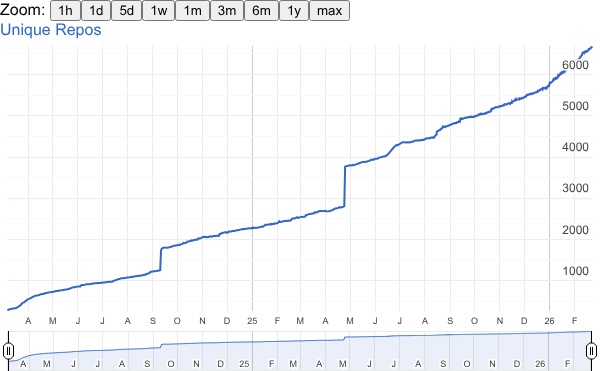
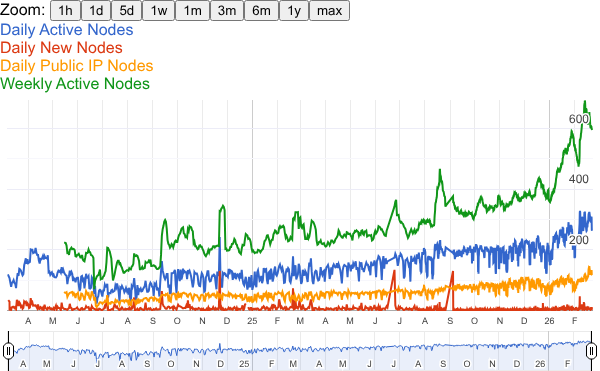
Estimates on the overall number of nodes and repos from the nodes that we run on the main network as of 2026-04-21 are attached. These have probably continued along the trend, maybe slightly accelerated (this very conversation is an anecdatum). We have around 8000 repositories on our seeds now.
2 media