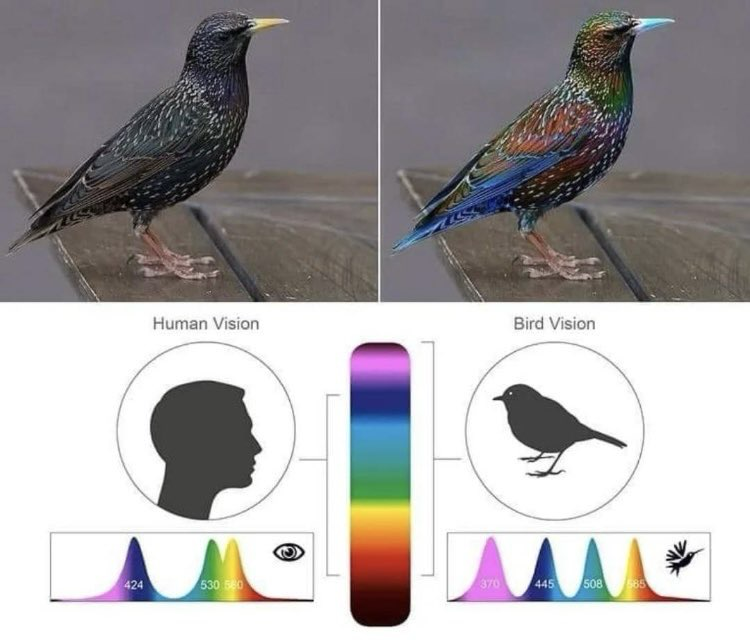

TIL crows, starlings and similar birds only *look* black to us — they’re actually very colorful in ways human eyes are unable to perceive. 🤯
Remember that next time people can’t see your “colors”.
Some colors just require different eyes.
Post
TIL crows, starlings and similar birds only *look* black to us — they’re actually very colorful in ways human eyes are unable to perceive. 🤯
Remember that next time people can’t see your “colors”.
Some colors just require different eyes.
@leaverou Having quad color vision would be so cool.
@leaverou
Interesting. But the diagrams show different wavelengths for human and bird vision - surely the wavelengths reflected will be the same? And why is pink visible left of the blue peak in the human vision diagram when according to the bracket in the middle, this pink is outside the human vision scope? ANd hwat about the green, yellow and red bits in the human vision diagram - why doesn't the human see those colours in the starling? What am I missing?
@leaverou I think with starlings it's pretty obvious that there's more going on than just black, I've noticed the darkish brilliant colours every once in a while.
@leaverou Screw google glass - I want BIRD GLASS!
@leaverou if you enjoyed that discovery, I recommend reading Ed Yong's An Immense World
@leaverou Yup. And we explain to ourselves that the females are usually drab brown because we are a ridiculous species of ape who have conditioned ourselves to view female as inferior, but to birds, that drab brown contains multitudes of colors that just confuse our eyes. If anything they are more brilliant.
@leaverou The same applies to people. Don't deny your richness just because you're not understood for the time being.
@leaverou @maudenificent the other thing that looks more interesting when you assign visible colours to invisible wavelengths – the universe as seen by radio telescopes.
@leaverou more of this content pls
@leaverou I wonder if this applied to dinosaur perception of dinosaur feathers...
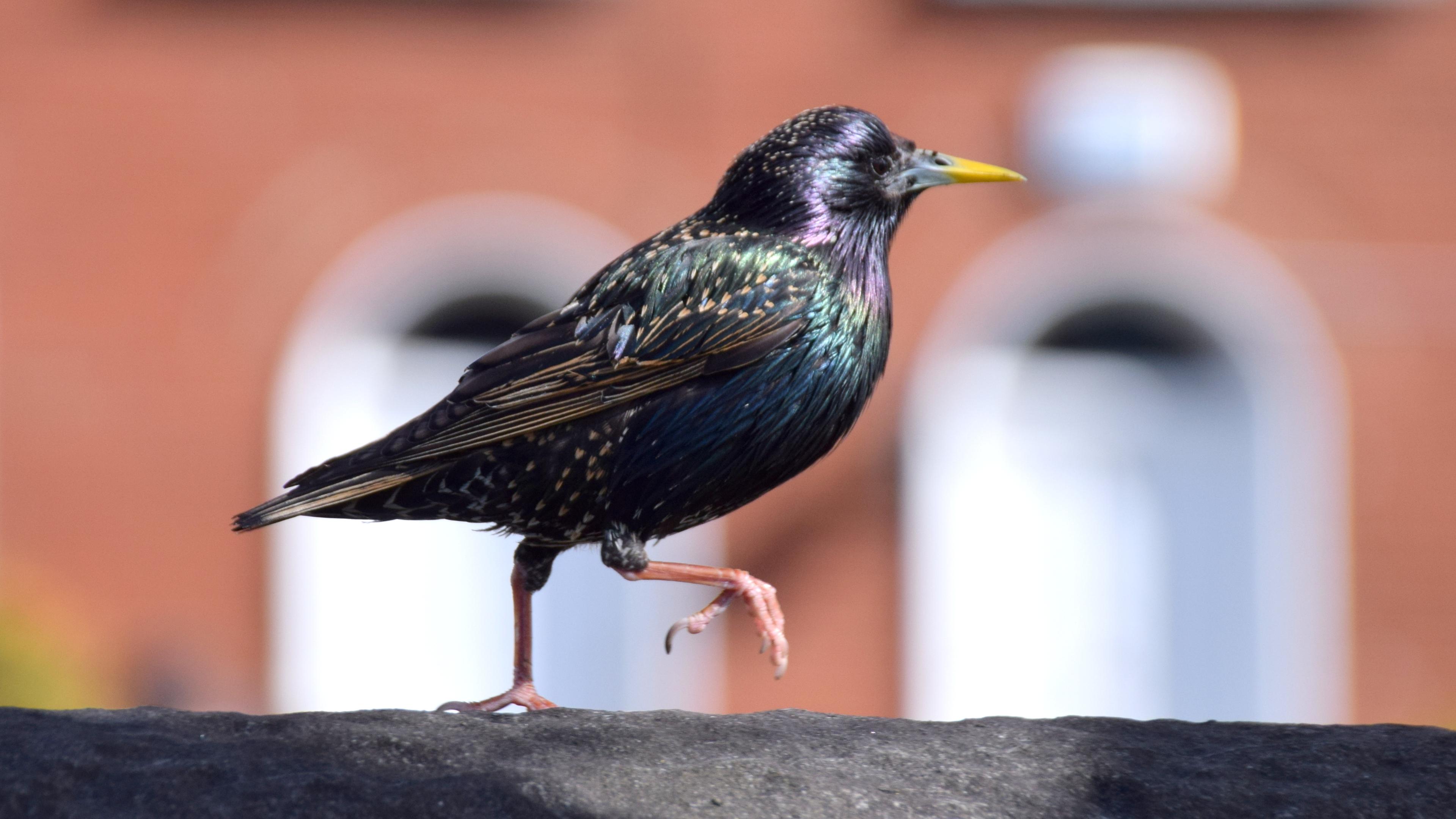
It’s much easier to see with Starlings but the light has to be right.
I have a bunch of shots like this one that shows the iridescent nature of the starlings fairly clearly. Obviously it would be much more dramatic if the camera could detect further into the IR and UV but this is unmodified out of a Nikon D5300 and is how I remember it looked to my eye.
I’ve never noticed this with crows or ravens around here but it’s common to see that flash of weird blue and green on magpies.
@leaverou
Absolutely correct 💯
@leaverou birds are tetrachromats and can see UV.
@leaverou so now we are birds haha
@leaverou starlings are kaleidoscopic

Install bonfire.cafe
Get the full app experience