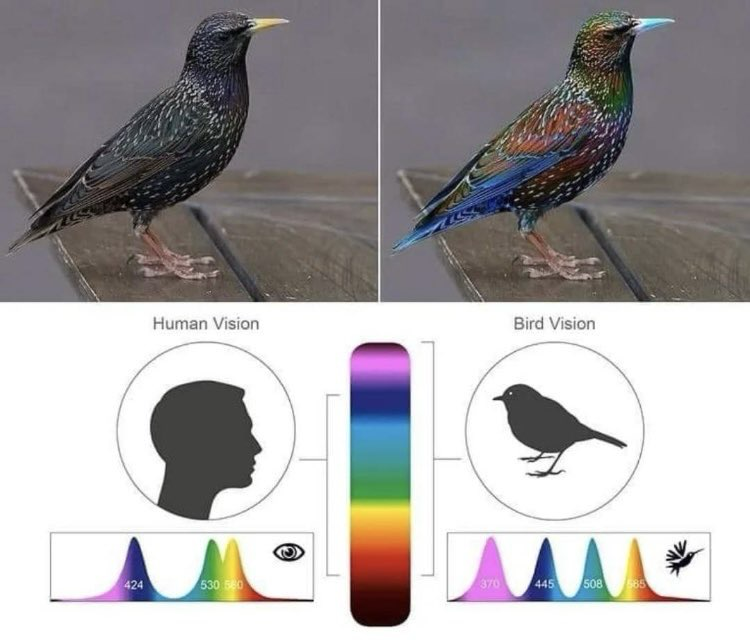

TIL crows, starlings and similar birds only *look* black to us — they’re actually very colorful in ways human eyes are unable to perceive. 🤯
Remember that next time people can’t see your “colors”.
Some colors just require different eyes.
Post
TIL crows, starlings and similar birds only *look* black to us — they’re actually very colorful in ways human eyes are unable to perceive. 🤯
Remember that next time people can’t see your “colors”.
Some colors just require different eyes.
@leaverou if you enjoyed that discovery, I recommend reading Ed Yong's An Immense World
@leaverou Yup. And we explain to ourselves that the females are usually drab brown because we are a ridiculous species of ape who have conditioned ourselves to view female as inferior, but to birds, that drab brown contains multitudes of colors that just confuse our eyes. If anything they are more brilliant.
@leaverou The same applies to people. Don't deny your richness just because you're not understood for the time being.
@leaverou @maudenificent the other thing that looks more interesting when you assign visible colours to invisible wavelengths – the universe as seen by radio telescopes.
@leaverou more of this content pls
@leaverou I wonder if this applied to dinosaur perception of dinosaur feathers...
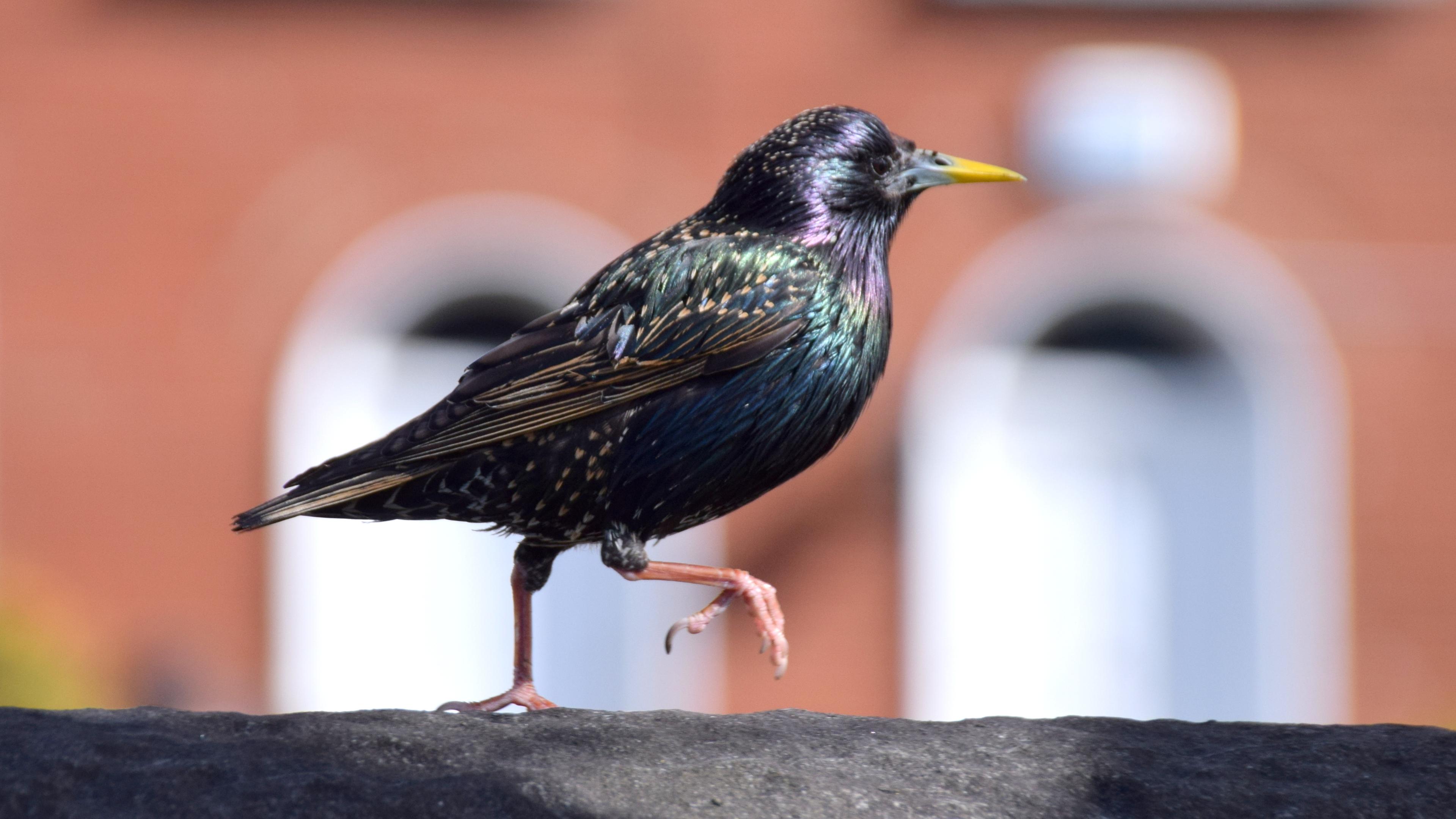
It’s much easier to see with Starlings but the light has to be right.
I have a bunch of shots like this one that shows the iridescent nature of the starlings fairly clearly. Obviously it would be much more dramatic if the camera could detect further into the IR and UV but this is unmodified out of a Nikon D5300 and is how I remember it looked to my eye.
I’ve never noticed this with crows or ravens around here but it’s common to see that flash of weird blue and green on magpies.
@leaverou
Absolutely correct 💯
@leaverou birds are tetrachromats and can see UV.
@leaverou so now we are birds haha
@leaverou starlings are kaleidoscopic
@leaverou gimme birbs eyes please 🥺
@leaverou
I was in a zoo JUST today, where I read a sign stating that blackbirds only seem black to humans, while actually being colorful in the bird world. This sign made me a bit mad by telling me such a thing without explaining why. Now only a few hours later, I stumble upon this. Fedi is amazing!
@leaverou Evidence, if needed, that we do not see the real world - what we experience is an approximate proxy.
Besides - the light rays from an object tend to fan in all directions - we only got a tiny sliver of these rays impinging on our retinas. So we only ever perceive very partially. And only perceive a minuscule fraction of all wavelengths.
@leaverou
I used to toss peanuts to crows regularly, and they were comfortable approaching me. One day in early winter, an hour or so after sunrise, a crow walked in front of me, between me and the sun. I was wearing amber polarized sunglasses, and just for ten seconds or so I saw red and turquoise bars on its wings - one of the most astonishing and beautiful things I remember. I've never been able to duplicate it, and have never found corroborating evidence, but I remember thinking "oh that's how they can tell each other apart"
@leaverou wait, birds are tetrachromatic?
i think you already know, but if not:
there are human tetratchromats, they are rare
all women
because women get two copies of genes related to vision which are on the sex chromosomes: XX, while men get one copy: XY. so only women can get one normal gene, and one with a mutation that shifts one of the three cones, thus giving them tetrachromacy
normal people can see 1-10 million colors, such rare women can see 100 million or more
https://www.bbc.com/future/article/20140905-the-women-with-super-human-vision
@leaverou Just today morning i layed in the sun with my dog and a flock of starlings started scavaging the park we were in. The sunlight reflected super colorful on them.
@leaverou I don't think that infography makes any sense. We do have a sensibility to green, but we still see colors from 400nm to 800nm. Also, what species of crow is that? I don't know any with white spots and a yellow beak.
Is there any source for that?
@leaverou Could you make the colors visible by taking a photo in RAW format and adjusting the color settings? I don't know how camera sensors work, but maybe they're able to capture these colors.
@leaverou Who keeps putting the UV at the lower, and infrared at the upper part of the spectrum??!
@leaverou Albeit the above is very true, this is also very much not a crow.

Install bonfire.cafe
Get the full app experience