
Discussion
Loading...

Post

Log in
  • About
  • Code of conduct
  • Privacy
  • Users
  • Instances
  • About Bonfire
Marc
Marc
@corpsmoderne@mamot.fr  路  activity timestamp last week

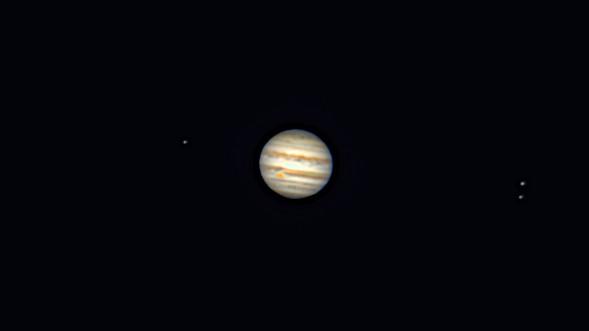
Look, it's not much, but I'm quite happy with the level of detail I was able to pull out from this mush of pixels 馃槄

From data collected last Christmas.

#astronomy #astrophotography

Jupiter, with bands of clouds and the big red spot visible. One of the Galilean moon is visible on its left, two are on its right, one just on top of the other.
  • Copy link
  • Flag this post
  • Block
Marc
Marc
@corpsmoderne@mamot.fr replied  路  activity timestamp last week

bonus: the mush (only the ~400 kept frames)

Your browser does not support the video tag.
This video cannot be previewed
Open original
shaky video of a very blurry and de-saturated jupiter
  • Copy link
  • Flag this comment
  • Block
Grant_H
Grant_H
@grant_h@mastodon.social replied  路  activity timestamp last week

@corpsmoderne did you record this as video or stills? What did you stack it with?

  • Copy link
  • Flag this comment
  • Block
Marc
Marc
@corpsmoderne@mamot.fr replied  路  activity timestamp last week

@grant_h I took a 3mn video with my 200/1000mm telescope and a planetary camera.

There are dedicated software but I like to suffer so I did the processing myself 馃槄

extracted the stills from the video with ffmpeg.

selected the 400 best images with a custom script (edge detection mostly).

stacked with Siril

postprocessing with Gimp (sharpening, mostly)

  • Copy link
  • Flag this comment
  • Block
Grant_H
Grant_H
@grant_h@mastodon.social replied  路  activity timestamp last week

@corpsmoderne cool. Thank you

  • Copy link
  • Flag this comment
  • Block
schnedan
schnedan
@schnedan@social.tchncs.de replied  路  activity timestamp last week

@corpsmoderne Voyager could not do any better...

  • Copy link
  • Flag this comment
  • Block
Marc
Marc
@corpsmoderne@mamot.fr replied  路  activity timestamp last week

@schnedan my camera is not from the 70's though 馃槵

  • Copy link
  • Flag this comment
  • Block
schnedan
schnedan
@schnedan@social.tchncs.de replied  路  activity timestamp last week

@corpsmoderne

The sensor used in the Voyager Imaging Science Subsystem
(ISS) camera system is a 25 mm diameter magnetic deflection
vidicon (number B41-003, General Electro-dynamics Co.). The
vidicon storage surface (target) is selenium sulphur and can
store a high resolution (1500 TV lines) picture for over 100
s at room temperature. The active image area on the target
is 11.14 x 11.14 mm. Each frame consists of 800 lines with
800 picture elements (pixels) per line, i.e., 1 pixel =14
microns. One frame requires 48 s for electronic readout.

....
https://pds-rings.seti.org/voyager/iss/instrument.html

Ring-Moon Systems Node - Instrument (ISS)

The Ring-Moon Systems Node of NASA's Planetary Data System is devoted to archiving, cataloging, and distributing scientific data sets relevant to planetary rings and moons, and the ways they interact.
  • Copy link
  • Flag this comment
  • Block

bonfire.cafe

A space for Bonfire maintainers and contributors to communicate

bonfire.cafe: About 路 Code of conduct 路 Privacy 路 Users 路 Instances
Bonfire social 路 1.0.2-alpha.7 no JS en
Automatic federation enabled
Log in
  • Explore
  • About
  • Members
  • Code of Conduct