Discussion
Loading...

Post

Log in
  • About
  • Code of conduct
  • Privacy
  • Users
  • Instances
  • About Bonfire
Laura G, Sassy 70’s
Laura G, Sassy 70’s
@LauraJG@deacon.social  ·  activity timestamp 5 days ago

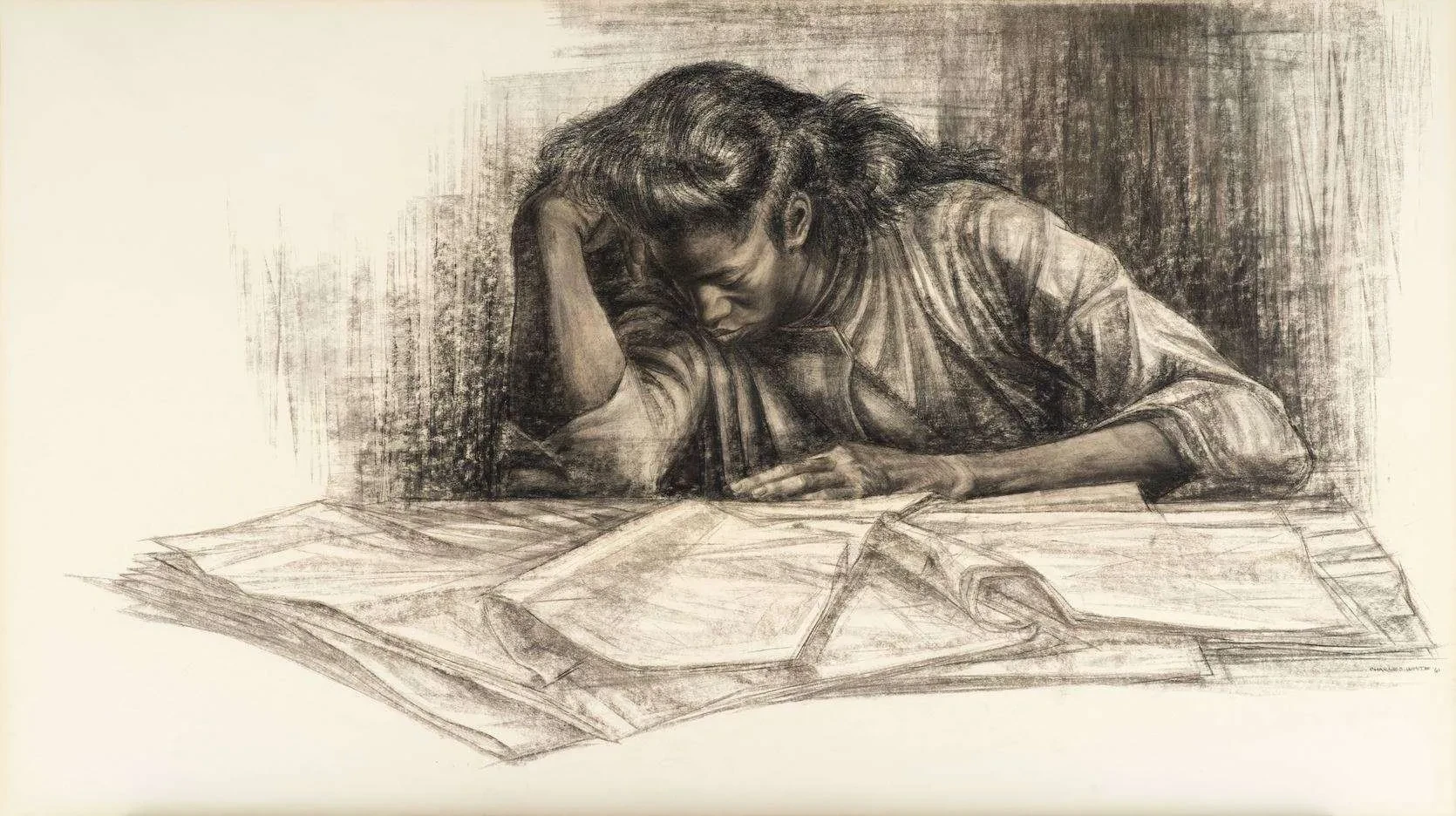
By African-American artist Charles White (1918-1979), "Awaken from the Unknowing," 1961, compressed charcoal and brown and gray vine charcoal with scratching out, blending, and erasing, 81.9 x 145.4 x 4.4 cm (32 1/4 x 57 1/4 x 1 3/4 inches), the Blanton Museum of Art at The University of Texas at Austin. #arthistory #blackartists #BlackArt #BlackHistoryMonth More info in ALT.

From the museum: ‘This intimate image of a young woman symbolizes the hope of many African Americans after the "Brown v. Board of Education" ruling in 1954. In this landmark case, the Supreme Court unanimously agreed that racial segregation in public schools violated the 14th Amendment’s mandate of equal protection of the laws of the U.S Constitution—thereby entitling students to a quality public school education regardless of their race. The work’s large scale attests to White’s mastery of drawing. By rubbing and erasing, the artist created gradient tones in the figure’s face and arms. White fashioned the undulating creases of the garment by blending, while he scratched the paper to produce the naturalistic texture of her hair. The work is also a testament to White’s reverence for learning. He attended a predominately white high school, where his teachers actively excluded black contributions to American society from their curriculum. As a child, White educated himself on the experiences of black Americans through frequent visits to the Chicago Public Library. The work was immensely popular in its time. In 1963, the Student Nonviolent Coordinating Committee (SNCC) put the image on the cover of a brochure announcing its Freedom School.’
  • Copy link
  • Flag this post
  • Block

bonfire.cafe

A space for Bonfire maintainers and contributors to communicate

bonfire.cafe: About · Code of conduct · Privacy · Users · Instances
Bonfire social · 1.0.2-alpha.7 no JS en
Automatic federation enabled
Log in
  • Explore
  • About
  • Members
  • Code of Conduct