

Gaza peace plan enters phase two.
I'm Isaac Saul, and this is Tangle: an independent, nonpartisan, subscriber-supported politics newsletter that summarizes the best arguments from across the political spectrum on the news of the day — then “my take.”
Are you new here? Get free emails to your inbox daily. Would you rather listen? You can find our podcast here.
Today’s read: 16 minutes.
☮️President Trump's Gaza ceasefire moves to phase two. Plus, Isaac weighs in on the protesters who disrupted a church service in Minneapolis, MN.ICYMI.
A year ago, the Tangle team sat down and came up with a comprehensive list of metrics we’d use to evaluate Trump’s second term in office — everything from traditional economic measures to his follow-through on campaign promises to international standing. This past Friday, we evaluated those metrics (as well as some pundit predictions) in a two-part edition. In case you missed it, check it out here!
Quick hits.
- Multiple outlets reported that Border Patrol commander Gregory Bovino and some federal agents will leave Minneapolis following the killing of Alex Pretti on Saturday. Border Czar Tom Homan will reportedly take over Immigration and Customs Enforcement operations in Minnesota, while Bovino will return to his previous Border Patrol position in California. (The report) Separately, according to court filings disclosed on Monday, the Trump administration has limited its investigation of Pretti’s death to a “use-of-force” review, which considers agents’ tactics but not whether they should face criminal charges. (The filings)
- The American Academy of Pediatrics recommended that children be vaccinated against 18 diseases, breaking with the Centers for Disease Control and Prevention’s new guidance to vaccinate children against 11 diseases. (The recommendations)
- President Donald Trump announced he is increasing tariffs on South Korean auto, lumber and pharmaceutical imports from 15% to 25%, saying the country has failed to enact its trade agreement with the U.S. (The tariffs)
- The Treasury Department said it canceled all of its contracts with the consulting firm Booz Allen Hamilton, alleging it failed to protect taxpayer data. One of the firm’s former employees pleaded guilty in 2023 to felony charges for leaking hundreds of thousands of records, including President Trump’s tax returns. (The cancellations)
- Officials in Bangor, Maine, said that a crash involving a private aircraft on Sunday killed all six people on board. The officials disputed an initial Federal Aviation Administration report on the incident that found eight people were on board and seven died. (The latest)

2026 will be another expensive year for car insurance
Rising repair costs, severe weather, and expensive parts and labor are all expected to keep car insurance premiums high in 2026, making it a great moment to shop around. Shop around and see how much you could save with Money’s Best Car Insurance Tool.
COMPARE RATESToday’s topic.
The latest on the Gaza peace deal. On January 14, the Trump administration announced the start of “phase two” of the ceasefire agreement between Israel and Hamas in Gaza. White House Special Envoy Steve Witkoff said the second phase will transition from “ceasefire to demilitarization, technocratic governance, and reconstruction.” On Thursday, President Donald Trump formally launched the Gaza “Board of Peace,” initially presented as a transitional body to oversee Gaza’s reconstruction. However, the board’s charter has since been expanded to cover a broader mandate for peace globally, raising questions about how it will interact with the United Nations (UN).
Back up: In early October, Israel and Hamas agreed to a 20-point peace plan for Gaza presented by President Trump. Phase one of the deal required the return of all living and deceased hostages held by Hamas, the return of approximately 2,000 Palestinians imprisoned by Israel, and a limited retreat from Gaza by the Israeli military. On Monday, the Israeli military announced it had recovered the remains of the final hostage held in Gaza, completing one of the key provisions of phase one.
We covered the peace plan here.
While Israel and Hamas each accused the other of violating the ceasefire at points during phase one — and hundreds of Palestinians were killed in Israeli airstrikes, according to local officials — violence in the strip has significantly decreased. Furthermore, the UN has reported that humanitarian conditions are improving, with 100% of Gazans’ basic food needs being met as of January.
Trump’s Board of Peace will oversee a Palestinian technocratic government — the National Committee for the Administration of Gaza (NCAG) — responsible for the day-to-day governance of the strip. Ali Sha’ath, a former deputy minister of transportation in the Palestinian Authority, will lead the government, whose core initial focus will be restoring public services and rebuilding civil institutions. Separately, on January 16, the White House announced an “executive board” to “operationalize the Board of Peace’s vision.” The appointed members are Witkoff, Secretary of State Marco Rubio, Trump’s son-in-law Jared Kushner, former British Prime Minister Tony Blair, Apollo Global Management CEO Marc Rowan, World Bank Group President Ajay Banga, and Deputy National Security Advisor Robert Gabriel.
On Thursday, President Trump held a signing ceremony for the Board of Peace attended by 20 of its member nations in Davos, Switzerland. Seven countries — including France and the United Kingdom — have declined Trump’s invitation to join the board so far, while Canada’s invitation was rescinded.
Some European leaders have expressed concern about the board’s expanded mission, which reportedly calls for “secur[ing] enduring peace in areas affected or threatened by conflict,” and its potential to undermine the UN. Many have also questioned Russian President Vladimir Putin’s invitation and Trump’s $1 billion asking price for a permanent seat. Trump has criticized those who declined his invitation and threatened to impose 200% tariffs on French wines to punish French President Emmanuel Macron for his decision and criticism.
Today, we’ll offer perspectives from the right, left, and writers in the Middle East about the next phase of the Gaza ceasefire. Then, Executive Editor Isaac Saul gives his take.
What the right is saying.
- Many on the right say the board offers a better alternative to the United Nations.
- Others worry that Trump is already looking past Gaza.
In The New York Post, Douglas Murray wrote “Trump’s new Board of Peace is necessary because the UN has failed again and again.”
“Countries like France and Britain are refusing to sign on to the president’s initiative. They complain that there are countries on the board they do not approve of. And that there is a risk that it could prove a rival organization to the United Nations,” Murray said. “It is true that the idea of Vladimir Putin or the dictator of Belarus being on the board is a worrying sign. But if the board can be a counter to the UN? Then good.”
“In order for peace to break out, Hamas needs to be disarmed. And that’s where the really big problem of the UN creeps in. I’ve witnessed plenty of UN peacekeeping efforts for myself over the years. And they have a huge problem. Mainly the fact that the last thing most UN ‘peacekeeping’ forces want to do is to fight,” Murray wrote. “To date, the answer in the region each and every single time has been the same: Israel and America… By appointing himself chairman of the Peace Board, Trump has shown that he is committed to the peace plan that is in place. By inviting regional actors to join him, he has shown that for once, it will not be just Israel and America that are expected to police the Middle East.”
In National Review, Noah Rothman warned against “mission creep.”
“[Trump’s] approach has helped unlock new possibilities for a prosperous and stable Middle East, and the Board of Peace could lay a new foundation on which to build an alternative to the social contract that has so far prevailed in the region. Or, at least, it might if the Board of Peace were still focused on Gaza. It’s not,” Rothman said. “It seems increasingly that the board, as Trump envisions it, seems to regard Gaza as too small a project. To hear the president and his allies speak of it, it is now a United Nations in miniature — one under the president’s control.”
“[The board] will not become a counter to the U.N. if it preserves the U.N.’s fatal flaw, which is that it is primarily composed of tinpot autocracies, socialistic backwaters, and solicitous developing nations, few of which are invested in the preservation of the U.S.-led global order,” Rothman wrote. “The Board of Peace and the institutions it was established to oversee hold much promise. But the president and his allies need to be more circumspect about what it can achieve or even what its goals should be.”
What the left is saying.
- Many on the left are critical of the board, viewing it as a vehicle for corruption.
- Some note the flaws of Trump’s approach, but say he could be key to lasting peace in the region.
In Common Dreams, Jeffrey D. Sachs and Sybil Fares argued “every nation in the world should reject Trump’s absurd and dangerous ‘Board of Peace.’”
“The so-called ‘Board of Peace’ being created by President Donald Trump is profoundly degrading to the pursuit of peace and to any nation that would lend it legitimacy. This is a trojan horse to dismantle the United Nations,” Sachs and Fares wrote. “It is, to put it simply, a pledge of allegiance to Trump, who seeks the role of world chairman and the world’s ultimate arbiter. The BoP will have as its Executive Board none other than Trump’s political donors, family members, and courtiers.”
“If the charade of representatives isn’t enough, nations will have to pay $1 billion for a ‘permanent seat’ on the Board. Any nation that participates should know what it is ‘buying.’ It is certainly not buying peace or a solution for the Palestinian people,” Sachs and Fares said. “For any nation, participation on the Board of Peace would be strategically foolish. Joining this body will create long-lasting reputational damage. Long after Trump himself is no longer President, a past association with this travesty will be a mark of poor judgment.”
In The Forward, Dan Perry asked if the board is “just another Trump scam, or a real move toward Middle East peace?”
“It would be a mistake for any country to put its security in the hands of a mechanism personally controlled by Trump. Such a structure — with power concentrated in the hands of one man, who would oversee all finances and be able to effectively veto any decision — is incompatible with constitutional government, transparency and the rule of law,” Perry wrote. “All of which makes the Board of Peace — whose members so far mostly include Trump cronies, plus, amusingly enough, the always amenable ex-British Prime Minister Tony Blair — a dead letter as a framework for strengthening the world order.”
“As a global architecture, the Board of Peace is vulgar, unserious, unworkable and possibly outright dangerous. And yet I hesitate to fully condemn it for one reason: Gaza,” Perry said. “[Trump is] driven by a sense of ownership. He remains focused when a project feels like his, and the Middle East is such a project. If the Board of Peace appears to be key to sustaining his sense of ownership — and if it keeps pressure on regional actors, maintaining momentum toward dismantling Hamas’ grip on Gaza — then it may be useful, even if its structure is indefensible.”
What Middle East writers are saying.
- Some Israeli writers see Trump’s plan as flawed but workable.
- Some Palestinian writers say peace cannot be imposed by outside actors.
In Ynet, Ben-Dror Yemini wrote “give Trump’s Gaza vision a chance, even if the odds are long.”
“Trump has already delivered what many considered miracles. Without him, there would have been no cease-fire. The war of attrition would have dragged on. Each week we would have counted our dead. Living hostages would have continued to suffer in subhuman conditions, and it is doubtful how many would have survived,” Yemini said. “At the same time, it is impossible to ignore the fact that Trump ushered Qatar and Turkey in through the front door and elevated them to central players in the Middle East. There is also concern that Hamas will remain a central actor in Gaza.”
“Israel should bite its lip and avoid positioning itself as the spoiler of [Trump’s] vision, whose chances of realization are not high. Over the past two years, because of an unwise policy, Israel has repeatedly lost the blame game,” Yemini wrote. “Why not only remain silent, but actively support the vision and do everything possible to advance it? Because if it is realized, including the demilitarization of Gaza, it would be extraordinary. In ordinary times, we would say the odds are negligible. But these are different days.”
In Al Jazeera, Refaat Ibrahim said “peace boards and technocrats won’t stem out Palestinian resistance.”
“The problem with the present setup and Israel’s insistence on ‘no Hamas, no Fatah’ is that they reflect a profound ignorance of the fabric of Palestinian society, its politics and history. The idea that a Palestinian political entity can be created by outside forces and fully integrated into the occupation to manage Palestinian affairs is unrealistic,” Ibrahim wrote. “Over the past 77 years, various Palestinian national movements and revolutions have emerged, united by a single common denominator: the rejection of Israeli colonial presence.”
“Legitimacy matters. It is something that cannot be created by foreign councils or Israeli-funded militias. That is because legitimacy in Palestine is derived from resistance, which ties national history and identity together,” Ibrahim said. “Any attempt to bypass this reality is doomed to failure, as it would only turn Gaza into a zone of permanent chaos, internal conflicts, and comprehensive security collapse. It would also shatter Trump’s legacy as a dealmaker and expose the present arrangement as nothing more than a political spectacle to cover up the fallout of an Israeli-executed genocide.”
My take.
Reminder: “My take” is a section where we give ourselves space to share a personal opinion. If you have feedback, criticism or compliments, don't unsubscribe. Write in by replying to this email, or leave a comment.
- After years of bad news, there is a glimmer of hope in Gaza.
- Both sides are making concessions, which is a good thing.
- Even though Trump’s plan gives us plenty to criticize, I welcome its genuine steps forward.
Executive Editor Isaac Saul: I honestly don’t know what to think.
A few weeks ago, when writing about the things we got right and wrong in 2025, we revisited this peace plan. I was pretty despondent. From my vantage point, this ceasefire has been in name only. From October through December, Israel reportedly violated the ceasefire hundreds of times, including a single day when it killed over 100 civilians and militants; four Israeli soldiers and some 480 Palestinians have been killed since the ceasefire went into effect, according to Reuters.
Extremist Israeli settlers continue to escalate land grabs in the West Bank, often beating or killing Palestinians before forcing them from land they’ve owned for generations. Meanwhile, several high-profile terrorist attacks have been perpetrated against Israelis inside Israel, and the government has justified every strike in Gaza since October by claiming provocation, including vague assertions of “suspicious activity.”
In essence, it has been more of the same: conflict with a major power imbalance, and continued suffering in Gaza. Perhaps worse yet, the public and global focus on the issue has faded. International stories about Australia, Iran, Venezuela, Greenland and Ukraine have supplanted a focus on Gaza, and this is the first issue we’ve dedicated to the conflict since October. The only encouraging notes I had during that gap in coverage is what I said in our 2025 review: that Hamas had returned all but one hostage while Israel had turned over thousands of Palestinians prisoners and reduced its control of Gaza to 53%, all conditions of the first phase of the peace deal.
But I did not expect this to last, given that the ceasefire looked less like a break in the cycle of violence and more like a continuation of what I called an ethnic cleansing last May, when I confessed how this way has challenged my Zionism.
And yet… it holds.
Somehow, Israel and Hamas appear to be headed for phase two. Inside the strip, the UN reports that 100% of Gazans’ basic food needs are now being met for the first time since 2023. Israel is preparing to reopen Gaza’s border with Egypt, allowing Gazans who fled during the war to return home and those in need of urgent medical care to be evacuated. Just four Israeli soldiers have been killed in Gaza since October 10, and all the hostages, dead or alive, are back in Israel. And in Tel Aviv’s Hostages Square, the clock that was counting the days since the hostages were taken has finally been turned off, a powerful symbol that the national shift toward healing has begun. Now, baruch Hashem, it may also be time for Palestinians to heal.
In the past, I’ve criticized the Trump administration’s unnecessary “blow it up” attitude toward any kind of reform. My position, for a long time, has been that many of our foreign policy structures are actually working pretty well, and we shouldn’t totally destroy things that require some moderate changes. That was the position from which I criticized Pete Hegseth’s nomination; we didn’t need someone to reset our unbelievably powerful military after decades of peace on our own shores, we needed someone to reduce bloat and usher in next-generation technologies. Similarly, I’ve argued that we don’t need to blow up NATO, an alliance that has served our global security well for decades; we just need to ask more of our allies.
Yet, as the Gaza peace plan unfolds, I’m realizing that the Israeli–Palestinian conflict could actually be a perfect use case for Trump’s “blow it up” mindset. Yes, the Gaza “Board of Peace” has become an obvious, transparent ruse to give Trump more power to shape (and profit from) the global world order, and its members alone diminish its standing as a serious international power broker. At the same time, it’s just the kind of wild Trump ploy that could knock down a rotting edifice and unearth some gold.
Let me give you an example. When I read pro-Israel writers criticizing Arab partners like Turkey getting a seat at the table, or read concerns in the Jerusalem Post about Hamas seeking a role for its police force in the new Palestinian administration of Gaza, my thought is: good. The West cannot simply parachute into Gaza and determine its leaders and its future; the Palestinian people have to drive those decisions, which means Palestinian and Arab representation. Trump’s fervent pro-Israel approach since he entered office gives him a lot of goodwill to spend here. This is best illustrated by writers like Ben-Dror Yemini (under “What Middle East writers are saying”), who call on Israelis to “give Trump’s Gaza vision a chance,” even though that vision contains what would have been poison pills under any past U.S. administration.
Many Israelis recognize that Trump helped get them to this point, and if he is insisting on Arab inclusion, then that’s just a prerequisite they’ll have to accept if they genuinely desire a lasting peace. Conversely, Palestinian and Arab writers criticize Trump’s approach for giving Israel and the West too much power; or, as Rafaat Ibrahim put it (under “What Middle East writers are saying”), “peace boards and technocrats” can’t stem the Palestinian resistance. But that same Palestinian resistance has kept whittling down their leverage year after year after year, so is that really a bad thing? Again, I read this and I think: good.
Both sides being disgruntled about Gaza’s transitional administration is actually not a bad thing; no lasting solution would result in one side being perfectly happy. Consider this: Just to clean up the rubble in Gaza will require at least three years, then another decade or more to rebuild. Temporary governance structures will have to last at least that long, and forming them will require difficult compromise from both sides.
Of course, the Board of Peace’s early days have opened it to scrutiny. For instance, Trump’s plan includes openings for him to blanket Gaza with his own hotels and profit from an economic boom there. Furthermore, Jared Kushner is becoming the face of the U.S. plan for Palestinian statehood. Kushner is Trump’s son-in-law, a civilian without a formal role in the administration, and a lifelong friend of Prime Minister Benjamin Netanyahu. The self-dealing, and the appointment of Kushner to oversee reconstruction, is absurd on its face. And yet, at the same time, at least Kushner has a plan. He has put forward a clear vision for the day after the weapons are laid down, one that Israel and the United States never laid out; and it’s not as if the vision is some hellscape of bondage, poverty, and oppression.
Gaza is one of the most educated places on Earth, beautifully situated on the Mediterranean and abundant in natural resources, and — before the war — the Palestinian people had already turned parts of the strip into culturally rich and economically vibrant areas. It’s in a region known for its incredible ability to build, and Trump’s plan appropriately envisions a Palestinian future in that spirit. Is it really so bad to dream that future into existence? Even if you believe that the last two years have constituted a genocide, or that Trump’s interest in Gaza is solely self-interested, or that neither Hamas nor Netanyahu can be trusted — is this really such an immoral, horrifying path forward? Is this a plan worth dismissing out of hand?
When this peace plan was first rolled out, I gave Trump his kudos: I argued that it was well thought out, that it had some novel elements, and that it included important carrots and sticks for both sides to get them to agree. Violence has continued, yes, but they did agree. A few weeks ago I did not see a path forward, despite incremental progress, and yet we’re here now, with phase one all but completed, however tumultuously.
Maybe I’m a desperate optimist, but I can’t help but feel the hope creep back in — and the Trump administration deserves credit. All my reservations aside — about the violence during the ceasefire, the potential for corruption, the openings for self-dealing, the tenuous nature of whatever this new administrative state is — the truth is that I’m exhausted. I feel defeated by the last decade of conflict, and so many failed attempts at reconciliation, and so much hope dashed in moments of unrelenting hatred and killing. So I’m having a hard time mustering up resistance to a novel framework that I’ve always thought had some promise, and that now actually seems to be working. The ball is moving in the right direction, and though it may still be quite far out, a peaceful future may finally be in sight.
Take the survey: What do you think about the prospect of peace in Gaza? Let us know.
Disagree? That's okay. Our opinion is just one of many. Write in and let us know why, and we'll consider publishing your feedback.
Your questions, answered.
Q: I get that Tangle’s going to criticize Trump and ICE, but why are you silent on things like [former CNN anchor] Don Lemon storming a church with a bunch of anti-ICE protestors? I’d like to hear if that’s ok with Tangle.
— Miles from Chula Vista, CA
Executive Editor Isaac Saul: To cut to the chase: No, that kind of protesting is not ok with me. In fact, a couple years ago, I wrote a whole edition about how protesters aren’t always right, describing a lot of methods that I didn’t think made for effective protest. I didn’t include this at the time, but I’d definitely add “storming a place of worship” as a bad way to get your message across. I know that if a bunch of people busted into my synagogue while I was in prayer, I’d feel shocked and cornered, and I sympathize with the worshipers who had their Sunday prayers disturbed.
That said, I have a few caveats to note.
First, I don’t think it’s fair to call us “silent.” As much as I’d like to, we can’t cover all the important stories that break every day. We cover four major stories in a week, and around the time of this incident we were writing about threats to invade Greenland, Trump’s healthcare plan, and Trump’s housing affordability proposal — all stories with national implications. One could also accuse me of being “silent” on Rep. Maxwell Frost (D-FL) being assaulted and threatened with deportation at a film festival, but it’s another one of those jarring stories we don’t have time to cover.
Second, I haven’t had a chance to share my broader thoughts on anti-ICE protest methods, but doing things like following civilian cars that look like vehicles ICE is using, then demanding civilians prove they aren’t federal agents, crosses a line for me. I actually have spoken out about that on X, though not in Tangle.
Finally, my take on this issue: Lemon followed along with the agitators, and he seemed sympathetic to their cause, which I don’t think is proper conduct for a journalist acting in the capacity of a neutral observer. But it’s also a stretch to say he “participated” in the protest. That’s not some flimsy distinction, either — it has direct, legal implications. Members of the press are provided latitude to cover events without being charged. Under First Amendment precedent (established in cases like Brandenburg v. Ohio and NAACP v. Claiborne Hardware), you can’t be charged unless you actively aid, direct, or incite the illegal conduct. That’s why a federal magistrate tossed out the charges against Lemon when the Justice Department indicted the protesters.
Want to have a question answered in the newsletter? You can reply to this email (it goes straight to our inbox) or fill out this form.
Under the radar.
On Tuesday, RealClear Opinion Research and Emerson Polling released the results of a new poll showing bipartisan support for primary reform in the United States. 71% of voters said they support requiring states to hold open primaries, which allow all voters to participate regardless of whether they are affiliated with a political party. The results were consistent across partisan groups, with 79% of Democrats, 70% of independents, and 65% of Republicans in support. Furthermore, a majority (59%) said party primaries contribute to political division, and open primaries were the top reform that respondents said would reduce political polarization. Unite America has the story.
SPONSORED BY Together with MoneyWhat would you do with an extra $1,000?
Many drivers who switch providers find they can save well over $1,000 a year. Which can go toward everyday expenses or a little extra breathing room. See how much you could save with Money’s Car Insurance Tool.
See if you could saveNumbers.
- 10,000. The approximate number of trucks of aid brought into Gaza since the start of the October ceasefire between Israel and Hamas.
- 50–75%. The percentage of basic food needs met in Gaza at the end of 2025 (defined as a percentage of food in stock to meet a minimum caloric standard), according to the United Nations.
- 100%. The percentage of basic food needs met in Gaza in January 2026.
- 60. The number of countries that were initially invited to join President Trump’s Board of Peace.
- 25. The number of countries that have accepted the invitation.
- 7. The number of countries that have rejected the invitation.
The extras.
- One year ago today we covered the inspector general firings.
- The most clicked link in yesterday’s newsletter was the video breakdown of Alex Pretti’s shooting.
- Nothing to do with politics: It’s not just Oscars season — announcing the nominees for the Razzy Awards for cinematic ignominity.
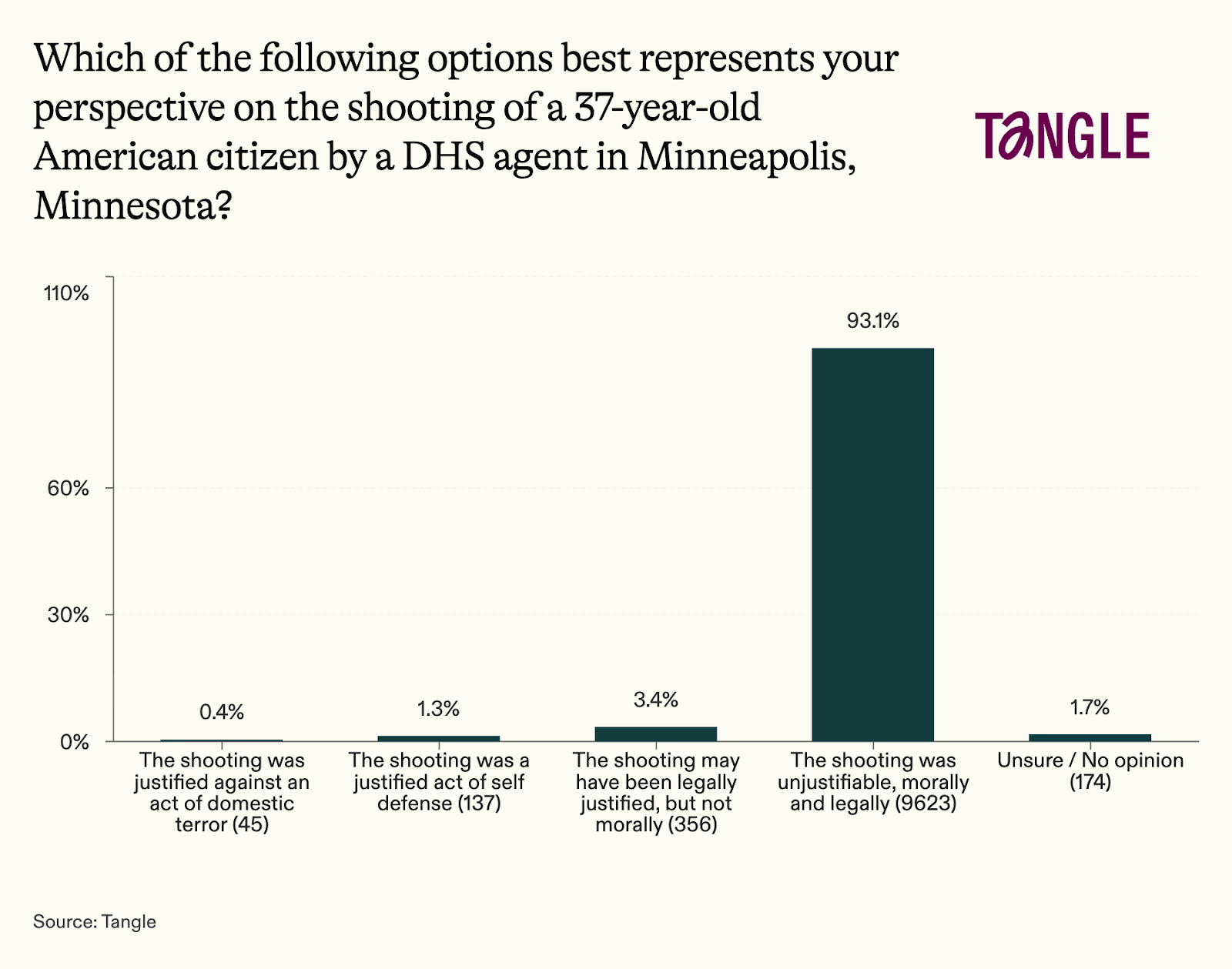
- Yesterday’s survey: 10,335 readers responded to our survey on the shooting of Alex Pretti with 93% finding it morally and legally unjustifiable. “As a resident of MN, the character attack of Alex Pretti feels like an attack on all of us. He was protecting people on the street just like most Minnesotans have been because of the tactics used by ICE here,” one respondent said. “Mask a normal person, and they will do unimaginable harm to those around them,” said another.
Have a nice day.
In late December, Dave Nguyen was leaving his company’s Christmas party in Ottawa, Ontario, and was struggling to find a ride service to take him home. After walking for 20 minutes, he finally connected with an Uber. The driver, Chance Niyromugabo, came to Canada from Rwanda, and Nguyen learned that he had never done any winter activities despite living there for eight years. Nguyen resolved to change that, and a few days later, they reconnected and went tobogganing at a local hill. “I never get time just to have fun, just focusing, just working, money, so on that time, meeting with him, it was really fun,” Niyromugabo said. The Ottawa Citizen has the story (and pictures).