WordPress Federation: Recap of 2025
In June, we published our 2025 roadmap: Building the Future of WordPress Federation, outlining the areas we wanted to focus on for the rest of the year.
As we step into 2026, it’s time to look back at how the roadmap held up and what we shipped in 2025.
2025 at a Glance
2025 turned out to be an ambitious and, at times, challenging timeline. Even so, we were able to make meaningful progress across most of the areas we set out to work on.
Over the course of the year, we introduced the Following feature, significantly expanded moderation tooling, refined actor handling, and improved the reliability and performance of core federation workflows. Along the way, we also shipped a first experimental draft of the Reader, offering an early look at what reading the Fediverse inside WordPress could become.
Not everything on the roadmap was completed, but we’re happy with how much we were able to achieve and with the foundations that are now in place for what comes next.
Roadmap
Below is a review of the roadmap topics we outlined for 2025, what we worked on, and what remains open.
Followers / Following ✅
Work in 2025 expanded ActivityPub beyond followers by introducing the Following feature, allowing WordPress sites and users to actively follow accounts on the Fediverse.

Alongside this, we improved the reliability and performance of both follower and following lists, including better synchronization across instances and faster resolution and display of large collections.
This work also laid the foundation for later features, such as the experimental Reader.
Related release posts:
Actors ✅
We continued refining how local and remote actors are represented and resolved. Internal refactors reduced special-case handling and improved consistency and performance across actor resolution, including follower, following, and block lists.
This work primarily affected internal behavior rather than user-facing UI.
Related release posts:
Moderation ✅
In 2025, ActivityPub-specific moderation was significantly expanded. Site-wide and personal blocking now cover domains, keywords, and individual actors, with consistent checks applied to incoming activities.
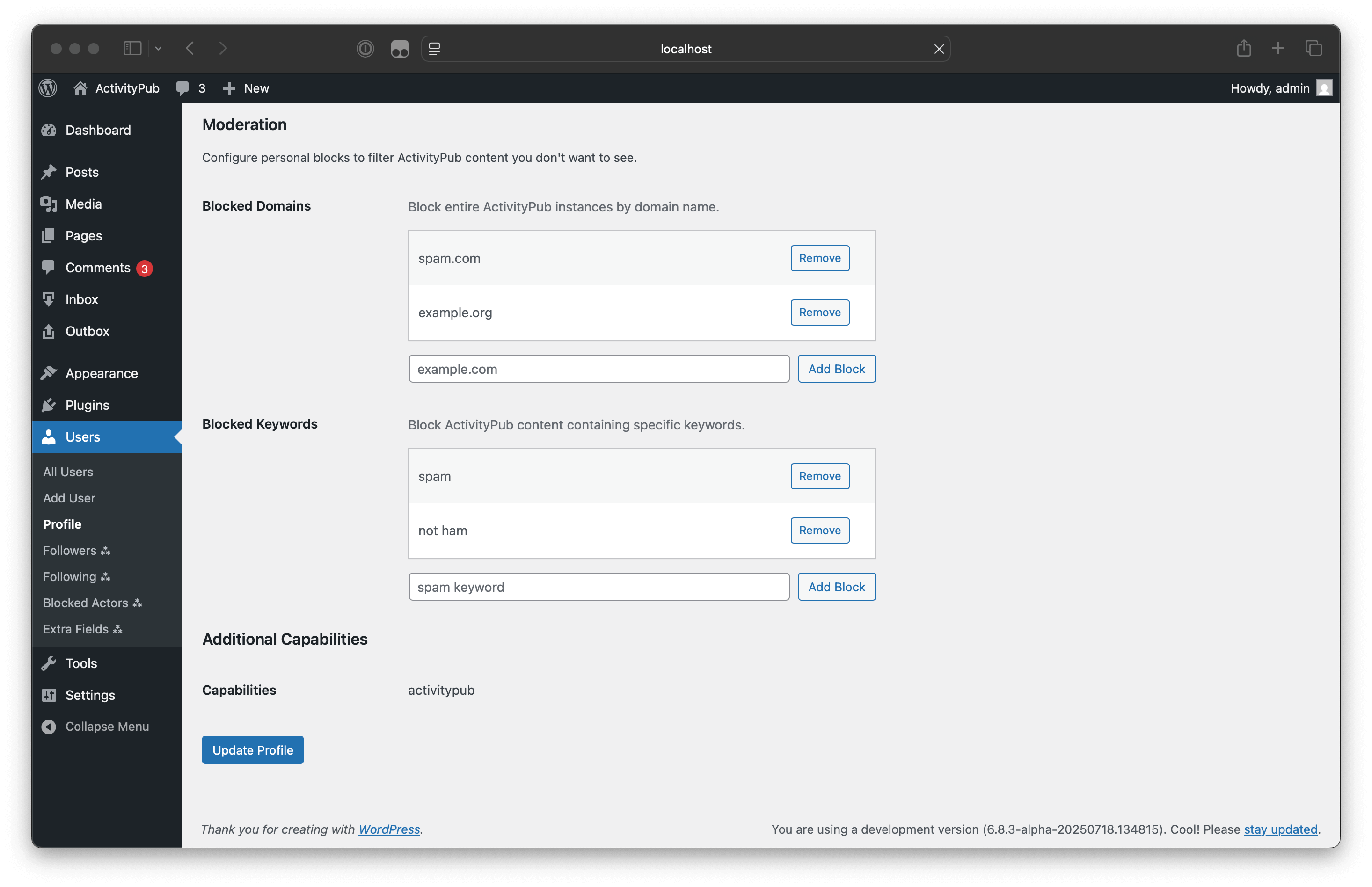
We added blocklist subscriptions with scheduled syncing and bulk domain imports, including support for community-maintained lists such as the IFTAS DNI list. Moderation handling was also refined with improved reject behavior for quote interactions.
Related release posts:
Reader 🧪

An experimental Reader UI was introduced behind a feature flag. When enabled, it adds a “Social Web” area to the dashboard where posts and shares from followed accounts can be read inside WordPress.
The feature is disabled by default and explicitly marked as experimental.
Related release posts:
Direct Messages ⏸️
Direct Messages were not implemented in 2025. This remains an open roadmap topic for future consideration once related foundations mature further.
Fully Delete Profiles ✅
Deletion semantics were improved to better support explicit federated cleanup. Delete activities are now sent when WordPress users are removed, and deletion-related handling was aligned across activity processing.

A CLI-based self-destruct command was introduced to allow site owners to explicitly remove their site’s federated presence.
Related release posts:
Client-to-Server API ⏸️
Client-to-Server API support was not implemented in 2025. No user-facing features shipped under this topic.
Beyond the Roadmap
While the roadmap helped guide our focus in 2025, not everything that shipped was planned from the start. Some features emerged from day-to-day usage, feedback, and practical needs that became clearer over time.
A few of those are worth highlighting.
Quotes
Support for quote interactions improved significantly over the year. We refined detection and handling of quoted replies and links, added proper handling for quote comments, and improved how quote permissions are revoked when quoted content is deleted. This made quoted interactions more reliable and consistent across instances.
Related release posts:
Onboarding
We also improved onboarding for new users by adding clearer guidance and better defaults after plugin activation. This helped reduce friction for sites federating for the first time and made initial setup more approachable.
Related release posts:
Extra Fields UI
While not originally planned as a roadmap item, work on Extra Fields resulted in a more flexible and user-friendly UI. New blocks and layout options made it easier to display federated profile data in different formats, allowing themes to choose how much structured information to surface.
Related release posts:
Wrapping up
Looking back, 2025 was a year of steady progress. We focused on the foundations we set out to improve, shipped meaningful features along the way, and left room for unplanned work that addressed real needs as they came up.
Now we’d love to hear from you: What was your favorite feature this year? What are you most excited about and what do you still miss or hope to see next?
Your feedback has shaped this project throughout 2025, and it continues to guide where we go from here. We’re already working on our 2026 timeline, and your ideas, experiences, and questions are an important part of that process.
Thanks for being part of the journey and see you on the Fediverse.
7.8.0 – Happy Holidays
As the year wraps up, ActivityPub 7.8.0 lands with stronger moderation tools, more flexible reactions, and a small surprise. Subscribe to shared blocklists with automatic updates and bulk-import domain blocks. Reactions now support a clean, avatar-free summary view. Plus, curious users can preview the new experimental Social Web Reader inside WordPress admin.
7.7.0 — Extra Quotable
Right on the heels of WordPress 6.9 we released a new version of the ActivityPub plugin today, making quote comments visible in the Reactions block and bringing you new ways of customizing your author pages.
7.6.0 — Command, Sync & Go
This release puts speed and control right at your fingertips. Whether you’re jumping between settings, syncing followers, or handling quotes in real time, version 7.6.0 makes managing your Fediverse presence faster and more intuitive than ever.
7.3.0 – Ctrl+Fed+Delete
Say hello to smoother moderation and a proper goodbye to old accounts. ActivityPub for WordPress 7.3.0 lets you block, filter, and even fully delete your presence from the Fediverse—site-wide or user-by-user. Whether you’re cleaning house or just want more control, this update makes managing your Fediverse footprint easier than ever.
What we shipped so far in 2025

Alongside our upcoming plans, we’ve already shipped several important features in recent releases. Here are some highlights of what’s now available in the ActivityPub plugin.
Onboarding
We’ve added an onboarding flow after plugin activation to help guide new users through key decisions — such as selecting the Actor Mode.

It’s also a great opportunity to explain Fediverse concepts for users who are new to them.
More details:
👉 5.9.0 — Easier onboarding for your Fediverse experience
Move
The Move Activity is used by Mastodon to migrate accounts to different servers — and can also be used for domain or username changes.
In the WordPress ecosystem, one of the main motivations for implementing Move was to support changing the domain of a WordPress blog — a common scenario for WordPress site owners.
We’ve built a solid foundation in the plugin to both send and receive Move Activities. However, because Move is not yet widely adopted across the Fediverse, we’ve decided to pause further work on this feature until there is broader ecosystem support.
Account migration remains a crucial capability for a healthier, more portable social web. If you’re interested in the broader context and challenges around this, we recommend watching Cory Doctorow’s keynote from the June FediForum:
https://www.youtube.com/watch?v=7_Gs1t0qe78
We’ll revisit this as the standard matures and more servers implement consistent handling of Move.
More details:
Outbox
Earlier versions of the plugin supported only the federation of custom post types, sending all messages in one bulk.
That approach works up to about 1000 followers, but does not support retries, logging, or error handling.
To support larger blogs or news sites — we needed a more robust system.
We now have mechanisms to:
- Federate activities to more than 1000 followers.
- Use a staggered delivery system that prioritizes servers.
- Provide a stable and scalable architecture.
- Support retries and error reporting.
This improved Outbox system also makes it easier for third-party plugin developers to federate their own content types in a reliable and scalable way.
More details:
Changelogs
These are just the major milestones. If you’re interested in everything we ship, be sure to subscribe or follow the blog — we publish detailed changelog posts with every new plugin release, listing all new features and improvements.
As always, we welcome your feedback and ideas — they help shape the future of the ActivityPub plugin and the growing WordPress Fediverse community! 🚀
Our 2025 Roadmap: Building the Future of WordPress Federation

We’re excited to share this roadmap — there’s a lot happening with the ActivityPub plugin, and we can’t wait to show you what’s coming next.
We often refer to this roadmap in GitHub issues and discussions, but until now, we haven’t published a full roadmap post — nor a formal changelog. This post is a first step toward keeping the community more informed about what’s planned and what’s coming up next.
Our goal for this year is to finalize the full ActivityPub experience — so that WordPress can be used as a first-class citizen of the Fediverse. This means enabling not only publishing to the network, but also following, reading, interacting, and moderating — all in a seamless way that feels natural for WordPress users.
This roadmap is not set in stone — priorities may shift based on community feedback, WordPress updates, or changes in the wider Fediverse. But it should give you a good sense of where we’re going.
Followers/Following
This is what we’re currently working on. You can follow the progress on GitHub.
Right now, the plugin supports only Followers. It doesn’t yet offer a way for your site to follow others in the Fediverse. But with new initiatives like the “Reader Experience,” this will need to change.
To support true two-way relationships — both Followers and Following — we need a database model that can clearly represent both types of connections. The current system, which relies on GUIDs to track remote actors, wasn’t designed for this. At the moment, it can store a remote actor as a follower of your site, but it doesn’t easily support the ability for your site to follow them back.
Implementing Following cleanly will require rethinking how this data is stored and connected.
Actors
This ties into a broader challenge with how the plugin currently models actors — both local users on your site and remote users from other Fediverse servers.
Today, the plugin uses virtual users to represent these actors. This was a practical choice early on to get federation working without rewriting how WordPress manages users.
But as the plugin grows — especially with features like Following and the Reader Experience — this approach is creating friction. Virtual users don’t behave exactly like regular WordPress users, so each time we add new features, we end up writing special workarounds.
Over time, this adds complexity and makes the system harder to maintain. Moving toward a more unified model for actors — one that integrates more naturally with WordPress’s existing structures — will keep the plugin flexible and reliable.
Moderation
Currently, the plugin relies on WordPress’s built-in “Disallowed Comment Keys” system to filter unwanted content at the inbox endpoint — before any ActivityPub request is processed. This mechanism allows you to block activities based on keywords or domains, using the same rules you’d apply to comments.
However, this approach is fairly blunt: it’s a simple keyword filter, not a nuanced moderation tool. This limitation will become more important as the plugin expands — for example, when adding support for image-based comments or richer media interactions.
Building a dedicated filtering mechanism is an important step toward giving site owners fine-grained moderation tools that are tailored to the unique challenges of federated content.
More details:
Reader
A full Reader experience is one of our long-term goals — it’s the final big feature needed to give WordPress sites a complete ActivityPub/Fediverse experience.
Today, the plugin lets others follow your site, but there’s no built-in way for you to subscribe to and read content from others — in other words, there’s no “timeline” yet inside WordPress.
We plan to start with a simple, flexible approach: focusing first on storing remote posts in a way that’s compatible with tools like the WordPress.com Reader or third-party plugins like Friends or the Event Bridge for ActivityPub.
Once this foundation is in place, we’ll iterate on direct support — making it possible for site owners and users to follow and read Fediverse posts right inside WordPress.
Direct Messages
As part of this evolution toward a full Reader experience, we’re also exploring support for Direct Messages.
This is a frequently requested feature and an important part of richer Fediverse interactions. We plan to start with an initial implementation that enables private messaging — and then build on it as we learn from real-world use.
Fully delete profiles
One key principle of the GDPR is the “right to be forgotten.”
Currently, the plugin supports remote deletions, but does not trigger Delete Activities for local user actions.
The challenge is that WordPress operates differently from most federated social networks. Users might expect Delete Activities for certain actions that could have major consequences — for example, deactivating the plugin.
But deactivating a plugin is also a common troubleshooting step in WordPress.
To address this, we first need to define different use cases and guide users on how to trigger Delete Activities appropriately.
More details:
👉 GitHub — User Delete Milestone
Client-to-Server API (exploration)
In addition to the way servers communicate with each other across the Fediverse, ActivityPub also defines a “Client-to-Server” API.
This API is mainly designed to allow apps and clients (such as mobile apps) to publish content to a Fediverse server.
In the future, this could open up interesting possibilities for WordPress — for example, allowing WordPress to act as a bridge or proxy, making it easier to bring in and federate content from other tools or platforms.
At this stage, we’re exploring and evaluating this based on community interest and potential use cases.
Staying Informed
We’ll continue to keep you informed about the progress of this roadmap.
For each new release, we’ll publish posts highlighting the latest features and improvements. For larger projects — like the Reader experience or expanded moderation tools — we’ll also share regular updates so you can follow along as the work evolves.
As always, we welcome your feedback and ideas — they help shape the future of the ActivityPub plugin and the growing WordPress Fediverse community! 🚀