Discussion
Loading...

Post

Log in
  • About
  • Code of conduct
  • Privacy
  • Users
  • Instances
  • About Bonfire
Beardy Star Stuff 馃彺馃尮馃嚨馃嚫
@dennyhenke@social.coop  路  activity timestamp 2 weeks ago

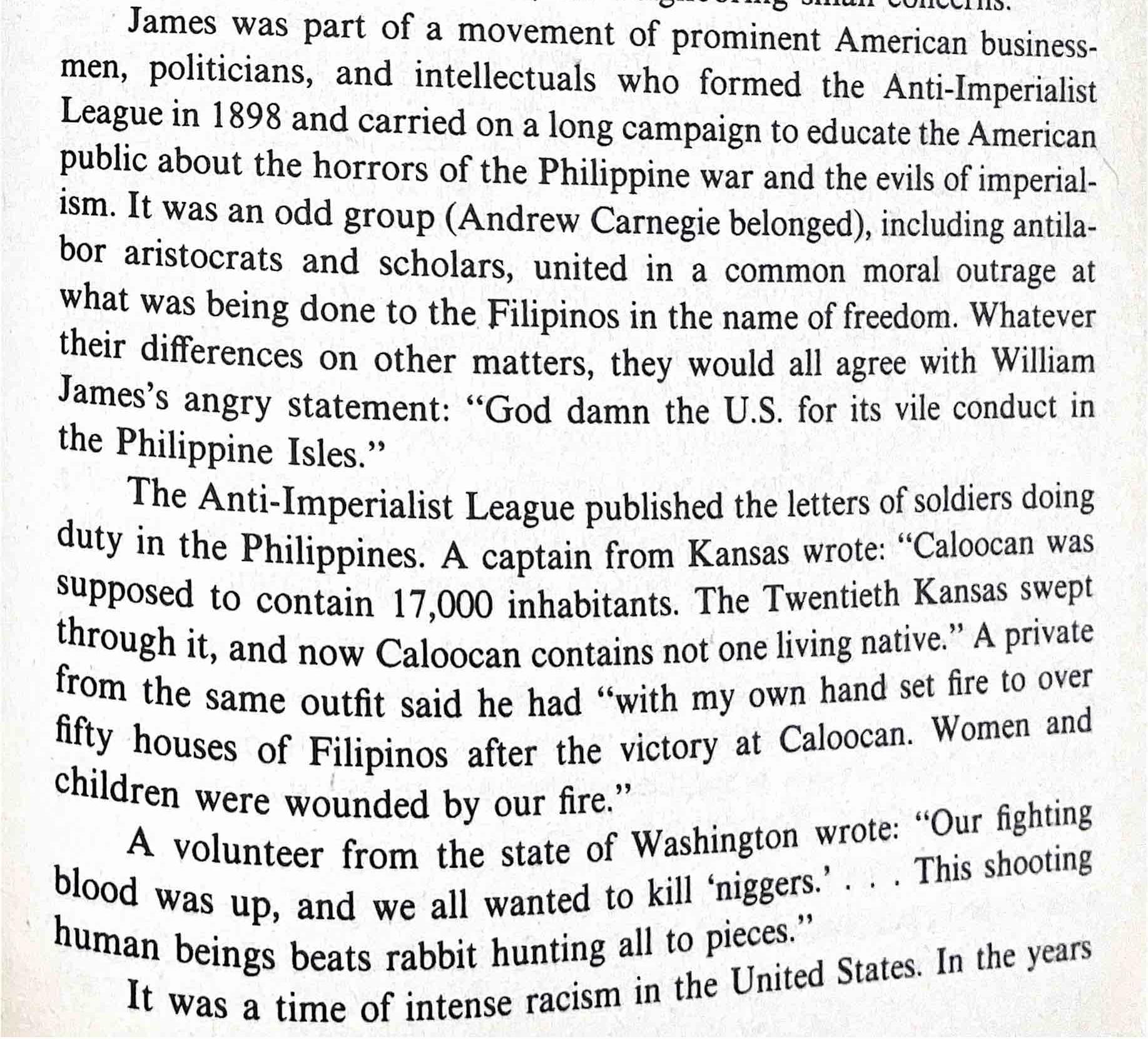
United States has always been about violent conquest and profit seeking for capitalists. That is the core.

From Howard Zinn's "The People's History of the United States", chapter 12, The Empire and the People"

#US #Capitalism #Colonialism #Empire #Imperialism #War #Violence #Fascism

A page from The People's History of the United States, Chapter 12, The Empire and the People

Theodore Roosevelt wrote to a friend in the year 1897: "In strict confidence, I should welcome almost any war, for I think this country needs one."
The year of the massacre at Wounded Knee, 1890, it was officially declared by the Bureau of the Census that the internal frontier was closed. The profit system, with its natural tendency for expansion, had already begun to look overseas. The severe depression that began in 1893 strengthened an idea developing within the political and financial elite of the country: that overseas markets for American goods might relieve the problem of underconsumption at home and prevent the economic crises that in the 1890s brought class war.
And would not a foreign adventure deflect some of the rebellious energy that went into strikes and protest movements toward an external enemy? Would it not unite people with government, with the armed forces, instead of against them? This was probably not a conscious plan among most of the elite-but a natural development from the twin drives of capitalism and nationalism.
Expansion overseas was not a new idea. Even before the war agans.
Mexico carried the United States to the Pacific, the Monroe Doctrne looked southward into and beyond the Caribbean. Issued in 1823 when the countries of Latin America were winning independence from Spanish control, it made plain to European nations that the United States considered...

A page from The People's History of the United States, Chapter 12, The Empire and the People Theodore Roosevelt wrote to a friend in the year 1897: "In strict confidence, I should welcome almost any war, for I think this country needs one." The year of the massacre at Wounded Knee, 1890, it was officially declared by the Bureau of the Census that the internal frontier was closed. The profit system, with its natural tendency for expansion, had already begun to look overseas. The severe depression that began in 1893 strengthened an idea developing within the political and financial elite of the country: that overseas markets for American goods might relieve the problem of underconsumption at home and prevent the economic crises that in the 1890s brought class war. And would not a foreign adventure deflect some of the rebellious energy that went into strikes and protest movements toward an external enemy? Would it not unite people with government, with the armed forces, instead of against them? This was probably not a conscious plan among most of the elite-but a natural development from the twin drives of capitalism and nationalism. Expansion overseas was not a new idea. Even before the war agans. Mexico carried the United States to the Pacific, the Monroe Doctrne looked southward into and beyond the Caribbean. Issued in 1823 when the countries of Latin America were winning independence from Spanish control, it made plain to European nations that the United States considered...

  • Copy link
  • Flag this post
  • Block
Beardy Star Stuff 馃彺馃尮馃嚨馃嚫
@dennyhenke@social.coop replied  路  activity timestamp 2 weeks ago

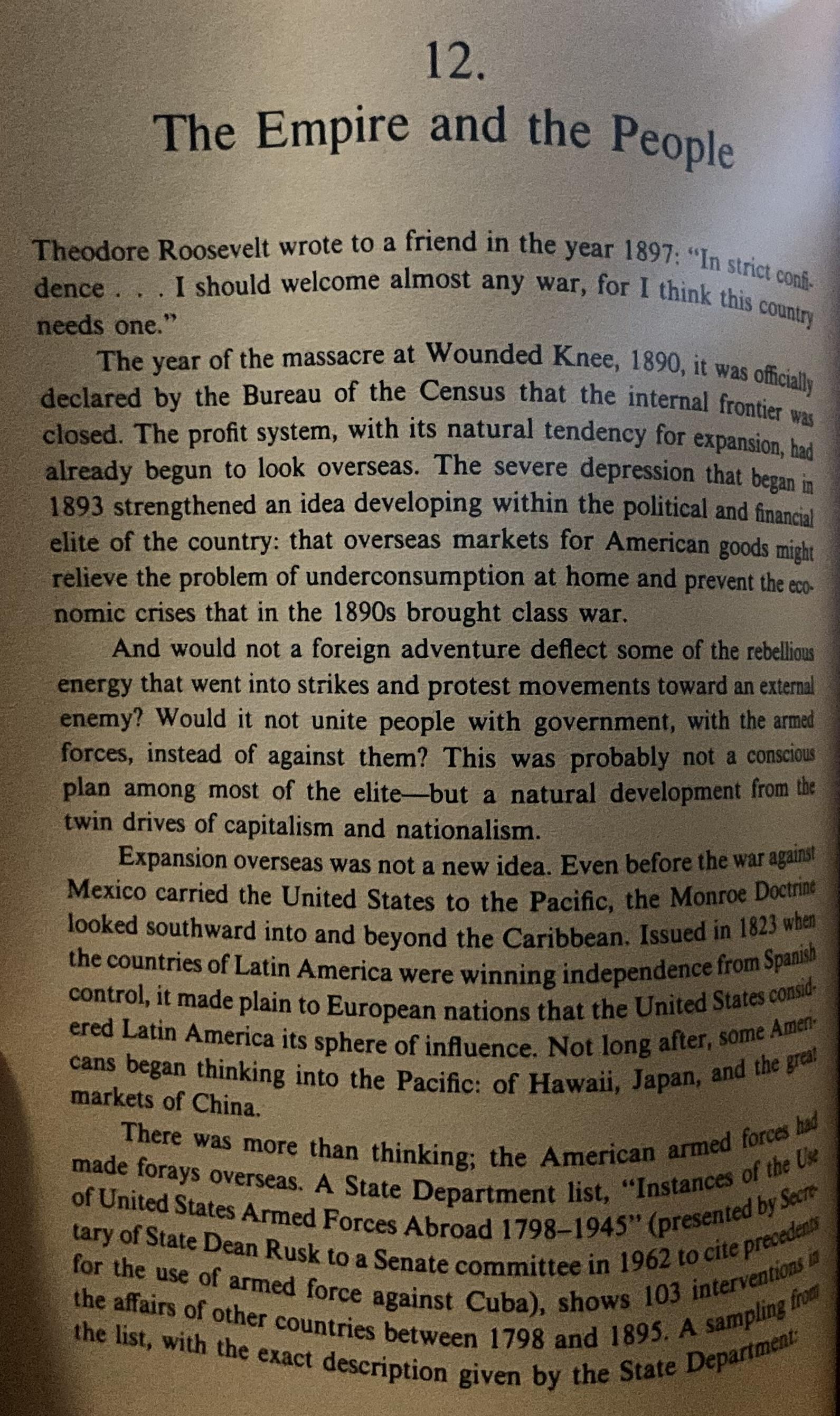
This was 1899, the Philippine war. Another in a long series of interventions which consisted of wiping out brown people that were in the way. This is an empire based on white supremacy and continues to this moment.

Excerpt from Howard Zinn's "The People's History of the United States":
James was part of a movement of prominent American business-men, politicians, and intellectuals who formed the Anti-Imperialist League in 1898 and carried on a long campaign to educate the American public about the horrors of the Philippine war and the evils of imperial-ism. It was an odd group (Andrew Carnegie belonged), including antila-bor aristocrats and scholars, united in a common moral outrage at what was being done to the Filipinos in the name of freedom. Whatever their differences on other matters, they would all agree with William James's angry statement: "God damn the U.S. for its vile conduct in the Philippine Isles."
The Anti-Imperialist League published the letters of soldiers doing duty in the Philippines. A captain from Kansas wrote: "Caloocan was supposed to contain 17,000 inhabitants. The Twentieth Kansas swept through it, and now Caloocan contains not one living native." A private from the same outfit said he had with my own hand set fire to over fifty houses of Filipinos after the victory at Caloocan. Women and children were wounded by our fire."
A volunteer from the state of Washington wrote. "Our fighting
blood was up. and we all wanted to kill 'niggers.'
... This shooting human beings beats rabbit hunting all to pieces."
It was a time of intense racism in the United States. In the years
Excerpt from Howard Zinn's "The People's History of the United States": James was part of a movement of prominent American business-men, politicians, and intellectuals who formed the Anti-Imperialist League in 1898 and carried on a long campaign to educate the American public about the horrors of the Philippine war and the evils of imperial-ism. It was an odd group (Andrew Carnegie belonged), including antila-bor aristocrats and scholars, united in a common moral outrage at what was being done to the Filipinos in the name of freedom. Whatever their differences on other matters, they would all agree with William James's angry statement: "God damn the U.S. for its vile conduct in the Philippine Isles." The Anti-Imperialist League published the letters of soldiers doing duty in the Philippines. A captain from Kansas wrote: "Caloocan was supposed to contain 17,000 inhabitants. The Twentieth Kansas swept through it, and now Caloocan contains not one living native." A private from the same outfit said he had with my own hand set fire to over fifty houses of Filipinos after the victory at Caloocan. Women and children were wounded by our fire." A volunteer from the state of Washington wrote. "Our fighting blood was up. and we all wanted to kill 'niggers.' ... This shooting human beings beats rabbit hunting all to pieces." It was a time of intense racism in the United States. In the years
  • Copy link
  • Flag this comment
  • Block
AKingsbury
AKingsbury
@AlexanderKingsbury@mastodon.social replied  路  activity timestamp 2 weeks ago

@dennyhenke

Is that why we violently conquered all of Europe when they were vulnerable after WWII?

  • Copy link
  • Flag this comment
  • Block
Beardy Star Stuff 馃彺馃尮馃嚨馃嚫
@dennyhenke@social.coop replied  路  activity timestamp 2 weeks ago

@AlexanderKingsbury Read the book and get back to me.

  • Copy link
  • Flag this comment
  • Block
AKingsbury
AKingsbury
@AlexanderKingsbury@mastodon.social replied  路  activity timestamp 2 weeks ago

@dennyhenke

Oh, we didn't? That's not a thing that happened at all? Interesting. I thought we were "always" about "violent conquest"?

Is it actually the case that we have conquered....how many actual nations?

  • Copy link
  • Flag this comment
  • Block
Beardy Star Stuff 馃彺馃尮馃嚨馃嚫
@dennyhenke@social.coop replied  路  activity timestamp 2 weeks ago

@AlexanderKingsbury I'll not discuss it with you. I'm not interested in your libertarian bullshit. If you haven't read the book then you can fuck right off. Blocking you now.

  • Copy link
  • Flag this comment
  • Block
stfn
stfn
@stfn@fedi.stfn.pl replied  路  activity timestamp 2 weeks ago

@dennyhenke it took me a very long time to finish that book because every few pages I had to stop reading and calm down

  • Copy link
  • Flag this comment
  • Block
Beardy Star Stuff 馃彺馃尮馃嚨馃嚫
@dennyhenke@social.coop replied  路  activity timestamp 2 weeks ago

@stfn Yeah. It is the story of atrocity after atrocity. 250 years of atrocities and grift. Violence and theft. And here we are today with the same story carrying on. I don't think this nation is redeemable. It is rotten to the core.

  • Copy link
  • Flag this comment
  • Block

bonfire.cafe

A space for Bonfire maintainers and contributors to communicate

bonfire.cafe: About 路 Code of conduct 路 Privacy 路 Users 路 Instances
Bonfire social 路 1.0.1 no JS en
Automatic federation enabled
Log in
  • Explore
  • About
  • Members
  • Code of Conduct