
and raising three sons with her second husband, Mexican artist Francisco Mora. Aware of her Communist affiliations, the United States government began surveilling Catlett. When she became a Mexican citizen in 1962, the US immediately deemed her an "undesirable alien" and barred her from entering the country until nearly a decade later. As a political exile, Catlett brought a global perspective to her work. She immersed herself in international cultural networks that extended beyond the US and
Post
Replies:
3
and raising three sons with her second husband, Mexican artist Francisco Mora. Aware of her Communist affiliations, the United States government began surveilling Catlett. When she became a Mexican citizen in 1962, the US immediately deemed her an "undesirable alien" and barred her from entering the country until nearly a decade later. As a political exile, Catlett brought a global perspective to her work. She immersed herself in international cultural networks that extended beyond the US and
Mexico to associates in #LatinAmerica, Africa, Asia, and Eastern Europe. With them she found strength and #solidarity in shared struggles against poverty, racism, and imperialism.
3 - "Central America Says No!" (1986), #linocut. Catlett repeatedly expressed outrage against #imperialism and US interventions around the world. This piece combines several printing blocks that Catlett used for earlier #prints. "Chile I" and "Chile Il" are powerful statements condemning the atrocities committed
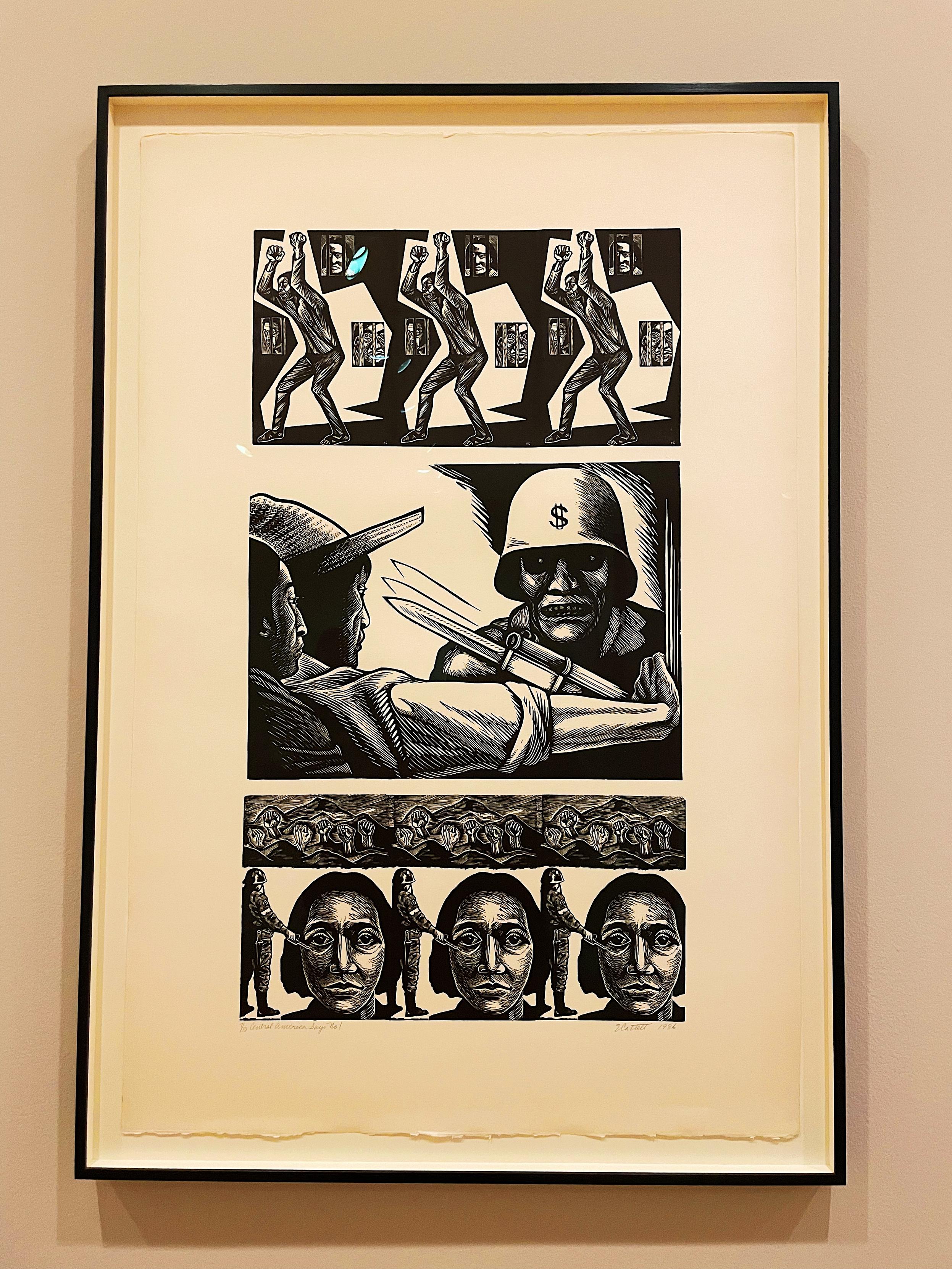
during the military dictatorship of Augusto Pinochet, who assumed power following the 1973 overthrow of Salvador Allende's government in a coup backed by the US. Catlett made "Alto a la agresión (Stop Aggression)" in 1954 to oppose US intervention in Guatemala. The impact of these histories is amplified through association and repetition, making "Central America Says No!" one of Catlett's most powerful anti-imperialist statements.