
What do I mean when I say everything in #Obsidian should feel instantaneous?
No more than 0.1 seconds.
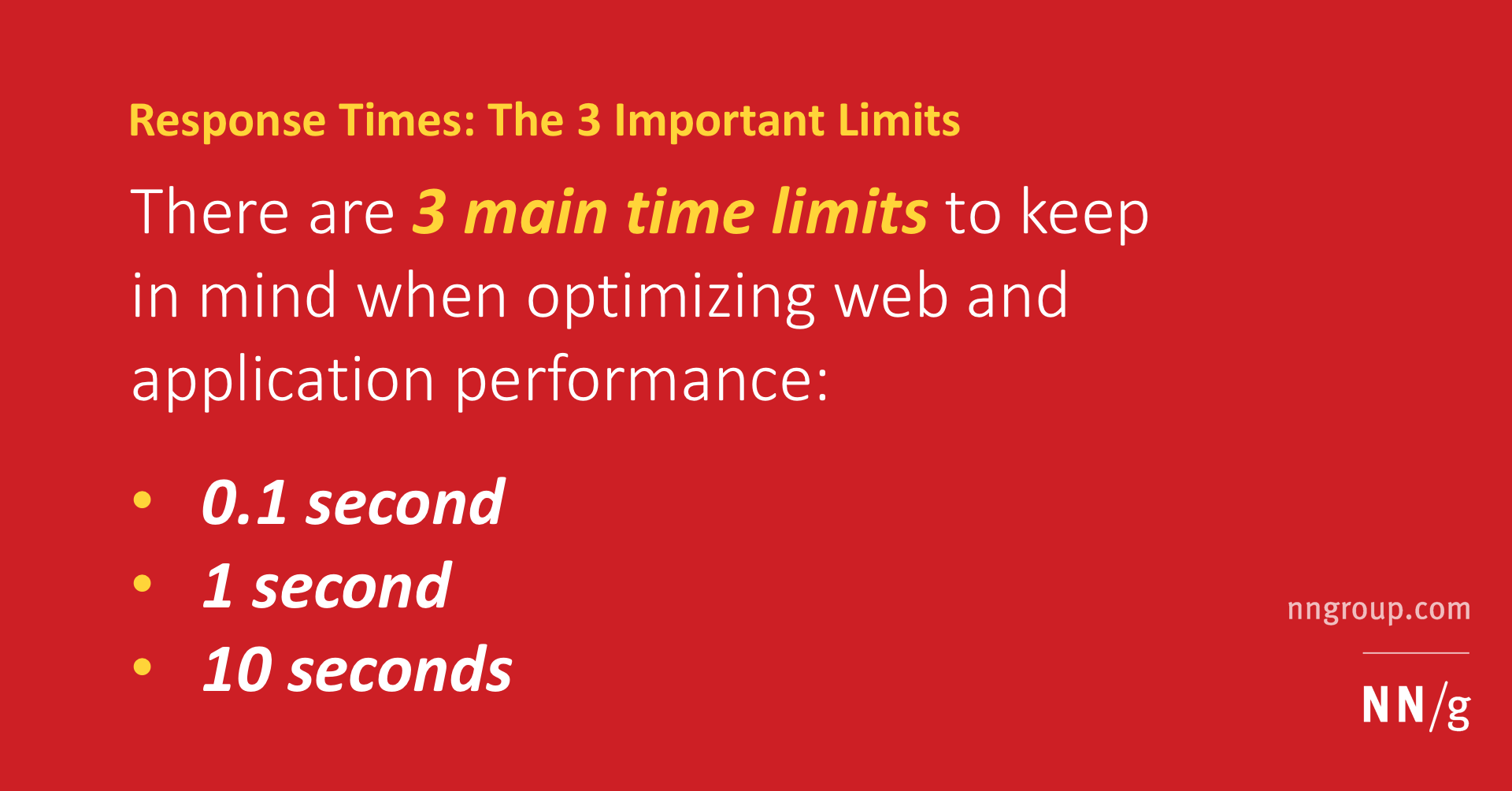
The target was established in 1968 by Robert Miller and well described in 1993 by Jakob Nielsen here:
What do I mean when I say everything in #Obsidian should feel instantaneous?
No more than 0.1 seconds.
The target was established in 1968 by Robert Miller and well described in 1993 by Jakob Nielsen here:
@kepano From my experience, the Sync plugin is very slow when I started the Obsidian in mobile. It took me today 2min 14 sec
@projectmb I can't reproduce that. Please open a bug on the forum with reproducible steps!
@kepano whenever I try some other note app, despite being native and better integrated into the system (Mac), I find it cumbersome and clunky because I'm used to Obsidian's instant speed. Congratulations, it's an incredible job.
@kepano I’m curious what their view is on animations. In many cases animations can make applications feel not instantaneous. However I think they serve a function of helping the user to understand what the change actually was. When the change is instantaneous then the user is forced to before and after the change in order to understand what the change actually was.
@dandylyons animations can be good, but make them fast
@kepano 💯 So I think it'd be interesting/helpful to explore what the best advice for animation timing would be, like this article.
In my experience 0.1-0.2 seconds feels good for most use cases. But I gotta explore this more.
@kepano as the greatest premature optimizer of all time, hire me and Obsidian shall be blazing fast (I'd rewrite hot paths in native code or WASM and use battle-tested projects like ripgrep where applicable).
It's worth studying the classics of interaction design.
"Response Times: The 3 Important Limits" by Jakob Nielsen (1993)
https://www.nngroup.com/articles/response-times-3-important-limits/
@kepano in the eighties when I was coding character displays for vt100s for a moderately decent software house, the rule was: if the UI took more than two seconds to respond, you had to fix the program.
Certainly not a rule i see other people following these days…
"Response time in man-computer conversational transactions" by Robert Miller (1968)
"Human processor model" is a cognitive modeling method developed by Stuart K. Card, Thomas P. Moran, & Allen Newell (1983) used to calculate how long it takes to perform a certain task.
https://en.wikipedia.org/wiki/Human_processor_model
@kepano I agree! On this specific topic, I found this more recent research a nice addition to the classics:
https://www.inkandswitch.com/slow-software/