"the average causal mediation effect of proportion of other-payoffs within-action transitions on the relation between CRT score and proportion of equilibrium responses is statistically significant (p = .002, based on 10000 bootstrap samples), accounting for an estimated 58 % of the total effect between CRT score and proportion of equilibrium responses (Table 4)."
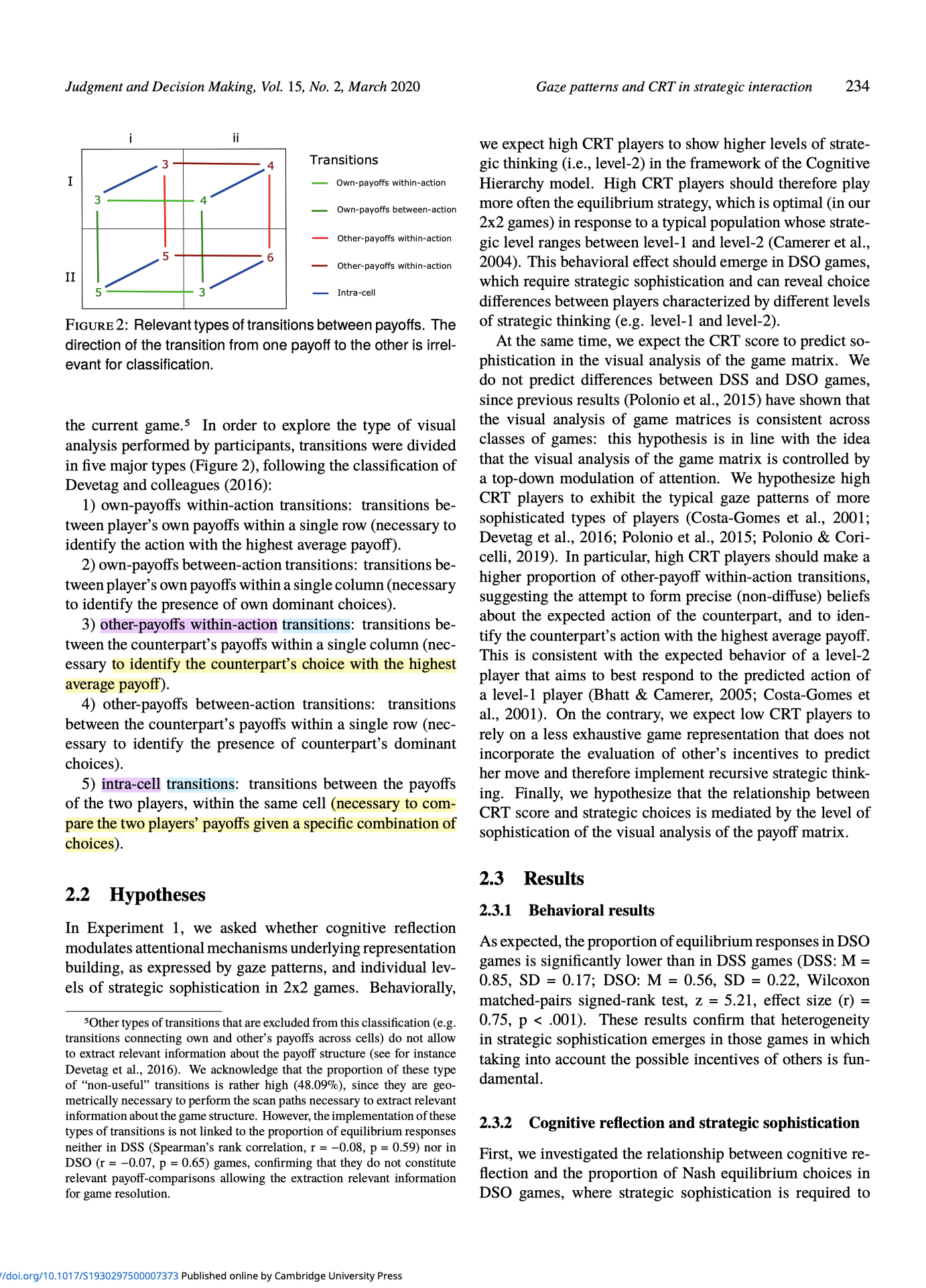
"In order to explore the type of visual analysis performed by participants, transitions were divided in five major types (Figure 2), following the classification of Devetag and colleagues (2016):

1) own-payoffs within-action transitions: transitions between player’s own payoffs within a single row (necessary to identify the action with the highest average payoff).

2) own-payoffs between-action transitions: ....

3) other-payoffs within-action transitions: ...

4) other-payoffs between-action transitions: transitions between the counterpart’s payoffs within a single row (necessary to identify the presence of counterpart’s dominant choices).

5) intra-cell transitions: transitions between the payoffs of the two players, within the same cell (necessary to compare the two players’ payoffs given a specific combination of choices)."
"In order to explore the type of visual analysis performed by participants, transitions were divided in five major types (Figure 2), following the classification of Devetag and colleagues (2016): 1) own-payoffs within-action transitions: transitions between player’s own payoffs within a single row (necessary to identify the action with the highest average payoff). 2) own-payoffs between-action transitions: .... 3) other-payoffs within-action transitions: ... 4) other-payoffs between-action transitions: transitions between the counterpart’s payoffs within a single row (necessary to identify the presence of counterpart’s dominant choices). 5) intra-cell transitions: transitions between the payoffs of the two players, within the same cell (necessary to compare the two players’ payoffs given a specific combination of choices)."
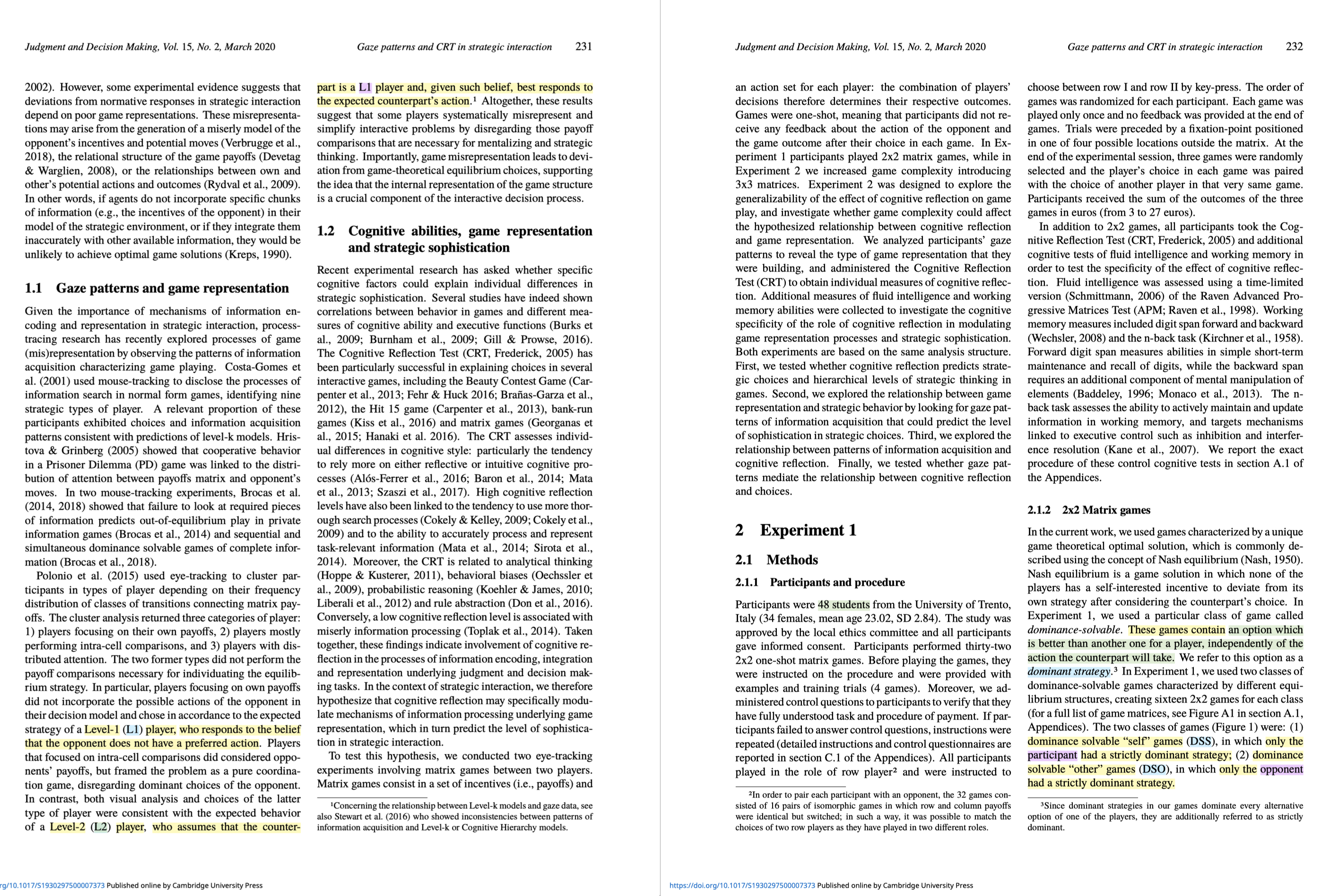
"Nash equilibrium is a game solution in which none of the players has a self-interested incentive to deviate from its own strategy after considering the counterpart’s choice. In Experiment 1, we used a particular class of game called dominance-solvable. These games contain an option which is better than another one for a player, independently of the action the counterpart will take. We refer to this option as a dominant strategy.3 In Experiment 1, we used two classes of dominance-solvable games characterized by different equilibrium structures, creating sixteen 2x2 games for each class (for a full list of game matrices, see Figure A1 in section A.1, Appendices). The two classes of games (Figure 1) were: (1) dominance solvable “self” games (DSS), in which only the participant had a strictly dominant strategy; (2) dominance solvable “other” games (DSO), in which only the opponent had a strictly dominant strategy."