Discussion
Loading...

Post

Log in
  • About
  • Code of conduct
  • Privacy
  • Users
  • Instances
  • About Bonfire
Jan Adriaenssens
Jan Adriaenssens
@verbeeld@mastodon.social  ·  activity timestamp 2 months ago

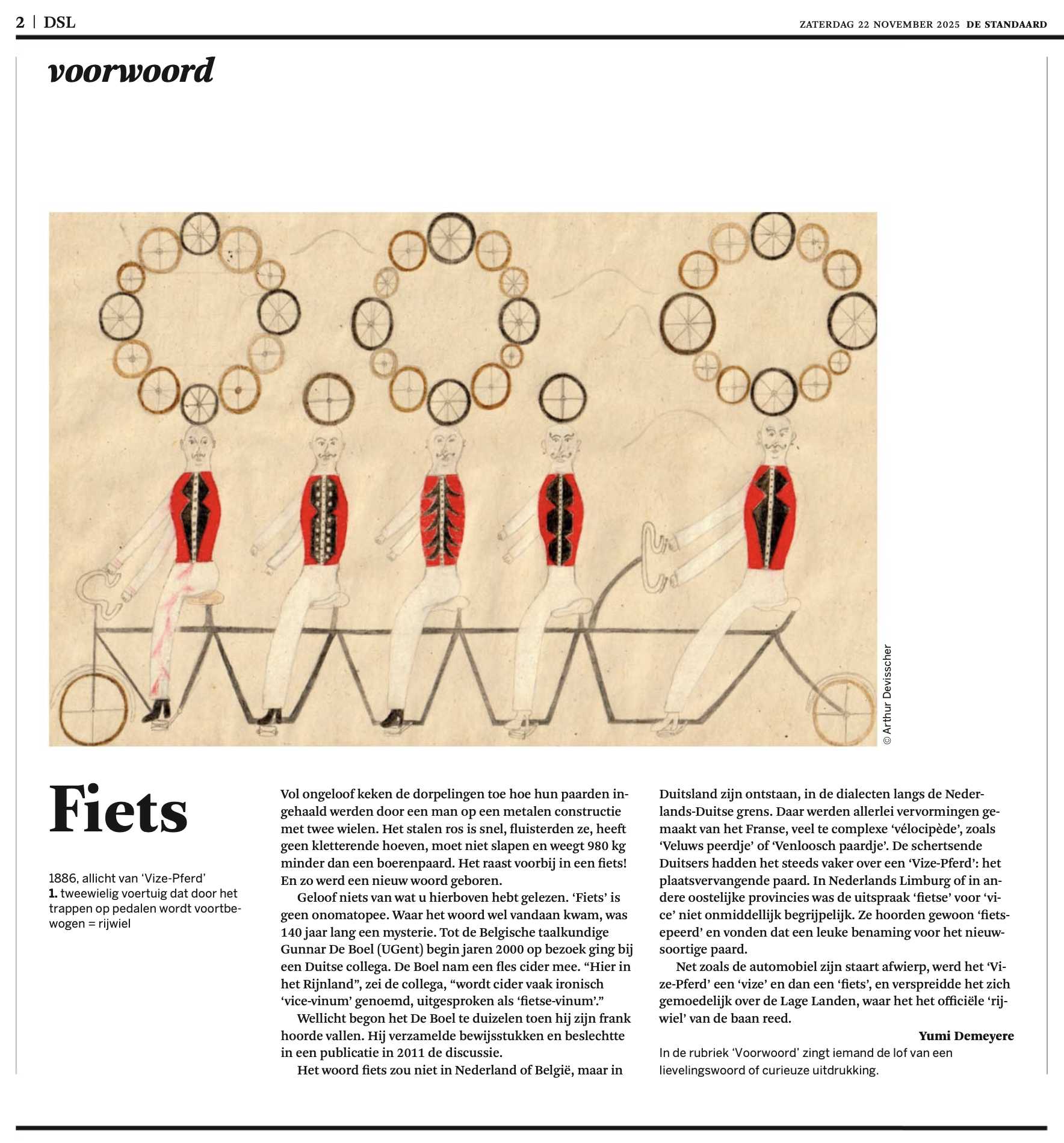
This weekend in the Belgian national newspaper De Standaard, a brief article on the origins of the Dutch word "fiets".

Apparently it comes from the 1886 German neologism "Vize-Pferd", meaning "vice-horse" or horse substitute.

"Vize-Pferd" became "Vice" which became "fiets".

(Translation in the alt-text.)

cc @AmericanFietser @americanfietser.bsky.social @fietsflik.bsky.social

#fiets #fietser

Copy of a Dutch newspaper article (with a large artistic illustration), titled "Fiets".

Translated into English:

1886, perhaps from “Vize-Pferd”

Where the word "fiets" comes from was a mystery for 140 years. Until the Belgian linguist Gunnar De Boel (UGent) visited a German colleague in the early 2000s. De Boel brought a bottle of cider. “Here in the Rhineland,” said the colleague, “cider is often ironically called vice-vinum, pronounced as fietse-vinum.”
De Boel may have started to feel a bit dizzy when he heard that. He gathered evidence and settled the debate in a 2011 publication.
The word fiets did not originate in the Netherlands or Belgium, but in Germany, in the dialects along the Dutch–German border. There, all sorts of variations were made from the French, rather complex vélocipède, such as “Veluws little horse” or “Venlo horse.” The joking Germans increasingly spoke of a Vize-Pferd: the substitute horse. In Dutch Limburg or other eastern provinces, the pronunciation “fietse” for “vice” was not immediately clear. They simply heard “fietse-perd” and thought it a fun name for the new kind of horse.
Just as the car shed its tailpipe, the Vize-Pferd lost its “vize” and became a fiets, and the term spread easily across the Low Countries, where it eventually overtook the official “rijwiel.”

Copy of a Dutch newspaper article (with a large artistic illustration), titled "Fiets". Translated into English: 1886, perhaps from “Vize-Pferd” Where the word "fiets" comes from was a mystery for 140 years. Until the Belgian linguist Gunnar De Boel (UGent) visited a German colleague in the early 2000s. De Boel brought a bottle of cider. “Here in the Rhineland,” said the colleague, “cider is often ironically called vice-vinum, pronounced as fietse-vinum.” De Boel may have started to feel a bit dizzy when he heard that. He gathered evidence and settled the debate in a 2011 publication. The word fiets did not originate in the Netherlands or Belgium, but in Germany, in the dialects along the Dutch–German border. There, all sorts of variations were made from the French, rather complex vélocipède, such as “Veluws little horse” or “Venlo horse.” The joking Germans increasingly spoke of a Vize-Pferd: the substitute horse. In Dutch Limburg or other eastern provinces, the pronunciation “fietse” for “vice” was not immediately clear. They simply heard “fietse-perd” and thought it a fun name for the new kind of horse. Just as the car shed its tailpipe, the Vize-Pferd lost its “vize” and became a fiets, and the term spread easily across the Low Countries, where it eventually overtook the official “rijwiel.”
  • Copy link
  • Flag this post
  • Block

bonfire.cafe

A space for Bonfire maintainers and contributors to communicate

bonfire.cafe: About · Code of conduct · Privacy · Users · Instances
Bonfire social · 1.0.2-alpha.2 no JS en
Automatic federation enabled
Log in
  • Explore
  • About
  • Members
  • Code of Conduct