Discussion
Loading...

Post

Log in
  • About
  • Code of conduct
  • Privacy
  • Users
  • Instances
  • About Bonfire
Kelly Lepo
Kelly Lepo
@KellyLepo@scicomm.xyz  ·  activity timestamp 2 months ago

I'm glad this is finally out after the government shutdown!

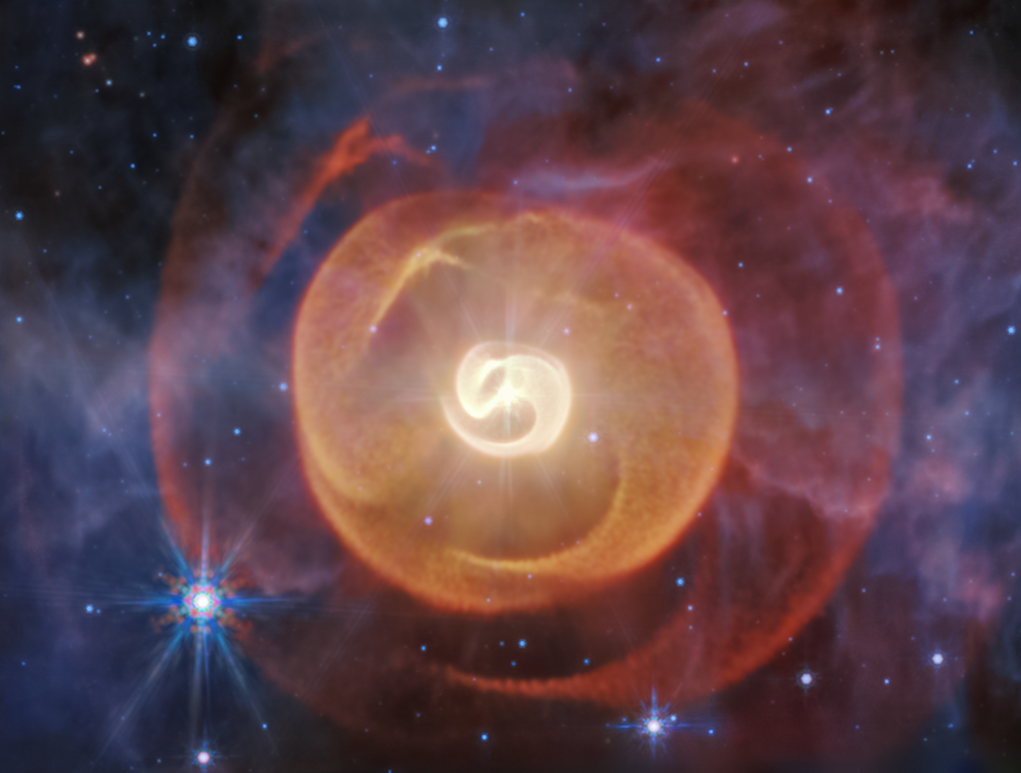
In this new JWST image, we see shells of dust surrounding the Apep system.

As the two Wolf-Rayet stars complete their 190-year orbit, they will get close enough that their winds will collide for about 25 years. These colliding winds produce carbon-rich dust that surrounds the stars in a shell. The shells then get blown outward by the winds.

A third star, a massive O-type star, orbits the pair of Wolf-Rayet stars in a wider orbit and destroys some of the top part of the dust shell. All three of these stars appear as a single point of light in the center of the image.

The result: At least four nested shells of dust, showing the history of the system like tree rings.
https://science.nasa.gov/missions/webb/webb-first-to-show-4-dust-shells-spiraling-apep-limits-long-orbit/

#astronomy #space #jwst

Four translucent dust shells expand away from three central stars that appear as a single pinpoint of light. Bright, arcing ridges partially outline the shells. The innermost shell is smallest, like the size of a thumbprint, and brightest. It is yellow and forms a backward lowercase e. A line at 3 o’clock swoops to the bottom-left in an arc that ends at 8 o’clock. A second line at 9 o’clock dips down to start, but then goes straight up, angling around the top. The second shell, about the size of a fist, is orange and has looser arcs. One appears from 4 to 7 o’clock. A brighter orange triangle appears from 10 to 12 o’clock. Its outer edges overlap, forming a rough circle. The third shell extends almost to the edges and is semi-translucent red, with similar arcs and a darker red line that also forms a faint triangle at top left. The widest shell is faintest and at the edges. A semi-transparent blue appears across the scene. A larger foreground star with spikes is at bottom left, and more distant stars and galaxies are strewn across the black expanse of space.
  • Copy link
  • Flag this post
  • Block
Kelly Lepo
Kelly Lepo
@KellyLepo@scicomm.xyz replied  ·  activity timestamp 2 months ago

A visualization of the Apep system, showing the nested shells of carbon-rich dust produced by the colliding winds of a Wolf-Rayet binary.

https://youtu.be/fITdexBNfkQ?si=mdEixVAcvkUpFI3W

  • Copy link
  • Flag this comment
  • Block

bonfire.cafe

A space for Bonfire maintainers and contributors to communicate

bonfire.cafe: About · Code of conduct · Privacy · Users · Instances
Bonfire social · 1.0.1 no JS en
Automatic federation enabled
Log in
  • Explore
  • About
  • Members
  • Code of Conduct