Discussion
Loading...

Post

Log in
  • About
  • Code of conduct
  • Privacy
  • Users
  • Instances
  • About Bonfire
Carrie Shanafelt
Carrie Shanafelt
@carrideen@c18.masto.host  ·  activity timestamp 3 months ago

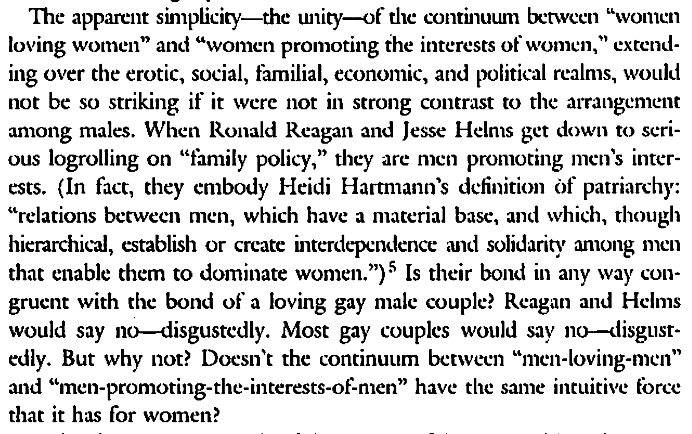
I woke up to that disgusting Vaseline-lensed NYT essay about how the world of Epstein was a long-ago different time when male power bonds emerged according to the ancient affective paradigms of NYC, lost in the mist of #metoo and I am desperate to know why no one ever thinks to look at the tremendous work on those affective paradigms written by those who could see them clearly at the time. Eve Sedgwick's Between Men (1985) will do nicely. She was declared dangerous for describing male affect:

TEXT: The apparent simplicity—the unity—of the continuum between “women
loving women” and “women promoting the interests of women,” extend-
ing over the erotic, social, familial, economic, and political realms, would
not be so striking if it were not in strong contrast to the arrangement
among males. When Ronald Reagan and Jesse Helms get down to seri-
ous logrolling on “family policy,” they are men promoting men's inter-
ests. (In fact, they embody Heidi Hartmann®s definition of patriarchy:
“relations between men, which have a material base, and which, though
hierarchical, establish or create interdependence and solidarity among men
that enable them to dominate women.”) Is their bond in any way con-
gruent with the bond of a loving gay male couple? Reagan and Helms
would say no—disgustedly. Most gay couples would say no—disgust-
edly. But why nor? Doesn't the continuum between “men-loving-men”
and “men-promoting-the-interests-of-men” have the same intuitive force
that it has for women?
TEXT: The apparent simplicity—the unity—of the continuum between “women loving women” and “women promoting the interests of women,” extend- ing over the erotic, social, familial, economic, and political realms, would not be so striking if it were not in strong contrast to the arrangement among males. When Ronald Reagan and Jesse Helms get down to seri- ous logrolling on “family policy,” they are men promoting men's inter- ests. (In fact, they embody Heidi Hartmann®s definition of patriarchy: “relations between men, which have a material base, and which, though hierarchical, establish or create interdependence and solidarity among men that enable them to dominate women.”) Is their bond in any way con- gruent with the bond of a loving gay male couple? Reagan and Helms would say no—disgustedly. Most gay couples would say no—disgust- edly. But why nor? Doesn't the continuum between “men-loving-men” and “men-promoting-the-interests-of-men” have the same intuitive force that it has for women?
  • Copy link
  • Flag this post
  • Block
Carrie Shanafelt
Carrie Shanafelt
@carrideen@c18.masto.host replied  ·  activity timestamp 3 months ago

She argues (beautifully, hilariously, enragedly) that patriarchy replicates itself by recruiting men at all levels of socioeconomic/political power to find themselves in brotherhood and solidarity through ritual, mutual humiliation of others (women, children, etc.). Even gay men can be invited into these emotional bonds, as willing participants, or they can become victims. Her great insight, I think, is that patriarchy is material but also emotional--a misty glorious past that is still with us.

  • Copy link
  • Flag this comment
  • Block
Carrie Shanafelt
Carrie Shanafelt
@carrideen@c18.masto.host replied  ·  activity timestamp 3 months ago

This sense of patriarchy as always passing, but never gone, something to be mourned even as it still holds (or temporarily rents) every seat of power, is part of how patriarchal violence recruits willing participants. (We don't want to lose this feeling, this manly feeling, the brotherhood of heroes feeling, right, guys???) Sedgwick's most upsetting claim is that patriarchy is firmly homoerotic--not homosexual, but *erotic* in its vectors of desire. (Prove you love us more than her.)

  • Copy link
  • Flag this comment
  • Block
Carrie Shanafelt
Carrie Shanafelt
@carrideen@c18.masto.host replied  ·  activity timestamp 3 months ago

That women's solidarity is homoerotic doesn't surprise anyone, I think. Sedgwick shows how "women loving women" could be sisters, lovers, coworkers, strangers, parent and child, sexual or not, with or without power differential, and that homoerotic zone of intimacy can allow us to care for one another--grooming, feeding, embracing. "Men loving men" as she recasts it is also about bodily intimacy. But because it is also homophobic, it recruits violence to express fear. Someone has to be the dog.

  • Copy link
  • Flag this comment
  • Block
Carrie Shanafelt
Carrie Shanafelt
@carrideen@c18.masto.host replied  ·  activity timestamp 3 months ago

The dog can be a child, a woman, a gay man, a trans person, an animal, or even the least favored of the bros that day. Violence and humiliation are the backbone that holds up the emotional life of patriarchy. Of course they're going to get panicky and frightened when their privacy is threatened; that's where all their emotions get to happen. But I don't think we need another "back in my day" always-already-gone retrospective of the misty watercolor world that is also just the world today.

  • Copy link
  • Flag this comment
  • Block
Carrie Shanafelt
Carrie Shanafelt
@carrideen@c18.masto.host replied  ·  activity timestamp 3 months ago

So how does this affective patriarchy end? There are many who are, correctly, focusing on ending the outrageous, world-destroying wealth hoarding of patriarchy, which is good and must happen. But I think we do well also to offer an affective alternative. How can men form bonds with others without making someone "the dog"? Sedgwick saw that homophobia was crucial to the violent infrastructure of patriarchy, because it's what prevents men from loving men without cruelty--fear of being cast out.

  • Copy link
  • Flag this comment
  • Block

bonfire.cafe

A space for Bonfire maintainers and contributors to communicate

bonfire.cafe: About · Code of conduct · Privacy · Users · Instances
Bonfire social · 1.0.2-alpha.23 no JS en
Automatic federation enabled
Log in
  • Explore
  • About
  • Members
  • Code of Conduct