Discussion
Loading...

Post

Log in
  • About
  • Code of conduct
  • Privacy
  • Users
  • Instances
  • About Bonfire
Tom Stafford
Tom Stafford
@tomstafford@mastodon.online  ·  activity timestamp 2 months ago

Lottery before peer review is associated with increased female representation and reduced estimated economic cost in a German funding line https://www.nature.com/articles/s41467-025-65660-9

New from @rmrahal and colleagues

Funder was German Foundation for Innovation in Higher Education (Stiftung Innovation in der Hochschullehre). "Lottery-first" meant short EoI were submitted and randomisation used to select those allowed to apply

#Metascience #MetaResearch #ResearchFunding

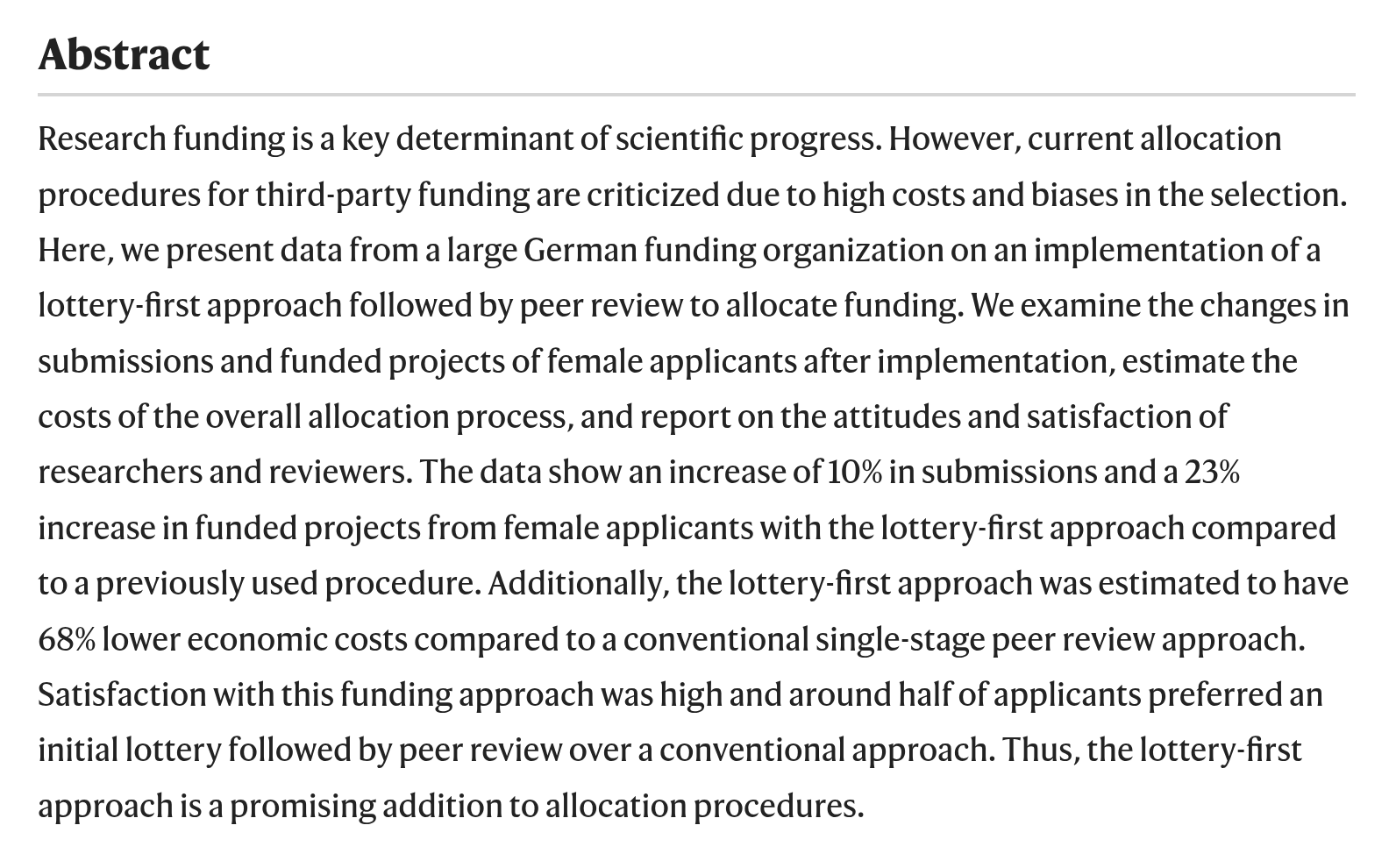
Research funding is a key determinant of scientific progress. However, current allocation procedures for third-party funding are criticized due to high costs and biases in the selection. Here, we present data from a large German funding organization on an implementation of a lottery-first approach followed by peer review to allocate funding. We examine the changes in submissions and funded projects of female applicants after implementation, estimate the costs of the overall allocation process, and report on the attitudes and satisfaction of researchers and reviewers. The data show an increase of 10% in submissions and a 23% increase in funded projects from female applicants with the lottery-first approach compared to a previously used procedure. Additionally, the lottery-first approach was estimated to have 68% lower economic costs compared to a conventional single-stage peer review approach. Satisfaction with this funding approach was high and around half of applicants preferred an initial lottery followed by peer review over a conventional approach. Thus, the lottery-first approach is a promising addition to allocation procedures.

  • Copy link
  • Flag this post
  • Block
Dan Goodman
Dan Goodman
@neuralreckoning@neuromatch.social replied  ·  activity timestamp 2 months ago

@tomstafford @rmrahal just one more step needed. 😉

  • Copy link
  • Flag this comment
  • Block
Tom Stafford
Tom Stafford
@tomstafford@mastodon.online replied  ·  activity timestamp 2 months ago

@neuralreckoning @rmrahal is that complete randomisation of funding?

  • Copy link
  • Flag this comment
  • Block

bonfire.cafe

A space for Bonfire maintainers and contributors to communicate

bonfire.cafe: About · Code of conduct · Privacy · Users · Instances
Bonfire social · 1.0.1 no JS en
Automatic federation enabled
Log in
  • Explore
  • About
  • Members
  • Code of Conduct