to the stable, the eternal, the identical, the constant”; the model is “vortical,” not laminar, operating “in an open space throughout which thing-flows are distributed, rather than plotting out a closed space for linear and solid things”; that model models not a “striated” space that “is counted in order to be occupied,” but a “smooth” space that “is occupied without being counted”; and the subtlest & hardest for me to grasp among all these distinctions, it is “problematic,” not “theorematic.”
Post
Replies:
15
We continue into our third week of reading “Nomadology: The War Machine,” slowly and carefully. Thanks so much to everyone who’s come along for the ride so far!
Today we pick up the story where we’d left it, in the middle of a passage where D&G are trying to establish that the war machine’s absolute exteriority to the State is mirrored in two ways of knowing, lineages of thought they call “royal science” and “minor” or “nomad science.” And there’s an asymmetry between these: just as the State
can only appropriate the war machine’s energies for itself by flattening and abstracting the very thing that generates those energies, royal science can only make use of the fruits of nomad science once they’ve been standardized, routinized, subjected to normalization operations.
D&G invoke the work of the French sociologist Anne Querrien to consider two moments at which they feel nomad science and royal science are poised in clearest opposition: in the construction of Romanesque and
Gothic cathedrals, starting in the European twelfth century, and then again in the engineering of bridges and roadways from the eighteenth century onward.
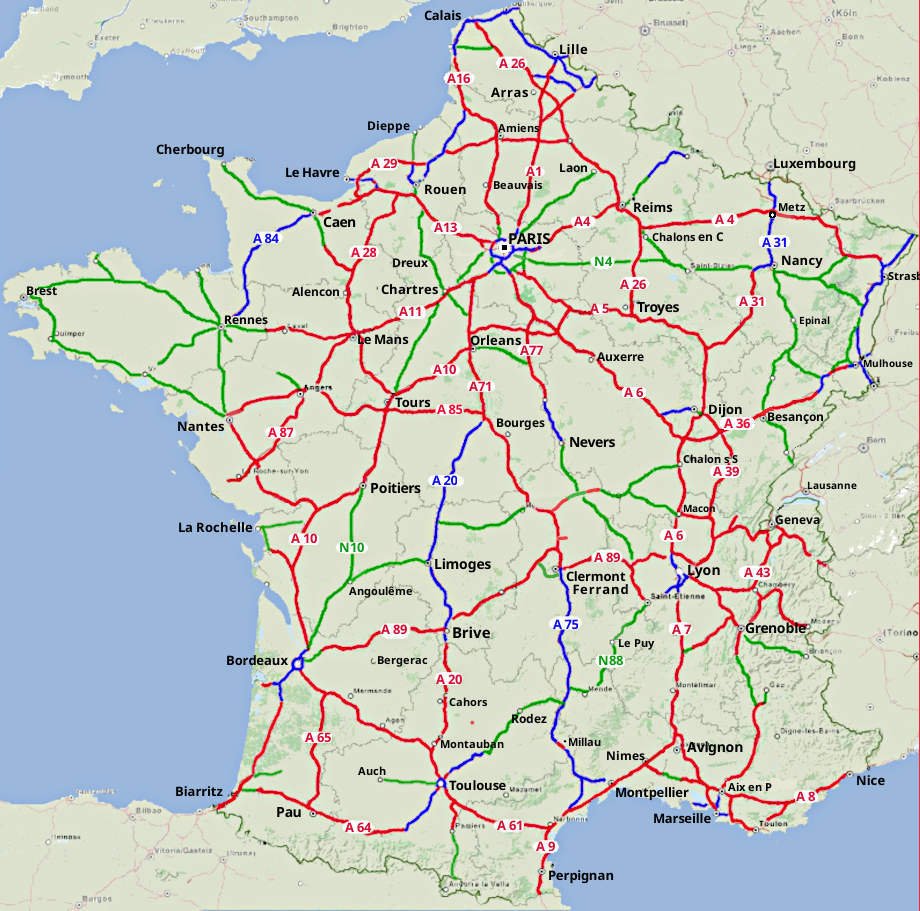
This latter case is curious, in that by that period, the construction of French bridges and roadways were both subject to State administration. (And with results that remain obvious even now. All roads may “lead to Rome,” but I suggest consulting a map of France to see just what a centralized imperial mobility network looks like.)
“But the fact remains that in the government agency in charge of bridges and roadways, roadways were under a well-centralized administration while bridges were still the object of active, dynamic and collective experimentation.” And this sets up a tasty parallel: the top-down, a priori, theorematic architects of Romanesque cathedrals are to road engineers what the “journeyman” masons feeling their way through what the stone wanted in the crafting of a Gothic cathedral are to bridgebuilders.
The methods employed by the engineers of bridges were unorthodox. And, again, multiple, horizontal and collective, to the point that “[director of the Ecole Nationale des Ponts et Cheussees Daniel-Charles] Trudaine organized unusual, open ‘general assemblies’ in his home.” (A quibble here: D&G claim Trudaine for the nomad lineage of bridge builders, but they might have more plausibly claimed the opposite, on the strength of the several thousand kilometers of royal routes he designed. Dang.)
What can we make of this “problematizing” spirit of curiosity, openness and collective experimentation, evidently surviving right at the pinnacle of the State’s own administration for the reticulation of the land? “What we wish to say...is that collective bodies always have fringes or minorities that reconstitute equivalents of the war machine — in sometimes quite unforseen forms — in specific assemblages such as building bridges or cathedrals, or rendering judgments, or making music, or
instituting a science, a technology...”
Now, as true as this may be empirically, it frankly strikes me as a little bit of a fudge factor. Having spent a few thousand words stressing the absolute exteriority of the war machine to the State, the utter outsideness and unknowability of nomad science to royal thought, D&G now tell us that we can find bits of these processes strewn throughout Empire if we know how to look for them. And we can imagine this, right? We can, because we’ve seen it.
Sometimes they take the form of inclusions, survivals, encapsulations. Sometimes their otherness is consciously put to work internally, even nurtured and encouraged, as red teams or OPFOR. Sometimes, indeed, the problematizing element resides in the echelon at the very top of the org chart: the renegade C-suite that has somehow set itself against the entire rest of the corporate body. I don’t want to make too much of this possibility, or, especially, romanticize it, but I do grant D&G’s premise.
How to square this seeming self-contradiction? Perhaps it is simply (as D&G would have it) that royal science can ultimately only leverage the products of nomad science, not its processes: “The State is perpetually producing and reproducing ideal circles, but a war machine is necessary to make something round.”
The gemlike little aphorism is as close to a koan as D&G ever get, which makes it an ideal place to break for tonight.
Tomorrow we’ll come back to the dense conversation leading up to that aphorism, which I’ve elided, and we’ll see if we can tease out what this all might mean.
In the meantime, you may enjoy this brief overview of the Ecole Nationale des Ponts et Cheussees...
https://www.inventionandtech.com/landmark_landing/80184
...and this road map of France, in which the centralized design of the network is made most obvious. All it’s missing is a little M. Bibendum with a beret. https://about-france.com/photos/maps/france-motorway-map.jpg
I want to back up a step, in continuing our investigation into “Nomadology” today. Yesterday, we’d wrapped up by opening up the question of how “fringes or minorities” upholding the war machine’s nomad science could possibly survive inside institutions of State, given the stress D&G place on their absolute exteriority. In explication, they offer the enigmatic aphorism, “The State is perpetually producing and reproducing ideal circles, but a war machine is necessary to make something round.”
And they follow this by observing that “the specific characteristics of nomad science are what need to be determined in order to understand both the repression it counters and the interaction ‘containing’ it.”
This passage seems, to me, to arc back toward the few pages immediately preceding it, rather than setting up the argument that follows, so my instinct is to dig back into those pages, and see if we can’t make them yield an accounting of what those “specific characteristics” are.
There’s a problem here, though — definitely in the ordinary sense, though hopefully in the Deleuzian sense as well — which is that this material is fairly opaque to me, in just the way D&G’s detractors so often accuse them of being.
For one thing, it starts by invoking Husserl, a writer whose oeuvre and general stance I have zero familiarity with. D&G tell us “he speaks of a protogeometry that addresses vague, in other words vagabond or nomadic, morphological essences...distinct from sensible
things, but also from ideal, royal or imperial essences” [emphasis in original]. The move here appears to be using Husserl’s phenomenology to open up a way of thinking about the relationship between the virtual and the real that blows through the familiar Platonic doctrine of form. The “essence,” here, is neither the actual thing itself nor the exact, perfect, ideal, transcendent form of royal science, but a mysterious, third thing: “anexact, but rigorous” [emphasis in original].
I interpret this to mean that the royal essence is theorematic, received from above, and in this way infertile, where the “vague essence,” this vagabond artifact and instrument of a counterscience, is perpetually generative — something that remains close to lived, contingent, adaptive practices of reckoning with space, and moving through it.
I confess to feeling a little lost here, though, a lostness which doesn’t simply turn on my manifest unfamiliarity with Husserl.