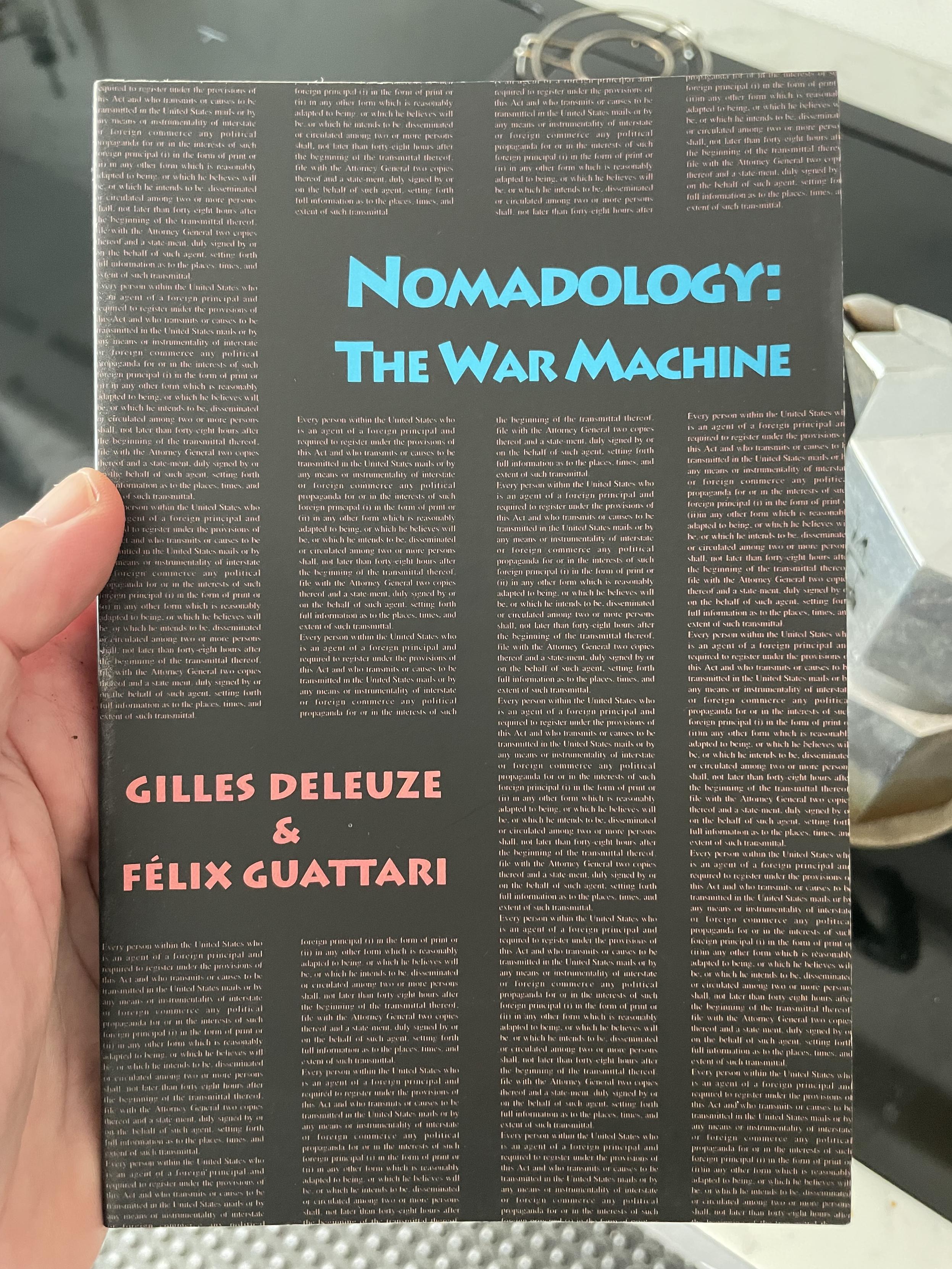
I got this down off the shelf because it’s relevant to one of the things I’m working on, and because – some 39 years after buying it and reading it for the first time – I feel like I’m finally in a position to understand and make use of it. Follow along with me, as I do a reasonably close reading of it here? It ought to be a fair amount of fun. #nomadology #deleuzeandguattari #deleuze #guattari
Post
Replies:
15
Here’s one last crystalline account of affect traversing the body: https://open.spotify.com/track/2JrMcWigCymlBNbnQp6YcN
See you tomorrow!
Ha! My partner, who’s not at all geekly in inclination, contributes her reading of “Dune” by way of “Nomadology”: the Houses of Atreides & Harkonnen as the two faces of State — Duke Leto Atreides no less a man of State than the twisted Baron; the Fremen as we meet them nearly pure avatars of the war machine, literally rising out of the smooth space of the desert to disrupt & destroy the Sardaukar; and the tragedy of the books, Muad’dib’s eventual reinscription of State logics amongst the Fremen.
That’s a pretty convincing reading, I tell you what! Makes me wanna read the three books (there are only three “Dune” books) again.
[I had to absorb both some good news and some difficult news today, so our reading of “Nomadology” will continue tomorrow! See you then.]
OK, we continue! We have discussed the war machine’s absolute exteriority to the State apparatus, and therefore the unthinkability of its driving dynamics for State thought. We now arrive at a second set of concerns, set off in the text as:
Problem 1: Is there a way of warding off the formation of a state apparatus (or its equivalents in a group)?
Proposition 2: The exteriority of the war machine is also attested to by ethnology (a tribute to the memory of Pierre Clastres).
And here we get into one of the most interesting, and certainly one of the most vexed, questions in the field of anthropology: how and why does the State arise in the first place, developmentally and historically?
There is a classic, linear developmental story for human sociation that D&G will refer to as “evolutionist,” and which retrograde thinkers like Jared Diamond still uphold. It goes like this, historically:
band → tribe → chiefdom → state.
This model was contributed by Elman Service, in his 1962 “Primitive Social Organization: An Evolutionary Perspective,” and it was basically the model I was taught in school. You were very likely raised on some version of Service’s schema, too: in the state of nature, human society was organized in small, mobile hunter-gatherer bands, with a high degree of egalitarianism and little to no formal division of labor. Or so the story goes.
Past some size, those bands that succeed become agricultural or pastoral societies. They settle in place, they develop hierarchy and fixed, stratified roles, and this allows them to begin generating the caloric surplus (and concomitant need for storage facilities, record-keeping technologies and specialists) that bring us to the threshold of the State. The rest, as they say, is history.
The trouble with this model isn’t merely that as the archeological record increasingly gets filled in, and our picture of the human past is rendered in higher and higher resolution, historical cases spring up that appear to confound this simplistic rubric. The problem is that it bears no resemblance to the account existing hunter-gatherer societies offer of their own choices, as the French anthropologist Pierre Clastres was among the first to point out, in his 1974 “Society Against The State.”
And indeed, for half a century or more there’s been a current within institutional anthropology that has called the linear, reductive Service model of societal development into sharp question: here’s where you’ll find Marshall Sahlins, Morton Fried, more recently James C. Scott and David Graeber. And what these writers have in common with Clastres is the insight that the State *is an option* — a conscious strategy that some groups embrace for what they think it can get them, and others do not.
Having accepted this, the clear implication is that there must be specific techniques that groups can employ to forestall the appearance of the nascent State, to prevent the emergence of even its progenitor or prototype institutions and mindsets. That’s where D&G start this second division of “Nomadology,” asking with Clastres “if it is not a concern of primitive [sic] societies to ward off or avert that monster they supposedly do not understand?”
And one answer they arrive at is clear: war.
This “surest mechanism directed against the formation of the State” works by “maintain[ing] the dispersal and segmentarity of groups,” preventing their agglomeration into entities that require the degree of specialization, stratification and institutionalization we associate with the onset of the State, but also preventing accumulations of personal power. We might expect this to be tempestuous — remember affect! — but the “collective mechanisms of inhibition” bound up in war “may be subtle.”
In fact, they may “function as micromechanisms,” operating at the level of small groups or even the individual subjectivity. The primary example D&G offer here is curious: drawn from the writing of Jacques Meunier, an obscure ethnographer whose work appears never to have been translated into English, it concerns mores among the street children of Bogotá. Meunier “cites three ways in which the leader” of a band or pack of such children “is prevented from acquiring stable power”: first, their


@adamgreenfield In Sartre's terminology this would be a development of the 'fused group' (for which his example is the crowd that took the Bastille), and his problem is how the fused group can maintain itself without degenerating into a bureaucracy.
@marinheiro Does Sartre discuss Canetti at all, I wonder?