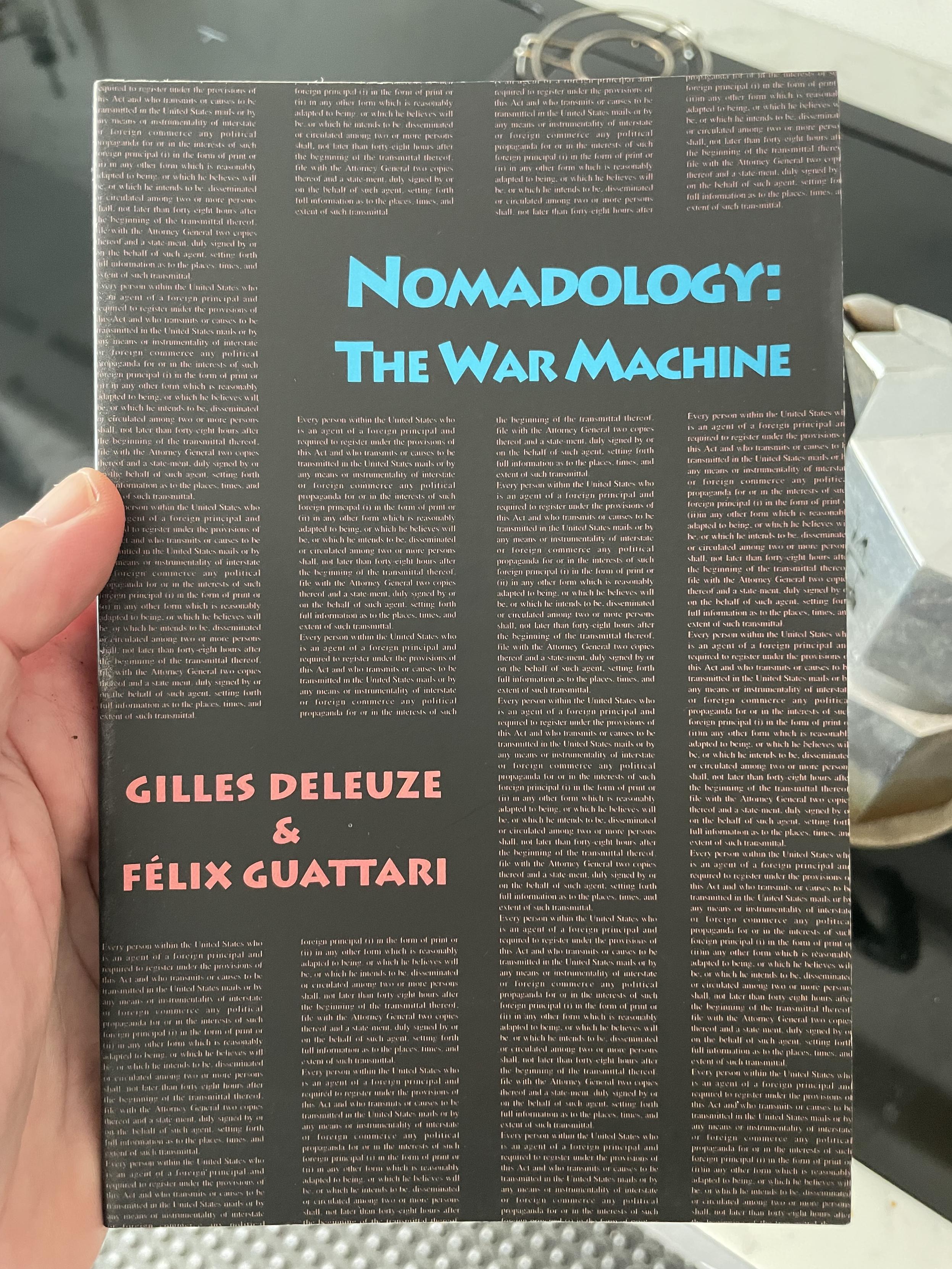
I got this down off the shelf because it’s relevant to one of the things I’m working on, and because – some 39 years after buying it and reading it for the first time – I feel like I’m finally in a position to understand and make use of it. Follow along with me, as I do a reasonably close reading of it here? It ought to be a fair amount of fun. #nomadology #deleuzeandguattari #deleuze #guattari
Post
Replies:
15
I’m sure those among you with a grounding in philosophy will pipe up at this point to correct/help me refine this understanding of exteriority & the outside, but let’s take what we have back to the context of “Nomadology,” where we’re told that we must “reach the point of conceiving the war machine as itself a pure form of exteriority.” That is to say: this roiling storm cannot be reduced to the State’s conception of it. It remains not merely external to control, but external to definition.
And D&G have already suggested why this is: because the State apparatus can only, helplessly, conceive of the world and its contents in terms of discrete states. It is static. The grandeur of its sovereign knowledge is of the order of statistics — quite literally state-istics. The war machine, however, is a continuous process of becoming.
The fundamental distinction between “being” & “becoming,” between object & process, is another that has a long pedigree in Western philosophy, going back to Parmenides and Heraclitus. Those of us coming at philosophical or theoretical writings from high above the plane of their ecliptic may need to encounter “becoming” a few dozen (or hundred) times before we quite twig to this — I’d only previously come across Parmenides in Phil Dick’s bonkers “Exegesis,” for example.
But just as a quick gloss, “becoming” (for me) connotes change, process, continuous flow — and, at times, a transition between states that cannot be broken down to the precession of discrete, Muybridgian intervals. The becomings that are most relevant for “Nomadology” are those associated with the figure of the war machine, and (especially in conjunction) they say more about D&G than they may have understood or intended: *becoming-animal* and *becoming-woman*.
This is all a lot to absorb, so let’s leave it there for today. See you tomorrow!
Notes: I mentioned Incite Seminars; you can (and should) find them at https://inciteseminars.com
PKD’s “Exegesis” can be found here, in its anguished entirety: https://archive.org/details/exegesisofphilip0000dick
Here’s a splendid example of what I mean when I invoke Muybridge:
https://www.metmuseum.org/art/collection/search/266429
Xenogothic is one post-Landian thinker whose extensive use of “the outside” may shed further light on the concept:
https://xenogothic.com/
Oh, by the way: a bunch of you have asked if it’s OK to share the link to this reading with friends.
Of course it is! It’s why I made the whole thing public in the first place. The conversation begins here: https://social.coop/@adamgreenfield/115084166276097771
PLEASE NOTE that there are a few places where Mastodon’s handling of very long threads seems to break down. If it seems like the discussion has come to a dead end…it hasn’t, though you may need to click around some.
So what are your thoughts, so far? Has this reading of “Nomadology” struck any sparks for you? Have you been able to put any of these concepts to work? I’d love to hear what you’re making of it, those of you who are following along.
OK, so: we continue. I want to leave the question of “becoming-animal” and “becoming-woman” here for the time being, and loop back to it later. What I want to take on right now is the propensity D&G can already see for the war machine — in all its exteriority or quality of absolute outsideness — to nevertheless “become confused with one of the two heads of the State apparatus.” In shifting light, or under conditions of (attempted or successful) capture by the State, we may mistake
certain qualities or attributes proper to the war machine for those belonging to one or another of the State’s cyclically alternating modes of domination. D&G offer the example of “speed and secrecy,” qualities par excellence of the war machine that are nevertheless occasionally found to be numbered among the State’s own tactics, albeit in the form of “a certain speed, a certain secrecy.” So “there is a great danger of identifying the structural relation between the two poles of political
sovereignty, and the dynamic interrelation of these two poles, with the power of war.” (Here Massumi helpfully provides the gloss of “puissance” for “power”: wotta great word.) And that danger consists precisely of forgetting that “the State has no war machine of its own: it can only appropriate one in the form of a military institution, one that will always cause it problems.” (Emphasis in original.)
I trust you can furnish any number of historical examples attesting to the truth of this:
for example, in the United States, the very extensive efforts gone to in order to produce a “professionalized” and nonpartisan military firmly yoked to civilian control and the notion of a supervening Constitution — efforts which are now being undone, with consequences that are readily foreseeable. I’m also put in mind, once again, of Lynn Margulis’s conception of the mitochondrion as something that once lived independently, and was subsumed as an engine by the eukaryotic cell lineage, though
there the process of subsumption appears to be total, irreversible and proceeding largely to the capturing agent’s advantage.
It’s still a useful metaphor, though: if the State wants to avail itself of the puissance and other productive properties of pure war, it has to envelop, encapsulate, absorb and appropriate the energies of a war machine. And almost without exception, this poses a continual challenge for the State that succeeds in this ambition.
D&G pivot here into a reasonably extended discussion of what this looks like in drama — specifically, in Heinrich von Kleist’s 1808 tragedy “Penthesilea.” (There’s that elite education rearing its head again.)
“Penthesilea” is the story of the queen of the Amazons, “a Stateless woman-people whose justice, religion, and loves are organized uniquely in a war mode,” and her encounter with Achilles at the battle of Troy. As D&G gloss that encounter, it is the titanic clash of being with becoming.
And we can almost draw ourselves a little matrix here, lining up the qualities associated with State apparatus and war machine respectively: being and interiority v. becoming and exteriority, and so on. But if Achilles, a man of State, has feelings, what equivalent does Penthesilea experience? The answer that D&G furnish us with is yet another of those theory-terms that overspills its conventional definition: they tell us that what traverses her body are affects.
I could probably spend two days posting about affect and the way it’s treated in contemporary philosophy and theory, and not exhaust the question. For now let’s conceive affect as the physical, indeed physiological component of emotion — the share that resists, exceeds or denies reason and language. For D&G, “[a]ffects transpierce the body, they are weapons of war.” These weapons have a specific function: they deterritorialize. When “feelings become uprooted from the interiority of a ‘subject,’