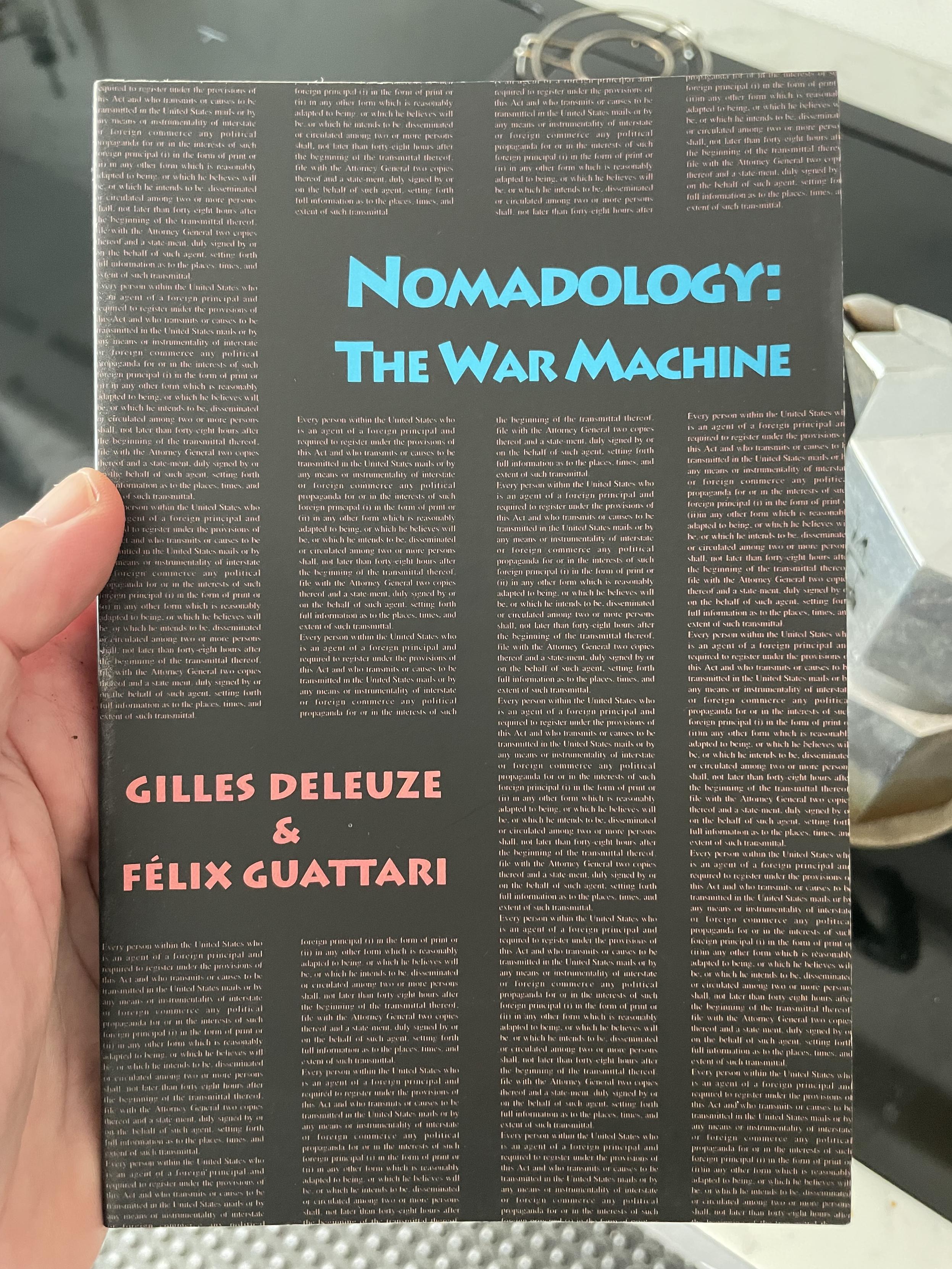
I got this down off the shelf because it’s relevant to one of the things I’m working on, and because – some 39 years after buying it and reading it for the first time – I feel like I’m finally in a position to understand and make use of it. Follow along with me, as I do a reasonably close reading of it here? It ought to be a fair amount of fun. #nomadology #deleuzeandguattari #deleuze #guattari
Post
Replies:
8


@adamgreenfield same feeling, I have that and red it way back when but only now do I think I have a hint of being able to take something useful and understood from it.
A couple of prefatory notes, by way of housekeeping: “Nomadology” is a chapter (or “plateau”) from “A Thousand Plateaus,” but I’ll be reading it as though it were a standalone offering; being equipped with only enough French to know when the subtitles on a film are terrible, I am necessarily reading translator Massumi’s “Nomadology”; and I don’t know what depth I’ll get into in posts or what kind of schedule I’ll be able to keep. Assume a reader with a magpie mind & little scholarly inclination.
So let’s get into it!
There’s very little in the way of front matter, only a sideways acknowledgment that this is an extract from a longer work, and no introduction to speak of. The very first lines that greet the reader are these:
“Axiom 1: The war machine is exterior to the State apparatus.
Proposition 1: This exteriority is first attested to in mythology, epic, drama and games.”
This is what’s known as “throwing the reader in at the deep end” (triply so if that reader is 17, self-taught but otherwise a product of American schooling, and struggling with what we’d now call “ADHD”). What could any of this possibly mean?

@adamgreenfield I also tried to read D&G too early for my own good
It’d be decades before anyone taught me to read for the text’s implicit ontology and epistemology, but we can already kinda see what the big chunky objects in play here are: the “State apparatus” – which I already had an instinctual anarchist’s antipathy for – and “the war machine,” which I was just about quick enough to realize they meant in something other than the literal, Black Sabbath “War Pigs” sense. And the latter occupied a relationship of exteriority to the former: it remained outside.


@adamgreenfield I might read along!