
Discussion
Loading...

Post

Log in
  • About
  • Code of conduct
  • Privacy
  • Users
  • Instances
  • About Bonfire
Corey S Powell
Corey S Powell
@coreyspowell@mastodon.social  ·  activity timestamp 5 months ago

Let's get this over with: Astronomers just found a new moon around Uranus.

It's part of an unusual group of 14 mini satellites orbiting close to the planet, within the orbit of its 1st major moon, Miranda. They may relate to the planet's rings & odd, sideways tilt.

https://science.nasa.gov/blogs/webb/2025/08/19/new-moon-discovered-orbiting-uranus-using-nasas-webb-telescope/ #space #science #nature #uranus
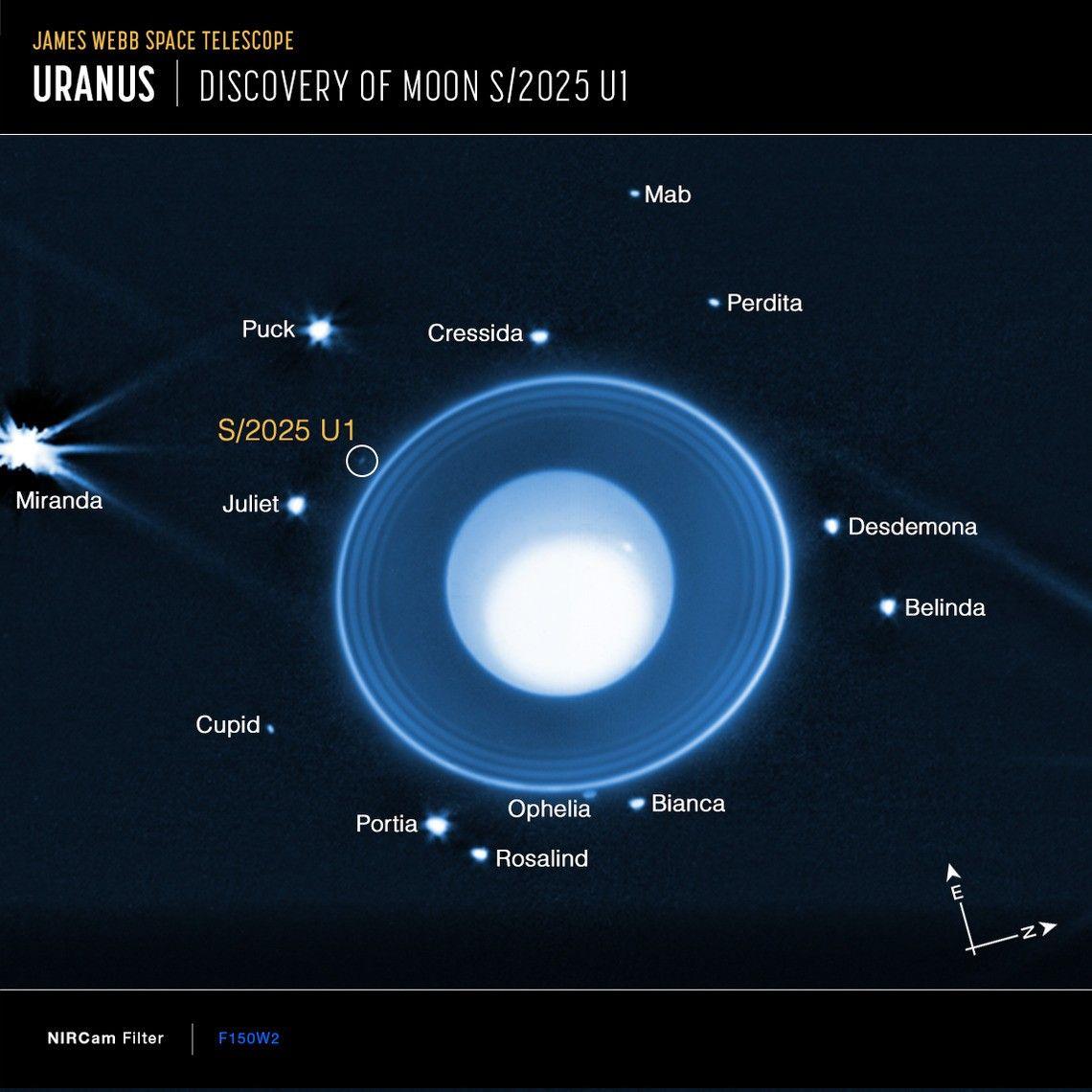
Astronomers using NASA’s James Webb Space Telescope discovered a new moon orbiting Uranus in images taken by Webb’s NIRCam (Near-Infrared Camera). This image shows the moon, designated S/2025 U1, as well as 13 of the 28 other known moons orbiting the planet. (The small moon Cordelia orbits just inside the outermost ring, but is not visible in these views due to glare from the rings.) Due to the drastic differences in brightness levels, the image is a composite of three different treatments of the data, allowing the viewer to see details in the planetary atmosphere, the surrounding rings, and the orbiting moons. The data was taken with NIRCam’s wide band F150W2 filter that transmits infrared wavelengths from about 1.0 to 2.4 microns.
  • Copy link
  • Flag this post
  • Block

bonfire.cafe

A space for Bonfire maintainers and contributors to communicate

bonfire.cafe: About · Code of conduct · Privacy · Users · Instances
Bonfire social · 1.0.1-beta.35 no JS en
Automatic federation enabled
Log in
  • Explore
  • About
  • Members
  • Code of Conduct