Panoramic view of Schönbrunn Palace seen from the elevated gardens, photographed in November 2002 in Vienna. The long, elegant yellow façade of the palace stretches across the center of the image, perfectly symmetrical, with the central pavilion and ceremonial entrance clearly visible. In front of the palace, the formal Baroque gardens unfold in precise geometric patterns of trimmed lawns, gravel paths, and hedges, with visitors walking along the avenues and gathering in small groups, giving a sense of scale. Dark evergreen trees and bare deciduous trees frame the lower foreground, emphasizing the late-autumn season. Behind the palace, the dense cityscape of Vienna rises, with rows of rooftops and church towers, including a tall Gothic spire standing out against the skyline. Above it all, a pale blue sky with light clouds adds a calm, open atmosphere.

Schönbrunn Palace was the summer residence of the Habsburg emperors and one of the most important imperial complexes in Europe. Much of the palace’s current Baroque appearance dates from the 18th century, especially the reign of Empress Maria Theresa. The gardens were carefully designed to reinforce symmetry, order, and imperial power, with elevated viewpoints like this one offering a commanding perspective over both the palace and the city beyond. This photograph captures the classic, postcard-like view of Schönbrunn, combining architectural grandeur with everyday life in Vienna.

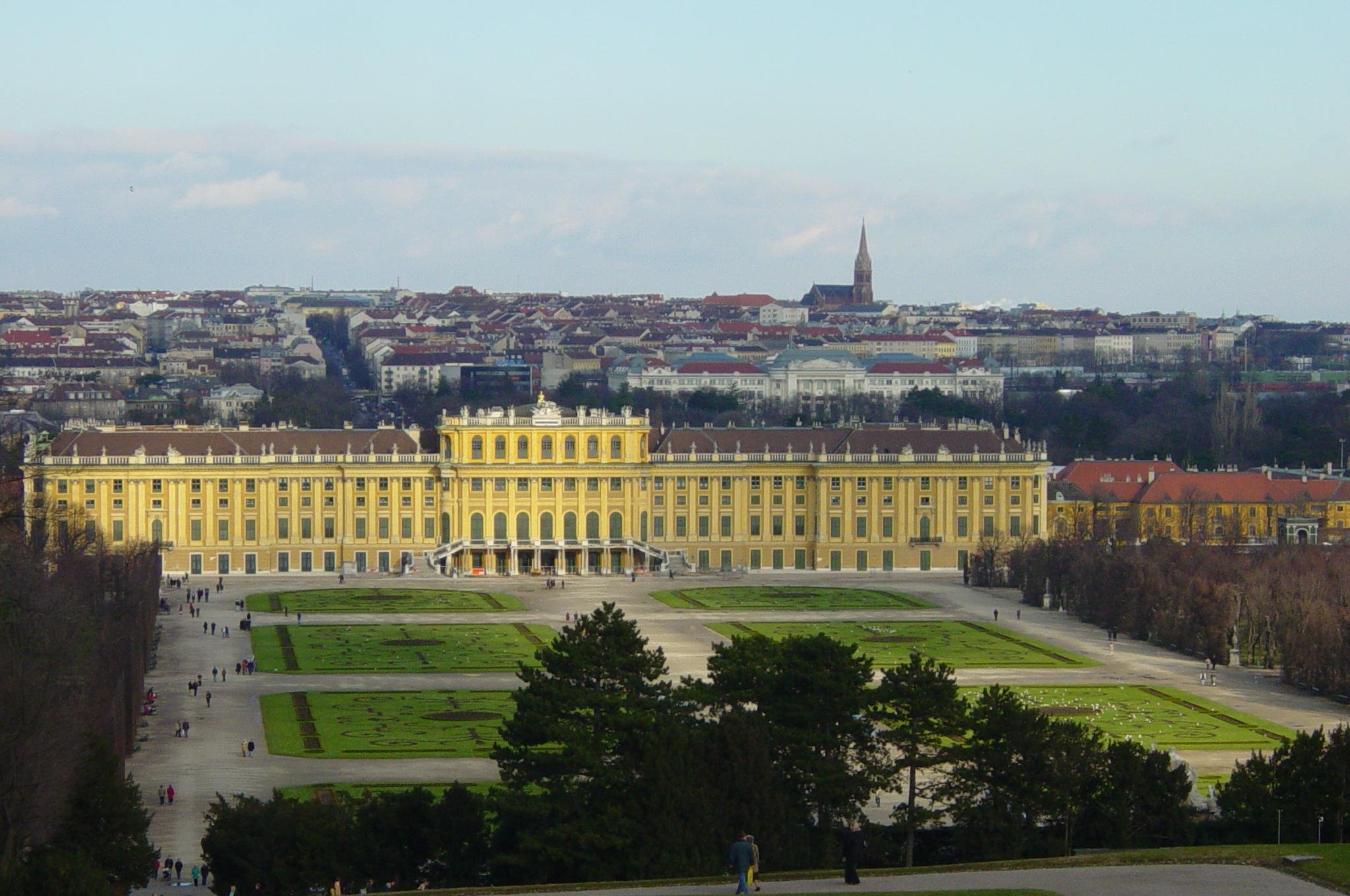
Panoramic view of Schönbrunn Palace seen from the elevated gardens, photographed in November 2002 in Vienna. The long, elegant yellow façade of the palace stretches across the center of the image, perfectly symmetrical, with the central pavilion and ceremonial entrance clearly visible. In front of the palace, the formal Baroque gardens unfold in precise geometric patterns of trimmed lawns, gravel paths, and hedges, with visitors walking along the avenues and gathering in small groups, giving a sense of scale. Dark evergreen trees and bare deciduous trees frame the lower foreground, emphasizing the late-autumn season. Behind the palace, the dense cityscape of Vienna rises, with rows of rooftops and church towers, including a tall Gothic spire standing out against the skyline. Above it all, a pale blue sky with light clouds adds a calm, open atmosphere. Schönbrunn Palace was the summer residence of the Habsburg emperors and one of the most important imperial complexes in Europe. Much of the palace’s current Baroque appearance dates from the 18th century, especially the reign of Empress Maria Theresa. The gardens were carefully designed to reinforce symmetry, order, and imperial power, with elevated viewpoints like this one offering a commanding perspective over both the palace and the city beyond. This photograph captures the classic, postcard-like view of Schönbrunn, combining architectural grandeur with everyday life in Vienna.
Panoramic view of Schönbrunn Palace seen from the elevated gardens, photographed in November 2002 in Vienna. The long, elegant yellow façade of the palace stretches across the center of the image, perfectly symmetrical, with the central pavilion and ceremonial entrance clearly visible. In front of the palace, the formal Baroque gardens unfold in precise geometric patterns of trimmed lawns, gravel paths, and hedges, with visitors walking along the avenues and gathering in small groups, giving a sense of scale. Dark evergreen trees and bare deciduous trees frame the lower foreground, emphasizing the late-autumn season. Behind the palace, the dense cityscape of Vienna rises, with rows of rooftops and church towers, including a tall Gothic spire standing out against the skyline. Above it all, a pale blue sky with light clouds adds a calm, open atmosphere.

Schönbrunn Palace was the summer residence of the Habsburg emperors and one of the most important imperial complexes in Europe. Much of the palace’s current Baroque appearance dates from the 18th century, especially the reign of Empress Maria Theresa. The gardens were carefully designed to reinforce symmetry, order, and imperial power, with elevated viewpoints like this one offering a commanding perspective over both the palace and the city beyond. This photograph captures the classic, postcard-like view of Schönbrunn, combining architectural grandeur with everyday life in Vienna.

Panoramic view of Schönbrunn Palace seen from the elevated gardens, photographed in November 2002 in Vienna. The long, elegant yellow façade of the palace stretches across the center of the image, perfectly symmetrical, with the central pavilion and ceremonial entrance clearly visible. In front of the palace, the formal Baroque gardens unfold in precise geometric patterns of trimmed lawns, gravel paths, and hedges, with visitors walking along the avenues and gathering in small groups, giving a sense of scale. Dark evergreen trees and bare deciduous trees frame the lower foreground, emphasizing the late-autumn season. Behind the palace, the dense cityscape of Vienna rises, with rows of rooftops and church towers, including a tall Gothic spire standing out against the skyline. Above it all, a pale blue sky with light clouds adds a calm, open atmosphere. Schönbrunn Palace was the summer residence of the Habsburg emperors and one of the most important imperial complexes in Europe. Much of the palace’s current Baroque appearance dates from the 18th century, especially the reign of Empress Maria Theresa. The gardens were carefully designed to reinforce symmetry, order, and imperial power, with elevated viewpoints like this one offering a commanding perspective over both the palace and the city beyond. This photograph captures the classic, postcard-like view of Schönbrunn, combining architectural grandeur with everyday life in Vienna.
Greg Lloyd boosted