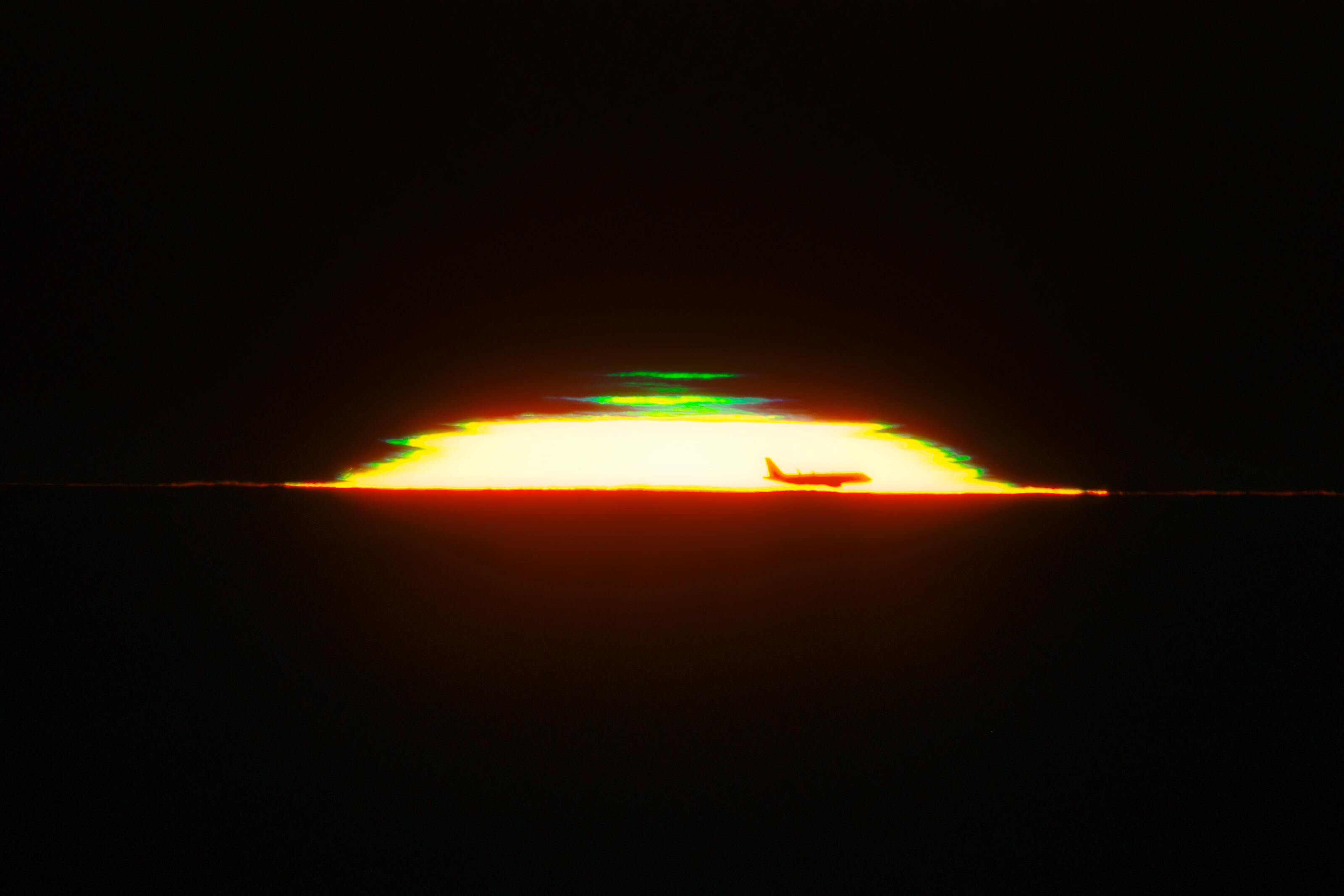
As the evening Sun fades from the viewpoint on Cerro Pachón, a green light peeks through. This phenomenon is known as a green flash, or green rim. The green is a result of atmospheric refraction as the Earth’s atmosphere separates white sunlight into its constituent wavelengths. Although a green rim is present at every sunset, there’s a good chance that you’ve never noticed it! It’s too thin to be seen by the naked eye, and only lasts a handful of seconds as the Sun slips past the horizon. Photography and videography are the best ways to capture the rare appearance of this atmospheric effect. While not a natural phenomenon, this image also serendipitously captures a soaring airplane against the fading sunlight.

This sunset was captured from Cerro Pachón in the Chilean Andes. Cerro Pachón is home to several telescopes operated by NOIRLab including the SOAR Telescope, a part of the U.S. National Science Foundation (NSF) Cerro Tololo Inter-American Observatory (CTIO), a Program of NSF NOIRLab; Gemini South, one half of the International Gemini Observatory, funded in part by the NSF; and NSF–DOE Vera C. Rubin Observatory, which is jointly funded by the NSF and the U.S. Department of Energy Office of Science (DOE/SC).

Petr Horálek, the photographer, is a NOIRLab Audiovisual Ambassador.

Credit: NOIRLab/NSF/AURA/P. Horálek (Institute of Physics in Opava)
As the evening Sun fades from the viewpoint on Cerro Pachón, a green light peeks through. This phenomenon is known as a green flash, or green rim. The green is a result of atmospheric refraction as the Earth’s atmosphere separates white sunlight into its constituent wavelengths. Although a green rim is present at every sunset, there’s a good chance that you’ve never noticed it! It’s too thin to be seen by the naked eye, and only lasts a handful of seconds as the Sun slips past the horizon. Photography and videography are the best ways to capture the rare appearance of this atmospheric effect. While not a natural phenomenon, this image also serendipitously captures a soaring airplane against the fading sunlight. This sunset was captured from Cerro Pachón in the Chilean Andes. Cerro Pachón is home to several telescopes operated by NOIRLab including the SOAR Telescope, a part of the U.S. National Science Foundation (NSF) Cerro Tololo Inter-American Observatory (CTIO), a Program of NSF NOIRLab; Gemini South, one half of the International Gemini Observatory, funded in part by the NSF; and NSF–DOE Vera C. Rubin Observatory, which is jointly funded by the NSF and the U.S. Department of Energy Office of Science (DOE/SC). Petr Horálek, the photographer, is a NOIRLab Audiovisual Ambassador. Credit: NOIRLab/NSF/AURA/P. Horálek (Institute of Physics in Opava)
As the evening Sun fades from the viewpoint on Cerro Pachón, a green light peeks through. This phenomenon is known as a green flash, or green rim. The green is a result of atmospheric refraction as the Earth’s atmosphere separates white sunlight into its constituent wavelengths. Although a green rim is present at every sunset, there’s a good chance that you’ve never noticed it! It’s too thin to be seen by the naked eye, and only lasts a handful of seconds as the Sun slips past the horizon. Photography and videography are the best ways to capture the rare appearance of this atmospheric effect. While not a natural phenomenon, this image also serendipitously captures a soaring airplane against the fading sunlight.

This sunset was captured from Cerro Pachón in the Chilean Andes. Cerro Pachón is home to several telescopes operated by NOIRLab including the SOAR Telescope, a part of the U.S. National Science Foundation (NSF) Cerro Tololo Inter-American Observatory (CTIO), a Program of NSF NOIRLab; Gemini South, one half of the International Gemini Observatory, funded in part by the NSF; and NSF–DOE Vera C. Rubin Observatory, which is jointly funded by the NSF and the U.S. Department of Energy Office of Science (DOE/SC).

Petr Horálek, the photographer, is a NOIRLab Audiovisual Ambassador.

Credit: NOIRLab/NSF/AURA/P. Horálek (Institute of Physics in Opava)
As the evening Sun fades from the viewpoint on Cerro Pachón, a green light peeks through. This phenomenon is known as a green flash, or green rim. The green is a result of atmospheric refraction as the Earth’s atmosphere separates white sunlight into its constituent wavelengths. Although a green rim is present at every sunset, there’s a good chance that you’ve never noticed it! It’s too thin to be seen by the naked eye, and only lasts a handful of seconds as the Sun slips past the horizon. Photography and videography are the best ways to capture the rare appearance of this atmospheric effect. While not a natural phenomenon, this image also serendipitously captures a soaring airplane against the fading sunlight. This sunset was captured from Cerro Pachón in the Chilean Andes. Cerro Pachón is home to several telescopes operated by NOIRLab including the SOAR Telescope, a part of the U.S. National Science Foundation (NSF) Cerro Tololo Inter-American Observatory (CTIO), a Program of NSF NOIRLab; Gemini South, one half of the International Gemini Observatory, funded in part by the NSF; and NSF–DOE Vera C. Rubin Observatory, which is jointly funded by the NSF and the U.S. Department of Energy Office of Science (DOE/SC). Petr Horálek, the photographer, is a NOIRLab Audiovisual Ambassador. Credit: NOIRLab/NSF/AURA/P. Horálek (Institute of Physics in Opava)
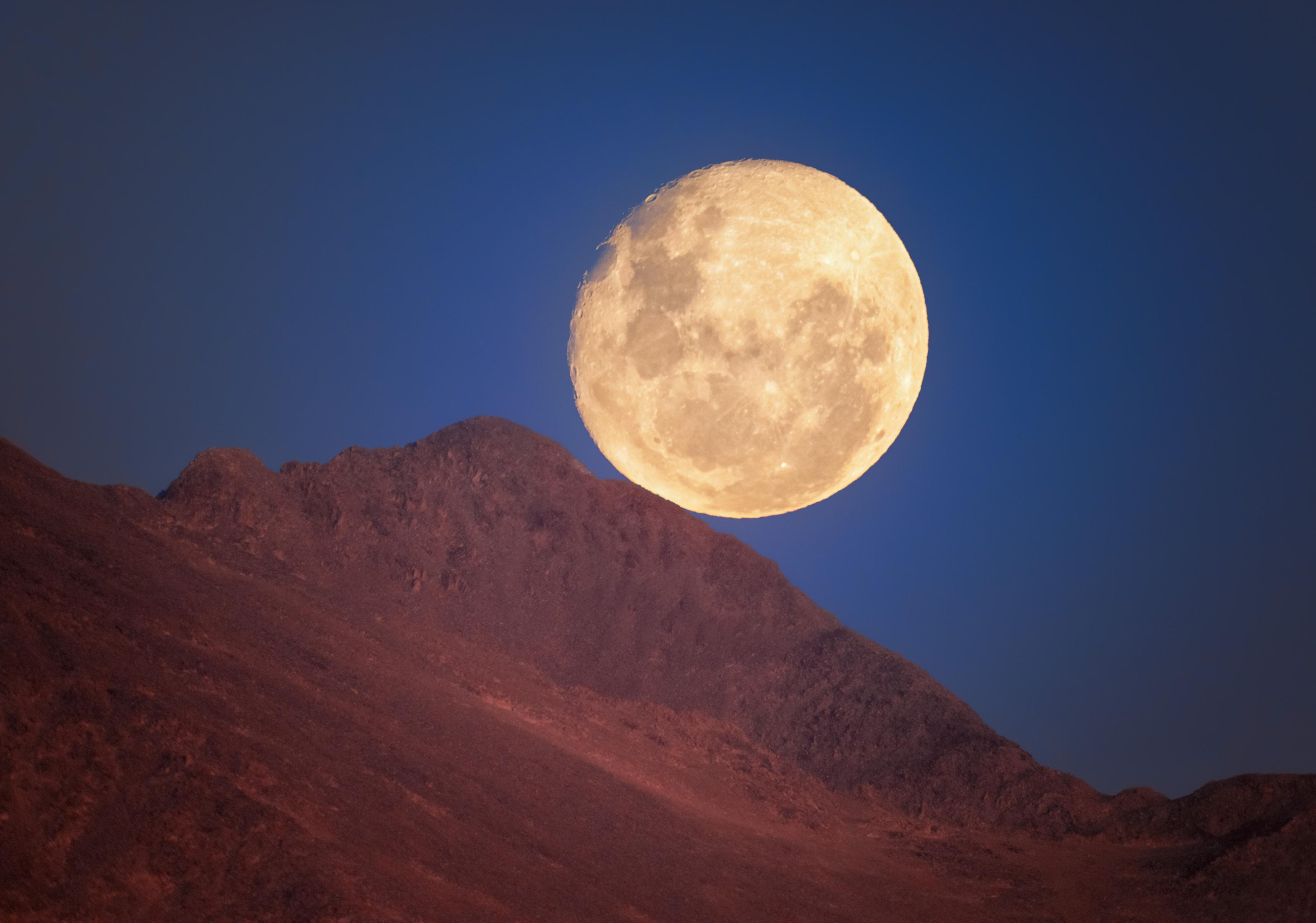
A gorgeous gibbous Moon rests above a ridge line near Cerro Pachón, the home of four NOIRLab-operated telescopes including NSF–DOE Vera C. Rubin Observatory; Gemini South, one half of the International Gemini Observatory, supported in part by NSF; and the SOAR Telescope of Cerro Tololo Inter-American Observatory, a Program of NSF NOIRLab.

The particular beauty of the Moon and its features are visible in this delightful image. The dark splotches of ancient, basaltic flats known as maria splatter across our satellite. These features formed when basalt moved from the lunar interior to fill basins on the surface during a time of active volcanism on the Moon. On the left side of the Moon, as seen from this perspective, are the two famous maria: Mare Tranquillitatis (immediately above center left) and Mare Serenitatis (center left). These maria, respectively, were the landing sites for the first and last human visits to the Moon.

On the upper left-hand edge of the Moon, the slopes and edges of the Moon’s other distinct feature, craters, appear starkly against the dark blue sky. One of the most distinct lunar craters, the massive Tycho crater, is in the upper right quadrant of the Moon in this image, flipped almost 180 degrees compared to the view from the northern hemisphere. Craters on the Moon are younger than the maria, and Tycho crater is particularly young, as evident by its sharp appearance.

A gorgeous gibbous Moon rests above a ridge line near Cerro Pachón, the home of four NOIRLab-operated telescopes including NSF–DOE Vera C. Rubin Observatory; Gemini South, one half of the International Gemini Observatory, supported in part by NSF; and the SOAR Telescope of Cerro Tololo Inter-American Observatory, a Program of NSF NOIRLab. The particular beauty of the Moon and its features are visible in this delightful image. The dark splotches of ancient, basaltic flats known as maria splatter across our satellite. These features formed when basalt moved from the lunar interior to fill basins on the surface during a time of active volcanism on the Moon. On the left side of the Moon, as seen from this perspective, are the two famous maria: Mare Tranquillitatis (immediately above center left) and Mare Serenitatis (center left). These maria, respectively, were the landing sites for the first and last human visits to the Moon. On the upper left-hand edge of the Moon, the slopes and edges of the Moon’s other distinct feature, craters, appear starkly against the dark blue sky. One of the most distinct lunar craters, the massive Tycho crater, is in the upper right quadrant of the Moon in this image, flipped almost 180 degrees compared to the view from the northern hemisphere. Craters on the Moon are younger than the maria, and Tycho crater is particularly young, as evident by its sharp appearance.