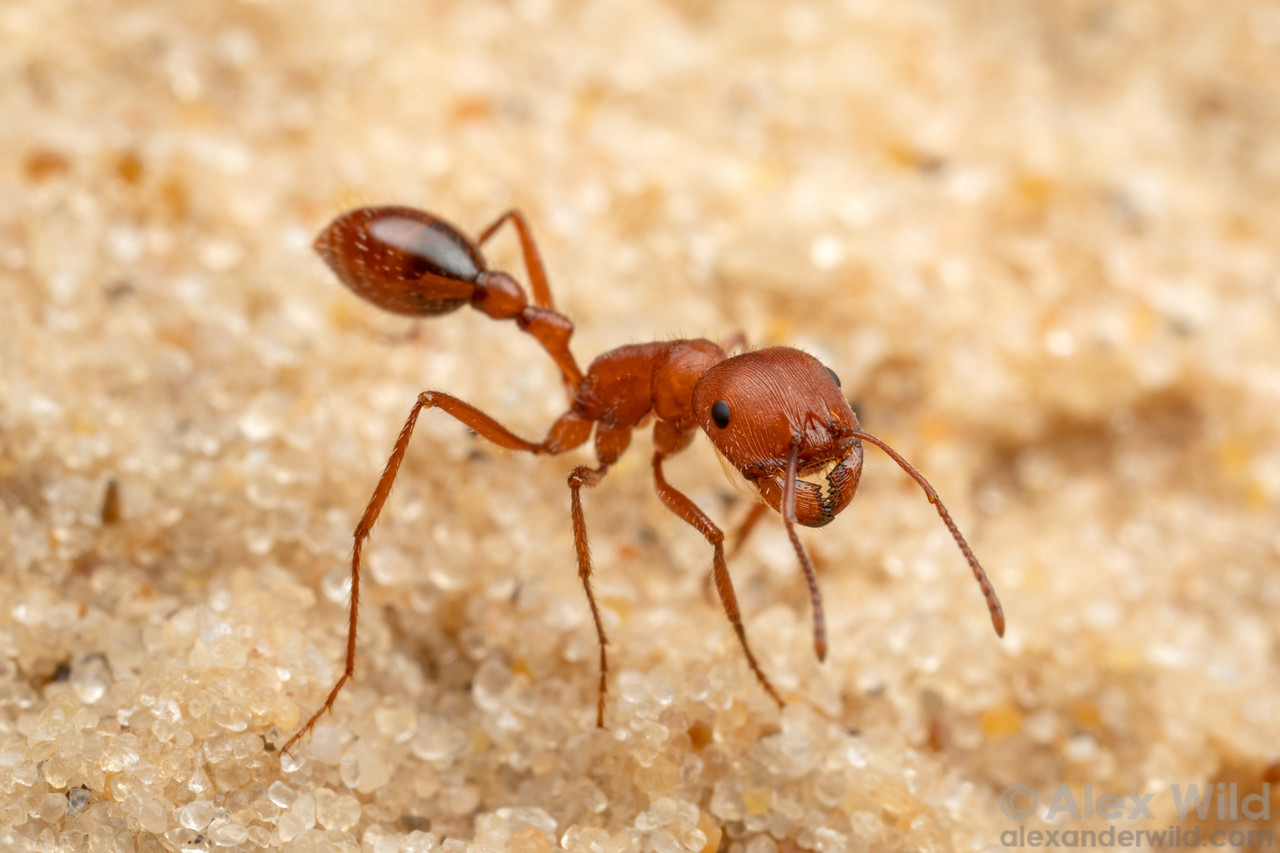
The genus name for American harvester ants, Pogonomyrmex, means "bearded ant", and it refers to a basket of hairs on the underside of the head that helps these desert ants carry dry sand.
Monahans Sandhills State Park, Texas.
#Tag
The genus name for American harvester ants, Pogonomyrmex, means "bearded ant", and it refers to a basket of hairs on the underside of the head that helps these desert ants carry dry sand.
Monahans Sandhills State Park, Texas.
This oughta really wind up the wingnuts.
"Living organisms are assumed to produce same-species offspring1,2. Here, we report a shift from this norm in Messor ibericus, an ant that lays individuals from two distinct species. In this life cycle, females must clone males of another species because they require their sperm to produce the worker caste. As a result, males from the same mother exhibit distinct genomes and morphologies, as they belong to species that diverged over 5 million years ago. The evolutionary history of this system appears as sexual parasitism3 that evolved into a natural case of cross-species cloning4,5, resulting in the maintenance of a male-only lineage cloned through distinct species’ ova. We term females exhibiting this reproductive mode as xenoparous, meaning they give birth to other species as part of their life cycle."
This oughta really wind up the wingnuts.
"Living organisms are assumed to produce same-species offspring1,2. Here, we report a shift from this norm in Messor ibericus, an ant that lays individuals from two distinct species. In this life cycle, females must clone males of another species because they require their sperm to produce the worker caste. As a result, males from the same mother exhibit distinct genomes and morphologies, as they belong to species that diverged over 5 million years ago. The evolutionary history of this system appears as sexual parasitism3 that evolved into a natural case of cross-species cloning4,5, resulting in the maintenance of a male-only lineage cloned through distinct species’ ova. We term females exhibiting this reproductive mode as xenoparous, meaning they give birth to other species as part of their life cycle."
"Living organisms are assumed to produce same-species offspring." You'd think this would be obvious and yet...the natural world. [2/]
#Eusociality#SocialInsects#Entomology#Formicidae#Evolution#ThrowYourBiologicalSpeciesConceptOutOfTheWindowNow#NatureRejectsTheRulebook