

Pescadero, CA, 2014
All the pixels, with none of the hypothermia or riptides at https://www.flickr.com/photos/mattblaze/14832380095
Incidentally. the metadata for this image claims it was captured at f/16. That's wrong; it was more like f/2.5 or so. This was an artifact of the too-clever-by-half way Leica M cameras estimate the f stop. There's no mechanical link between the aperture ring and the camera, so instead they estimate the f-stop with a separate light sensor that's compared with the brightness of the recorded image. This works reasonably well, except when you use an ND filter (as here), which confuses it to no end.
@mattblaze I take slight exception to the “works reasonably well" part of your statement. It is almost always wrong, sometimes by a lot. At least that's how it is on my M11. How wrong? Telling me I used f/1 on a (non Leica) f/2.8 lens. At least on a coded Leica lens the minimum reported aperture seems to be clamped to the minimum value.
@marchyman I dunno, I usually find it accurate to within one stop or so, but occassionally wildly wrong.
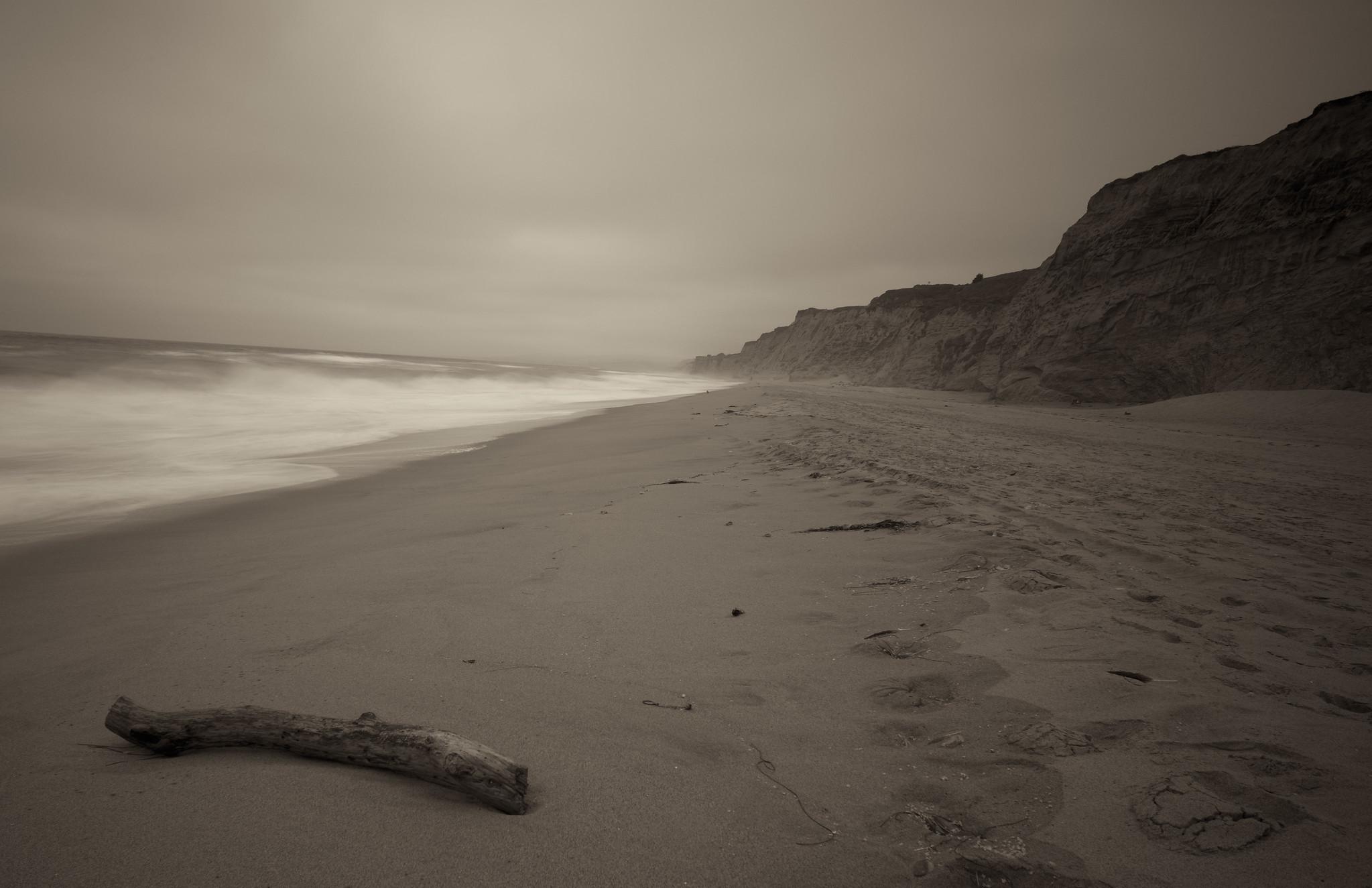



Captured with a small full-frame camera and 21mm lens. A three second exposure smoothed waves and surf.
This was an exercise in tone, perspective, and convergence. The four major boundaries of the scene converge (approximately) near the center of the frame, forming a flattened X.
I moved around and composed this both with and without the driftwood in foreground, which interrupts the composition but, I decided, is helpful to anchor the frame.