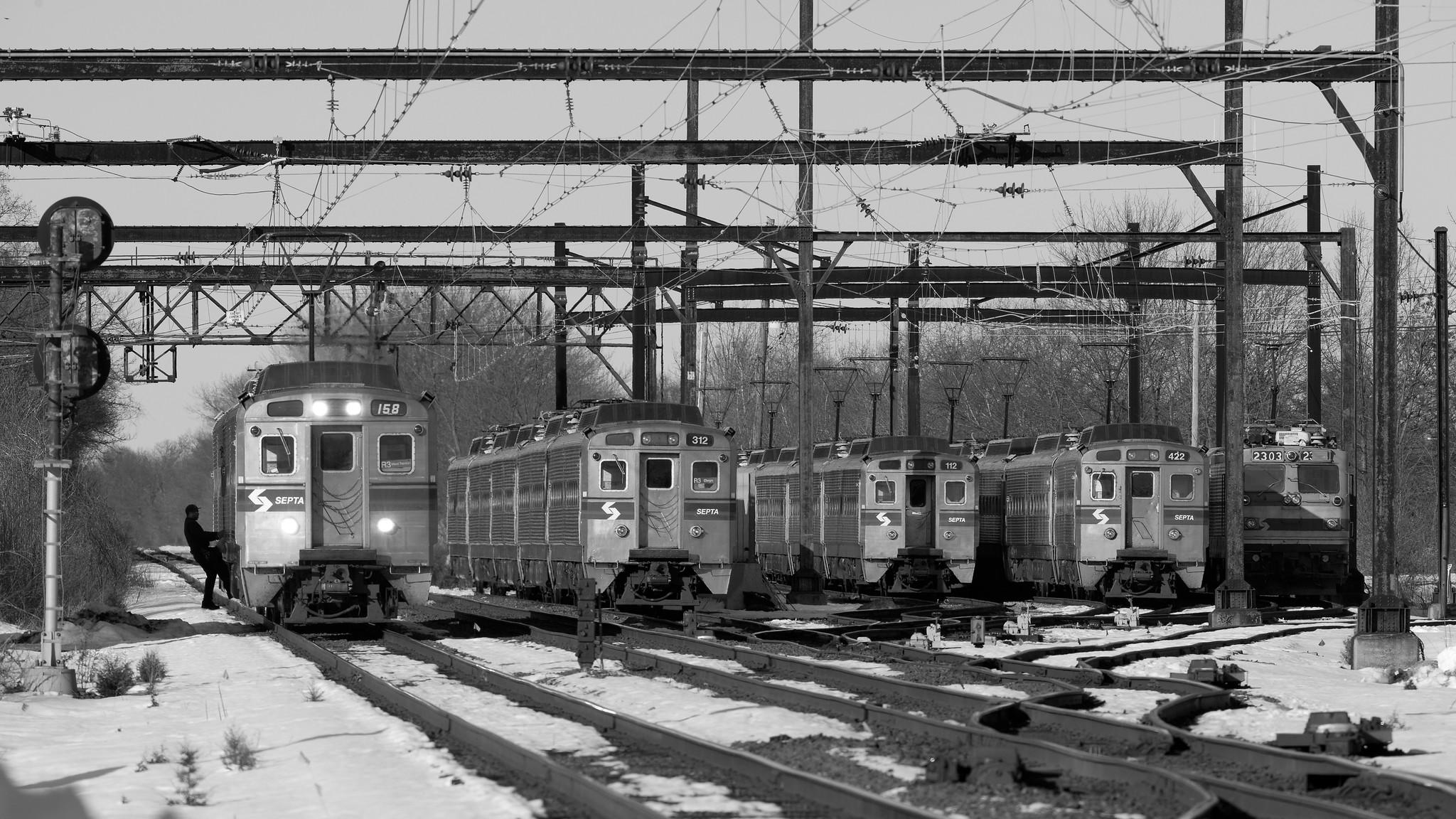

Commuter Trains, Ewing (West Trenton), NJ, 2010
All the pixels, reduced fare on weekends and off-peak hours, at https://www.flickr.com/photos/mattblaze/4377309058
Discussion
Commuter Trains, Ewing (West Trenton), NJ, 2010
All the pixels, reduced fare on weekends and off-peak hours, at https://www.flickr.com/photos/mattblaze/4377309058
This was captured with a DSLR and a 400mm/2.8 lens, which contributed to the compressed perspective. The conductor boarding the leftmost train is essential to the composition, I think.
Ewing, NJ ("West Trenton") is the last stop on SEPTA's commuter trains from Philadelphia on the former Reading Railroad's line to northern NJ. CSX freight trains still use the tracks north of the station, beyond the end of the overhead electrified wiring used for passenger service.
Very long lenses like the 400mm (and up), with their narrow field of view, are essential for some compositions (such as this one), but I find I only rarely actually use them. In fact, the longest lens I have for my main medium format camera system is 180mm (which yields the 35mm equivalent view of about a 120mm), and I hardly ever use even that for the most of the photography I do.
For wildlife photographers, on the other hand, 400mm is practically a wide angle.
One of the challenges of very long lenses is that they tempt you to compose images of subjects that are very far away. But the farther away something is, the more the atmosphere can distort the image. The effects of heat distortion, pollution, humidity, and weather are amplified across longer distances, no matter how sharp the lens is or how high resolution the sensor.
A quick and very pedantic note on long lens nomenclature:
Lenses with a narrow field of view and a long focal length (> ~90mm or so on 35mm cameras) are called, appropriately enough, "long" lenses.
Many, but not all, long lenses employ an optical design where their physical length is shorter than their optical focal length. These are called "telephoto" lenses. Most, but not all, telephoto lenses are long, and most, but not all, long lenses are telephoto. But he terms aren't interchangeable.
And none of this has anything to do with whether a lens is a "zoom", which refers to lenses with a focal length that can be varied across a range to achieve different angles of view without changing lenses. Many people casually use "zoom", "telephoto", and "long" interchangeably (usually when they just mean "long"), but that just confuses people who understand the technical meaning of those terms.
Also, fun fact, while zoom lenses today are very commonly used as a convenient alternative to multiple lenses in still photography, they were mostly developed for cinema, where "zooming" during a shot is an effect that can't be achieved without the ability to vary the focal length on the fly.
@mattblaze cropping photos taken at 400mm is pretty normal for my bird photos.
I’m carefully weighing up my options for 600+mm lenses but you quickly get into prices best compared with the price of a decent second hand car if you are too fussy.
@aimaz They've gotten a lot lighter lately, but not cheaper.

Install bonfire.cafe
Get the full app experience