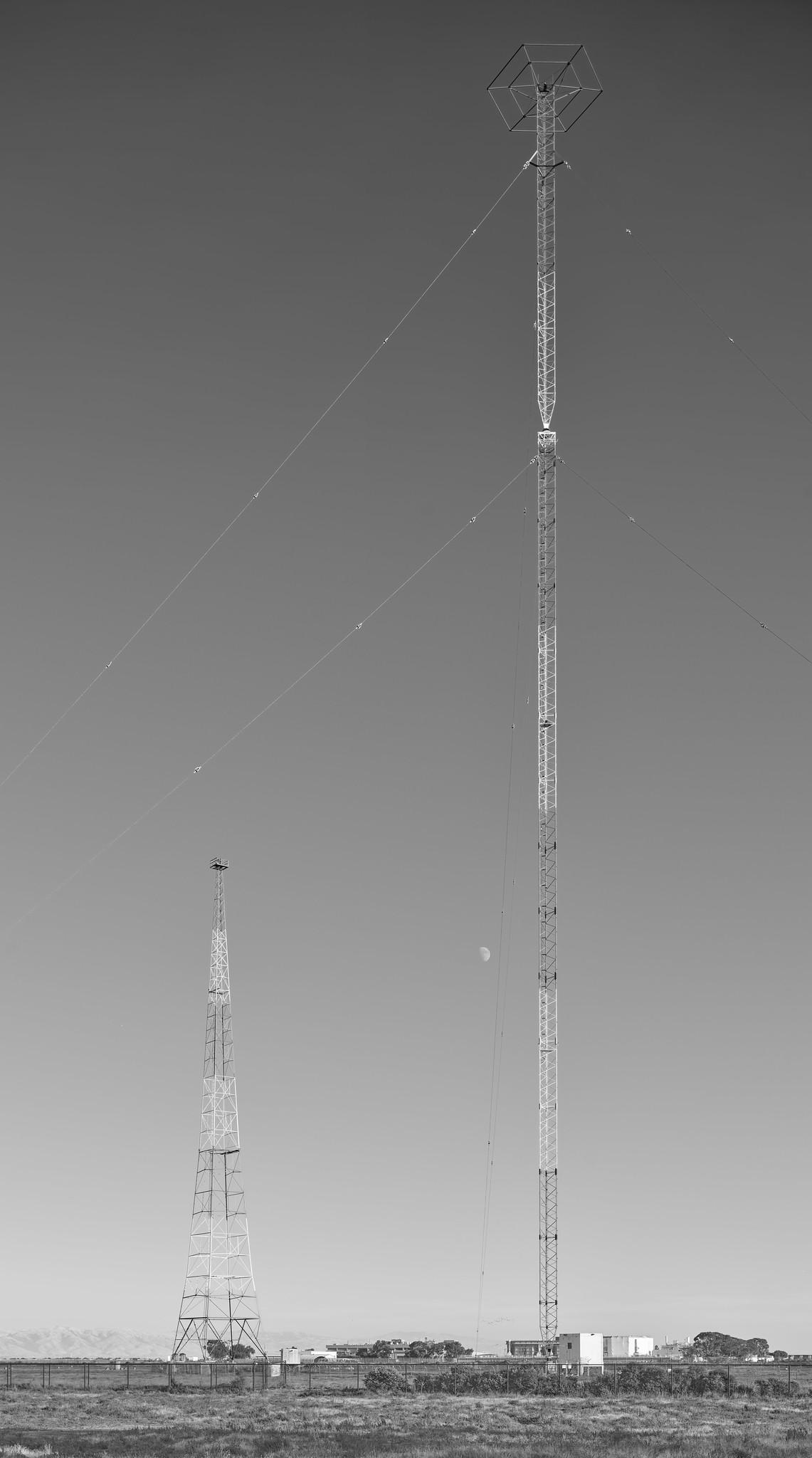
Redwood City, CA 10 November 2024 Rodenstock 50mm/4.0 HR Digaron-W lens (@ f/6.3), Phase One IQ4-150 digital back, Cambo 1250 camera (vertically shifted -23mm). The large amount of vertical shift required to keep the tall antenna mast fully in the frame while maintaining its geometry pushed the 50mm Rodenstock lens to the very limits of its image circle, Hard vignetting of the upper corners is visible in the full sensor image, but fortunately the composition benefited from a narrower aspect ratio that cropped out the blackened corners. KNBR is a 50KW "Class A" (formerly "clear channel") mediumwave (AM) rado station broadcasting on 680 KHz, serving the San Francisco Bay area (and, at night, most of the west coast of the US). Opened in 1922, It was originally known as KPO, (later KNBC, and still later KNBR), and soon became the flagship station for the National Broadcasting Company (NBC)'s western radio network. It is currently owned by Cumulus Media and broadcasts a sports format. Mediumwave (AM) broadcast radio uses lower frequencies than other kinds of modern broadcasting and so requires much larger antennas (generally getting larger and larger as the frequency gets lower on the dial). This often entails highly customized antenna designs engineered for the particular site and station frequencies. For most radio stations (FM, TV, etc), the towers are there simply to get the relatively small antennas up high, but for AM stations like KNBR, the towers generally ARE the antennas. The taller tower (550 feet) at right is the main KNBR antenna, built in 1949. It employs an unusual "pseudo-Franklin" design; it is actually an array of two antennas stacked one atop the other. The lower section, 400 feet tall, is insulated from the ground and fed from the bottom. It also carries a feedline to the upper 150 foot section, which is insulated from the lower section (visible as a narrowing of the tower just above the second set of guy lines from the top). The large (50 foot) diameter "capacitance hat" at the top (reminiscent of the famous Parachute Jump at Coney Island) electrically lengthens the top section to match the bottom, saving about 250 feet of additional height. This distinctive stacked dual antenna arrangement is used to lower the radiation angle of the antenna, concentrating transmitted power to the "ground wave" and reducing energy that would otherwise be sent upward into the sky. The smaller (300 foot) freestanding mast in the background left is not in current use but once had a FM broadcast antenna at its top. The tower can be used as an emergency spare antenna for KNBR during maintenance of the taller main antenna. The antenna is in the final approach and takeoff flightpath for SFO airport's runways 28L/R (and 10L/R), and so the site has special markings to warn pilots of a collision hazard. In addition to the usual tower lights and red/white paint, 3-dimensional "HAZ" warnings were installed around the field. These are easily visible in areal photos; see, e.g., earth.google.com/web/@37.5471204,-122.23429544,0.73120256...) No emulsions were harmed in the making of this image. P0003559