Discussion
Loading...

Discussion

Log in
  • About
  • Code of conduct
  • Privacy
  • Users
  • Instances
  • About Bonfire
Daniel Fischer
Daniel Fischer
@cosmos4u@scicomm.xyz  ·  activity timestamp last week

45 minutes til the simulated #ArtemisII launch, and according to https://www.youtube.com/watch?v=-KYhqePsm38 and https://www.nasa.gov/blogs/missions/2026/02/19/live-artemis-ii-wet-dress-rehearsal-coverage/ the 2ns wet dress rehearsal is going to plan. How the outcome will be reported: https://www.nasa.gov/news-release/nasa-to-provide-coverage-of-artemis-ii-wet-dress-rehearsal/

NASA

NASA to Provide Coverage of Artemis II Wet Dress Rehearsal

As NASA continues preparations for the Artemis II test flight, the agency will provide coverage Thursday, Feb. 19, of its next wet dress rehearsal, a fueling
NASA

LIVE: Artemis II Wet Dress Rehearsal Coverage

Live updates for the Artemis II wet dress rehearsal will be published on this page. Live views of the launch pad and test are available online. All times are
  • Copy link
  • Flag this post
  • Block
Daniel Fischer
Daniel Fischer
@cosmos4u@scicomm.xyz  ·  activity timestamp last week

JWST Discovers the Vertical Structure of #Uranus' Ionosphere: https://agupubs.onlinelibrary.wiley.com/doi/10.1029/2025GL119304 -> Webb maps the mysterious upper atmosphere of Uranus: https://esawebb.org/news/weic2602/ - Webb provides the first vertical view of the planet’s ionosphere, revealing auroras shaped by its tilted magnetic field.
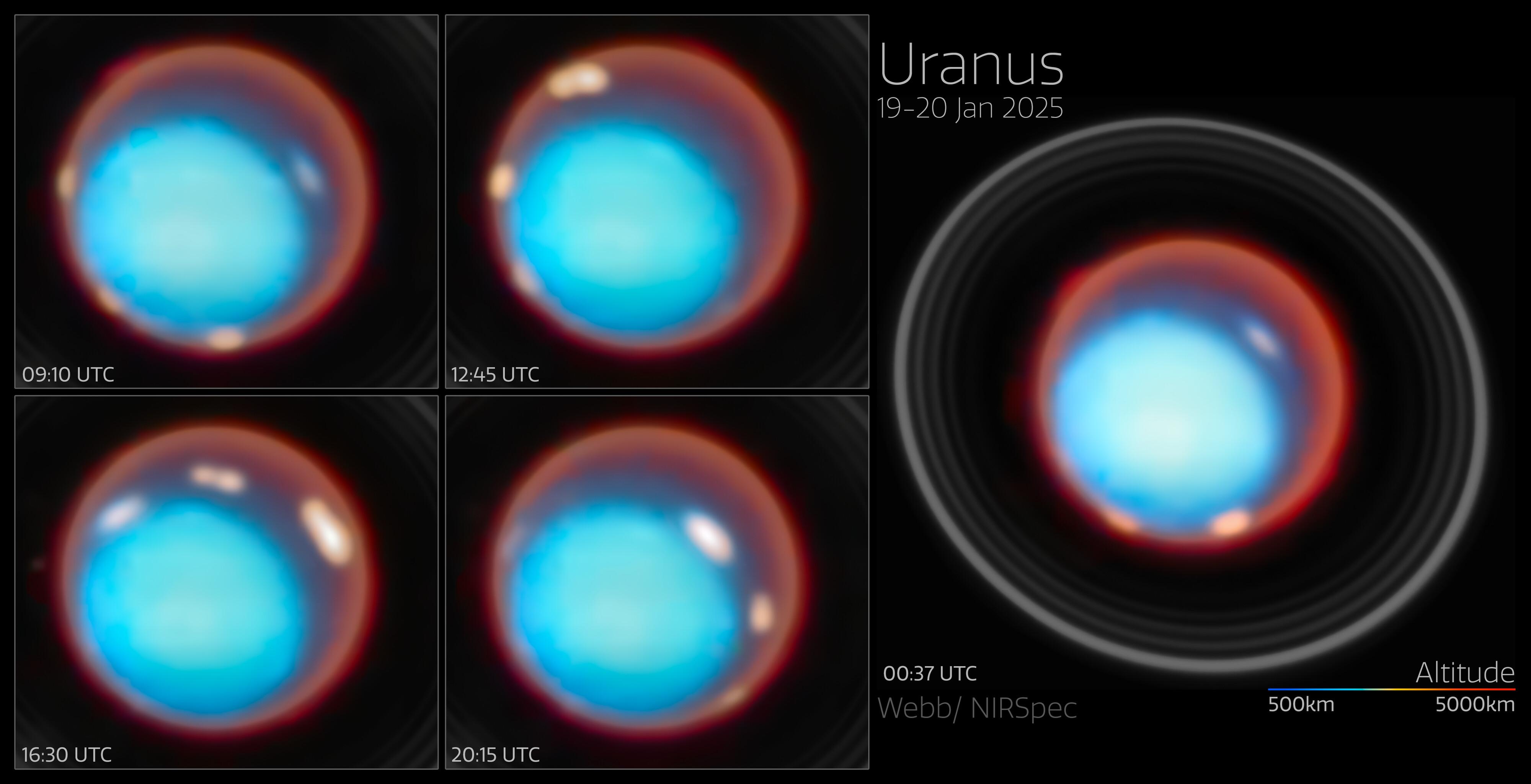

For the first time, an international team of astronomers have mapped the vertical structure of Uranus’s upper atmosphere, uncovering how temperature and charged particles vary with height across the planet. Using Webb’s NIRSpec instrument, the team detected the faint glow from molecules high above the clouds. These unique data provide the most detailed portrait yet of where the planet’s auroras form, how they are influenced by its unusually tilted magnetic field, and how Uranus’s atmosphere has continued to cool over the past three decades. The results offer a new window into how ice-giant planets distribute energy in their upper layers.
www.esawebb.org

Webb maps the mysterious upper atmosphere of Uranus - Webb provides the first vertical view of the planet’s ionosphere, revealing auroras shaped by its tilted magnetic field

For the first time, an international team of astronomers have mapped the vertical structure of Uranus’s upper atmosphere, uncovering how temperature and charged particles vary with height across the planet. Using Webb’s NIRSpec instrument, the team observed Uranus for nearly a full rotation, detecting the faint glow from molecules high above the clouds. These unique data provide the most detailed portrait yet of where the planet’s auroras form, how they are influenced by its unusually tilted magnetic field, and how Uranus’s atmosphere has continued to cool over the past three decades. The results offer a new window into how ice-giant planets distribute energy in their upper layers.
  • Copy link
  • Flag this comment
  • Block

bonfire.cafe

A space for Bonfire maintainers and contributors to communicate

bonfire.cafe: About · Code of conduct · Privacy · Users · Instances
Bonfire social · 1.0.2-alpha.34 no JS en
Automatic federation enabled
Log in
Instance logo
  • Explore
  • About
  • Members
  • Code of Conduct