Oh. Apparently I am "free bowel test" years old.
Thanks health.gov.au
hmmmmmm......................uncontested ownership of cores sounds silly, because we will generally want to maintain some kind of task-core local affinity (so virtual memory + i/o buffers from those tasks remains warm in per-core L1 cache).
this kind of structured locality is why we invented named i/o sync contexts for i/o state (and the transactional request=>commit model). so two questions arise here:
ok, found lots of keywords on wikipedia:
oh hell yes https://people.eecs.berkeley.edu/~culler/papers/fastsockets.pdf this is some top shelf ARPANET trash talk:
Current TCP/IP implementations use a complicated memory management mechanism.
they just made their own protocol. apparently you can do that
so this is kind of a horrifying cope to avoid just doing a microkernel but https://people.cs.uchicago.edu/~ftchong/290N-W12/isca92.pdf this is cited a million times and they do NOT fuck around when it comes to latency:
Tolerating communication latency has been raised as a fundamental architectural issue[1]; this is not
quite correct.
GODDAMN FUCKING RIGHT MOTHERFUCKER!
The real architectural issue is to provide the ability to overlap communication and computation,
which, in-turn, requires low-overhead asynchronous communication. Tolerating latency then becomes a
programming problem: a communication must be initiated sufficiently in advance of the use of its result.
IT'S LITERALLY THAT FUCKING SIMPLE!
See https://github.com/jqwik-team/jqwik/issues/708 for discussion about the "AI"-coding related changes to jqwik's reporting behaviour.
OpenMLS, our implementation of the Messaging Layer Security (MLS) protocol, has undergone a security audit conducted by @srlabs and sponsored by the @sovtechfund.
The security audit marks an important step toward making OpenMLS more secure. In this post, we share the results and take the opportunity to give a broader introduction to OpenMLS.
#GazaVerified campaigns that raised less than $200.0 in the past 7 days:
40. @maysaaelshamy8 ($0)
41. @mazuza ($0)
42. @mohanad22 ($0)
43. @monaashqer ($0)
44. @naeemafamily ($0)
45. @naem_hosaam ($0)
46. @nourgaza ($0)
47. @rana83 ($0)
48. @roba_1999 ($0)
49. @saiashshsh18@mastodon.social ($0)
50. @salemgaza ($0)
51. @sallyyii1_5566 ($0)
52. @savetoleen@mastodon.social ($0)
(4/15)
#GazaVerified campaigns that raised less than $200.0 in the past 7 days:
53. @shahedgaza ($0)
54. @shimaqassas ($0)
55. @sireen123@mastodon.social ($0)
56. @tallalnaser1990 ($0)
57. @usama971 ($0)
58. @feras1@mastodon.tn ($0)
59. @Saveeleen ($0)
60. @abedashour ($0)
61. @Omsham ($0)
62. @saja@mstdn.social ($0)
63. @samarsh ($0)
64. @maram4 ($5)
65. @soma23 ($5)
66. @alaamoh@mastodon.social ($6)
(5/15)
Orange County leaders say previously evacuated area is safe. Experts say risks still linger
https://www.latimes.com/environment/story/2026-05-26/orange-county-leaders-say-previously-evacuated-area-is-safe-experts-say-risks-still-linger?utm_source=flipboard&utm_medium=activitypub
Posted into Science @science-LATimes

The Solutions are Already Here
Are alternative energies and Green New Deals enough to deliver environmental justice? Peter Gelderloos argues that international governmental responses to the climate emergency are structurally incapable of solving the crisis. But there is hope.
Across the world, grassroots networks of local communities are working to realise their visions of an alternative revolutionary response to planetary destruction, often pitted against the new megaprojects promoted by greenwashed alternative energy infrastructures and the neocolonialist, technocratic policies that are the forerunners of the Green New Deal.
Gelderloos interviews food sovereignty activists in Venezuela, Indigenous communities reforesting their lands in Brazil and anarchists fighting biofuel plantations in Indonesia, looking at the battles that have cancelled airports, stopped pipelines, and helped the most marginalised to fight borders and environmental racism, to transform their cities, to win a dignified survival.
La España que arde cuando alguien dice que el fascismo asesinó a Lorca por maricón
https://www.eldiario.es/cultura/espana-arde-alguien-dice-fascismo-asesino-lorca-maricon_129_13251683.html?utm_source=flipboard&utm_medium=activitypub
Publicado en Cultura @cultura-eldiarioes
RE: https://flipboard.com/@ctvnews/saskatoon-4fq5e2plz/-/a-GTTh_FcYTDmkQDDeVZSlBg%3Aa%3A2823982346-%2F0
Women, so demanding. First, they want to vote (achieved in 1916). Then they get elected (achieved in 1919). And then they want somewhere to pee (we're waiting on that one).
The government is moving forward with a housing plan that aims to displace thousands of Palestinians from Bedouin communities in the E1 area.
link to the report in the comments.
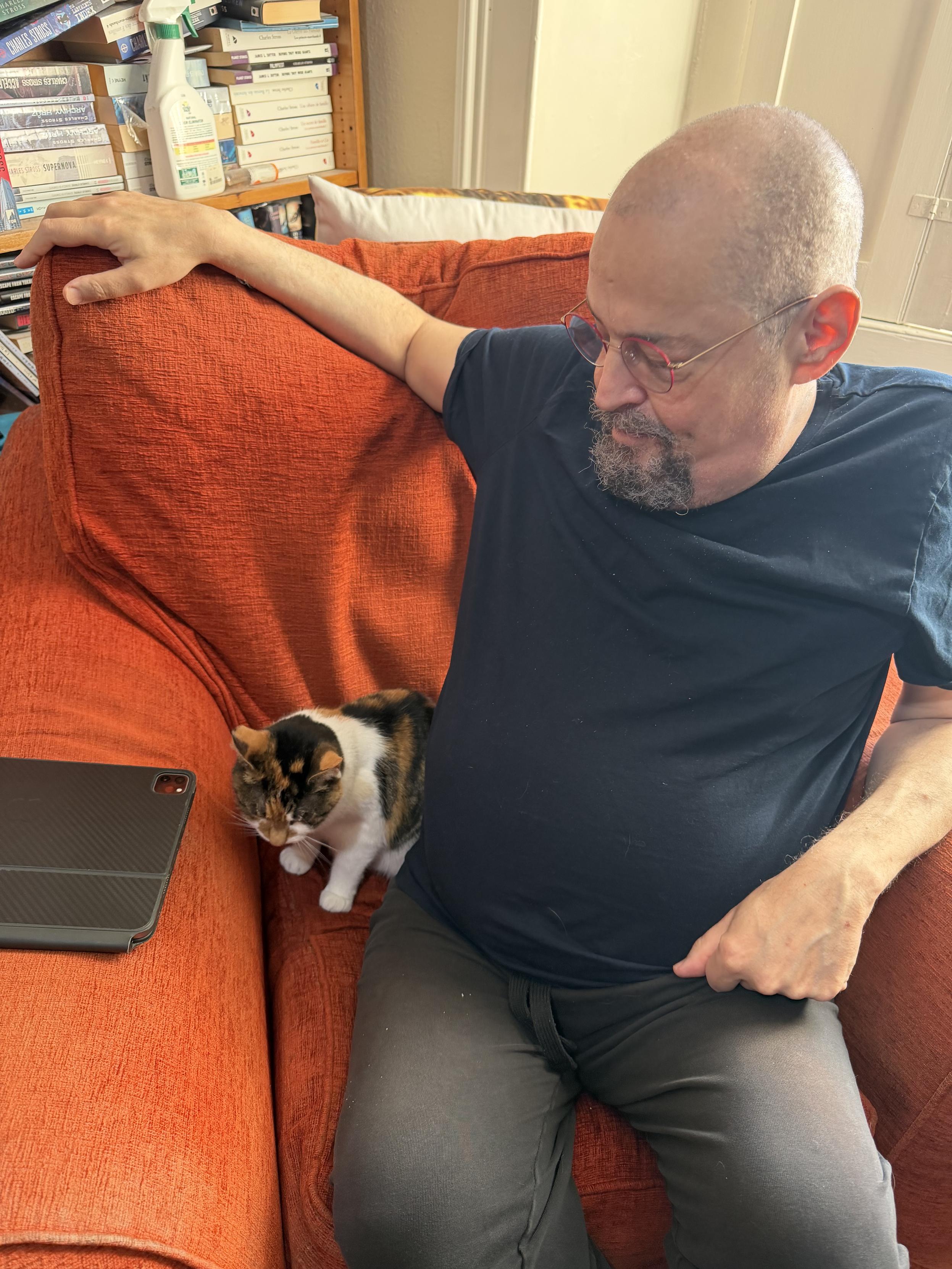
Rude @cstross tried to sit on my chair! I was here first.
The trick to avoid duplicating everything: the relay keeps one shared copy of incoming activities, and each device tracks where it is in it on its own. Nothing is lost when a device comes back online. Actions done on one device (likes, follows, posts...) sync to the others through the relay. When a device replies to an activity, it checks first that another one didn't already handle it, to avoid doubles or conflicts.
(2/3)
The relay only knows each device by a generated ID and a name. It relays activities but doesn't hold your keys or followers. When signing in on a new device, the app will offer to scan a QR code from the first one to share the account key, with safeguards against ending up with the same account but new keys and no data. It will be possible to see which devices are attached and online, with options to rename or revoke. Work on the relay side is complete, the app side is nearly there.
(3/3)

Slow Down
Why, in our affluent society, do so many people live in poverty, without access to health care, working multiple jobs and are nevertheless unable to make ends meet, with no future prospects, while the planet is burning?
In his international bestseller, Kohei Saito argues that while unfettered capitalism is often blamed for inequality and climate change, subsequent calls for “sustainable growth” and a “Green New Deal” are a dangerous compromise. Capitalism creates artificial scarcity by pursuing profit based on the value of products rather than their usefulness and by putting perpetual growth above all else. It is therefore impossible to reverse climate change in a capitalist society—more: the system that caused the problem in the first place cannot be an integral part of the solution.
Instead, Saito advocates for degrowth and deceleration, which he conceives as the slowing of economic activity through the democratic reform of labor and production. In practical terms, he argues for:
By returning to a system of social ownership, he argues, we can restore abundance and focus on those activities that are essential for human life, effectively reversing climate change and saving the planet.

Half-Earth Socialism
Over the next generation, humanity will confront a dystopian future of climate disaster and mass extinction. Yet the only ‘solutions’ on offer are toothless cap-and-trade programmes, catastrophic geoengineering schemes, and privatized conservation, which will do nothing to reverse the damage suffered by the biosphere. Indeed, these mainstream approaches assume that hyper-consumerism in the Global North can continue unabated. It can’t.
What we can do, environmental scholars Troy Vettese and Drew Pendergrass argue, is strive for a society able to ensure high living standards while stabilizing the environment: Half-Earth socialism. This means:
• Rewilding half the earth to absorb carbon emissions and restore biodiversity • A rapid transition to renewable energy, paired with drastic cuts in consumption by the world’s wealthiest • Global veganism to cut down on energy and land use • Worldwide socialist planning to efficiently and equitably manage production • The involvement of everyone—even you!
As this thrilling and provocative book makes clear, we must humbly accept that humanity cannot fully understand or control the earth—but we can plan new energy systems, large-scale rewilding, and food production for the common good.
git-ai-project / git-ai: A Git extension for tracking the AI-generated code in your repos ★1959 https://github.com/git-ai-project/git-ai
@jawnsy @pluralistic They pure done got Pichai'd and Nadella'd like they got Corzine'd 2 decades ago nearly!
There's a YouTuber that uses the names of top US administration officials to redact the swears in his subtitles. They go by so fast it took me a while to notice, but it cracks me up every time I see it.
Kuunkehän kirjatraileri nyt nähtävissä Peertubessa!
#Kuunkehä #RoyaumenAikakirjat #Kirjamastodon #Kirjafedi #Kirjatraileri
https://makertube.net/w/pRL7UDNzZ2Kqt9h97LsFWJ
III. The differences between machine and organismic function can be explained through the dynamic organization of a self-manufacturing cell or organism, which stands in stark contrast to the static architecture/blueprint of a machine. The fact that all the essential processes in a living system collectively co-constitute each other, renders their functional capacities open-ended, while machines (by design) come with (potentially large but) precisely defined spaces of possible behaviors. /4
In conclusion: assuming that the Ship of Theseus (a perfectly valid philosophical argument) and the substitution thought experiment (for either the brain or our whole body) are analogous is a logical fallacy. More precisely, it is a category error. We are comparing apples with oranges, and the idea that we can simply swap organic components for machine parts does not hold up to closer scrutiny.
Computationalism is not backed by evidence, but it is also not backed by logical reasoning. /5