Slow Down

The Degrowth Manifesto

Edition
288 pages
Published in 2024 by Astra House

Why, in our affluent society, do so many people live in poverty, without access to health care, working multiple jobs and are nevertheless unable to make ends meet, with no future prospects, while the planet is burning?

In his international bestseller, Kohei Saito argues that while unfettered capitalism is often blamed for inequality and climate change, subsequent calls for “sustainable growth” and a “Green New Deal” are a dangerous compromise. Capitalism creates artificial scarcity by pursuing profit based on the value of products rather than their usefulness and by putting perpetual growth above all else. It is therefore impossible to reverse climate change in a capitalist society—more: the system that caused the problem in the first place cannot be an integral part of the solution.

Instead, Saito advocates for degrowth and deceleration, which he conceives as the slowing of economic activity through the democratic reform of labor and production. In practical terms, he argues for:

  • the end of mass production and mass consumption
  • decarbonization through shorter working hours
  • the prioritization of essential labor over corporate profits

By returning to a system of social ownership, he argues, we can restore abundance and focus on those activities that are essential for human life, effectively reversing climate change and saving the planet.

Slow Down

The Degrowth Manifesto

Edition
288 pages
Published in 2024 by Astra House

Why, in our affluent society, do so many people live in poverty, without access to health care, working multiple jobs and are nevertheless unable to make ends meet, with no future prospects, while the planet is burning?

In his international bestseller, Kohei Saito argues that while unfettered capitalism is often blamed for inequality and climate change, subsequent calls for “sustainable growth” and a “Green New Deal” are a dangerous compromise. Capitalism creates artificial scarcity by pursuing profit based on the value of products rather than their usefulness and by putting perpetual growth above all else. It is therefore impossible to reverse climate change in a capitalist society—more: the system that caused the problem in the first place cannot be an integral part of the solution.

Instead, Saito advocates for degrowth and deceleration, which he conceives as the slowing of economic activity through the democratic reform of labor and production. In practical terms, he argues for:

  • the end of mass production and mass consumption
  • decarbonization through shorter working hours
  • the prioritization of essential labor over corporate profits

By returning to a system of social ownership, he argues, we can restore abundance and focus on those activities that are essential for human life, effectively reversing climate change and saving the planet.

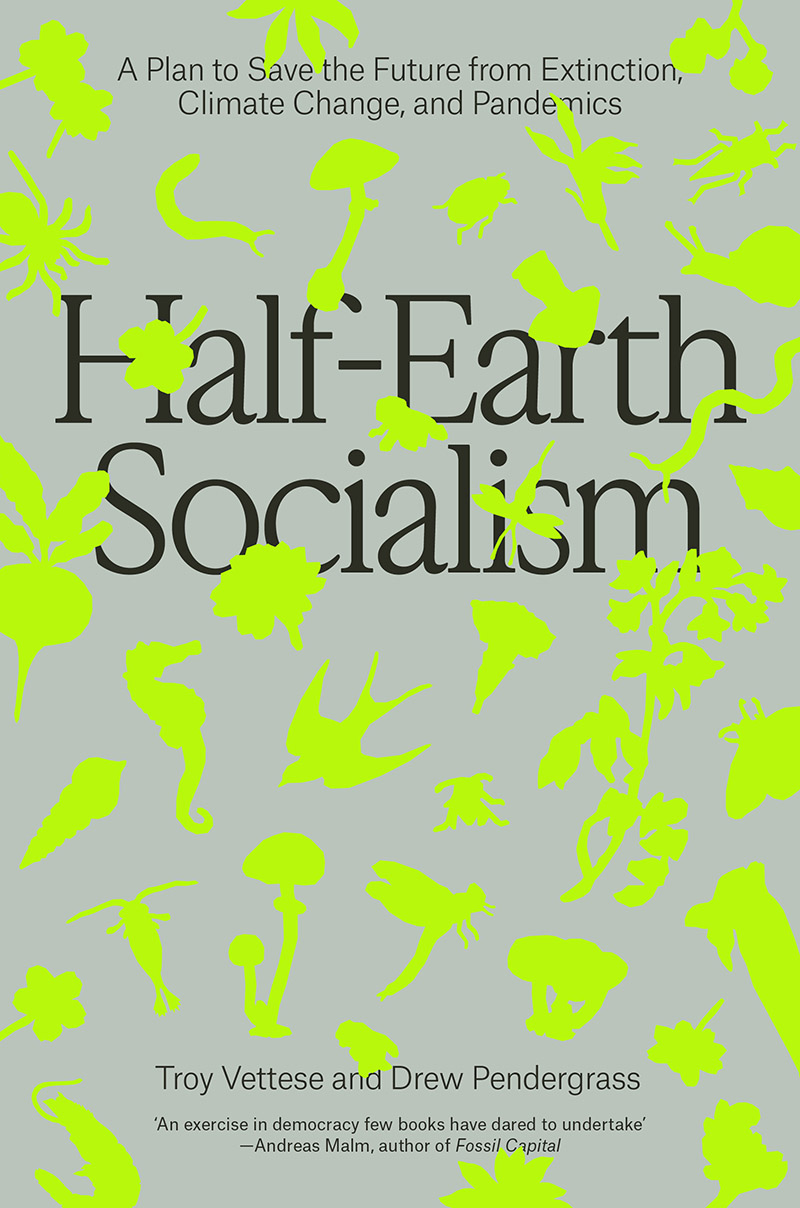
Half-Earth Socialism

A Plan to Save the Future from Extinction, Climate Change and Pandemics

Paperback Edition
240 pages
Published in 2022 by Verso

Over the next generation, humanity will confront a dystopian future of climate disaster and mass extinction. Yet the only ‘solutions’ on offer are toothless cap-and-trade programmes, catastrophic geoengineering schemes, and privatized conservation, which will do nothing to reverse the damage suffered by the biosphere. Indeed, these mainstream approaches assume that hyper-consumerism in the Global North can continue unabated. It can’t.

What we can do, environmental scholars Troy Vettese and Drew Pendergrass argue, is strive for a society able to ensure high living standards while stabilizing the environment: Half-Earth socialism. This means:

• Rewilding half the earth to absorb carbon emissions and restore biodiversity • A rapid transition to renewable energy, paired with drastic cuts in consumption by the world’s wealthiest • Global veganism to cut down on energy and land use • Worldwide socialist planning to efficiently and equitably manage production • The involvement of everyone—even you!

As this thrilling and provocative book makes clear, we must humbly accept that humanity cannot fully understand or control the earth—but we can plan new energy systems, large-scale rewilding, and food production for the common good.

3 media files