

RE: https://hachyderm.io/@mitsuhiko/117689560890425260
@mitsuhiko Also curious about devs rejecting it on ethical grounds and negative externalities?
@timbray @mitsuhiko utility is fragile.
Slaves had an extremely high utility, too.
(and still do, see AI training, but i digress)
@timbray @mitsuhiko myself, I've become convinced Armin is not engaging these conversations in good faith. He keeps spinning the inevitability rhetoric ("still rejecting"). I wouldn't bother.
@timbray @mitsuhiko a friend asked me this question yesterday, so I'll just provide y'all the same answer
@timbray @mitsuhiko I have never used them and hope I never do. Ethics, the environment, brainrot, and a feeling of betrayal all contribute to my decision.
People I know who still work in the industry fall into two camps: senior engineers who have given up programming because their knowledge lets them make the right decisions to guide the agents; and younger people who are all unhappy and questioning their jobs and their life choices, who are miserable or rebellious or both.
@timbray @mitsuhiko This question is so much in the “so, when did you stop beating your wife?” bin.
@timbray to clarify, responding to @mitsuhiko post, which strongly asserts that “utility” is a settled conclusion. To that, I would strongly disagree.
Begging the question here on the supposed utility of the clankers. What exactly are they useful for, and how do you measure this utility, especially compared to existing tools of similar function without all the negative externalities?
@timbray @mitsuhiko I’m happy successfully doing things with AI that I would not have time or skill to attempt without. I’m also getting things done that I need to do anyway but much faster and with better results than doing it myself or hiring someone. The first case is incremental jevons paradox driven extra work, but I think the second case is arguably lower environmental impact than having a human take much longer to do the work.
I'm still forming my mental model around genAI, but at the moment I liken it to cars or to assistive technologies.
The vast majority of the US is built around the notion that everyone has a car (actually, multiple cars, probably including a truck) with absolutely no regard whatsoever for the implied externalities. Incredible waste of resources to build multi-ton vehicles that are unnecessary 99% of the time, indecent use of fossil fuels driving up climate change, and very strong lobbying by the car industry against initiatives that try to make life possible without cars.
In hindsight, if we had been a smart species, we wouldn't have developed so much reliance on cars. We wouldn't have romanticized and glorified sports cars and made them such a status symbol. Instead, we would have promoted walking, biking, public transit as virtuous alternatives. And we would have saved cars (and fossil fuels) for stuff that truly matters - emergency responders, disabled folks.
GenAI accelerates a lot of things. Gives us a lot of comfort. And is incredibly wasteful if it's used everywhere. The vast majority of genAI use today is comparable to driving your car half a mile to buy a donut. Sure it's comfortable and feels faster than walking, and you can get a warm donut whenever you want - isn't that progress? But in the long run it'll be incredibly deleterious to the whole human race. The research overwhelmingly shows that relying on LLMs for cognitive work results in intellectual atrophy.
On the other hand, it has an incredible potential as an assistive technology. A dear friend of mine is blind and uses frontier LLMs to navigate gnarly life and administrative issues. It gives her a lot of autonomy, and I want that for her.
I hope that when the bubble bursts, she'll still be able to access these tools that truly make her life better.
@jpetazzo driving half a mile emits 0.15kg of CO2. Using an LLM for half an hour is about 0.005kg CO2.
@evan @adrianco @timbray @mitsuhiko okay I regret to inform you that you dramatically missed the point.
But for the sake of the argument - one person can only drive one car at a time. One person can, however, use 1000 LLMs simultaneously if they kick an agentic workflow. They can even have LLMs run automatically when they receive an email, when someone opens a PR, etc., without them being involved anymore.
The problem isn't whether it costs X or Y g of CO2. The problem is "can we afford to make that tech available to 7+ billion humans". Or, can we even make it available to 1 billion lucky few without torching the planet.
And as of today, no, we can't. We're already powering new datacenters with dirty gas turbines, so we're already making things worse, without the shadow of a doubt.
Using an LLM for half an hour is about 0.005kg CO2
How are you calculating that? I don't doubt that it's pretty low, but that seems like a very specific number given how little environmental data most frontier providers give out. And it probably varies significantly on the company and model being used (and with "reasoning" models, they'd do significantly more queries over the course of a session?)
@timbray @mitsuhiko I shared my thoughts about this a while ago.
@timbray @mitsuhiko my big thing is this: the environmental impact of AI in data centres is low as a percentage of all carbon emissions; about 0.1% of the world's total. It is disappointing to me that so few smart people are aware of the world's total GHG output (about 60GT) and what percentage comes from what activities. I think it's sad that so many AI critics claim that AI is a significant carbon emitter; it just isn't.
@timbray @mitsuhiko It's good to make big life changes to fight climate action. But take radical action by getting red meat and gasoline out of your life.
@evan @mitsuhiko Well, you can lecture people about lifestyle choices, or you can adopt a significant and steadily increasing carbon tax and that incents people and companies to do the right thing without having to lecture them.
@timbray @evan @mitsuhiko Or... both?
While eyes are open to the corporate strategy of shifting culpability for the climate crisis to consumers, there is still room for personal choice to slow the sprint to the abyss. And there is room for consumers - AKA people - to learn from others about which choices are most meaningful, even with a significant carbon tax. We need to fire from both barrels. (We need to mix all metaphors while we are at it.)
I agree! People doing individual actions matters.
https://evanp.me/2021/10/07/what-individual-action-does-for-the-climate-emergency/
@evan @mitsuhiko Hmm… https://climate.mit.edu/ask-mit/ais-energy-use-big-problem-climate-change they’re talking about 4-5% in the US and if the AI thought leaders are believable, the rest of the world would follow. Also that growth curve has one of those nasty exponential shapes.
@timbray @mitsuhiko 4-5% of electricity consumption in the US, not ghg emissions worldwide. Electricity generation is responsible for about 1/3 of ghg emissions in the US, so the MIT estimate would put US data centres at about 1.5% of US total carbon emissions.
@timbray @mitsuhiko I generally do personally but am forced to for work (where it’s a mixed bag). The inevitably framing is strong arming people into using despite the many serious ethical issues. But I have more concerns how it’s being force fed into every software product in almost every domain.
@timbray Yeah, I don't even *get* to the point of rejecting the utility, because I'm still stuck on provenance (or to put it another way, rejecting the "fair use" theory, along with the various license laundering theories.)






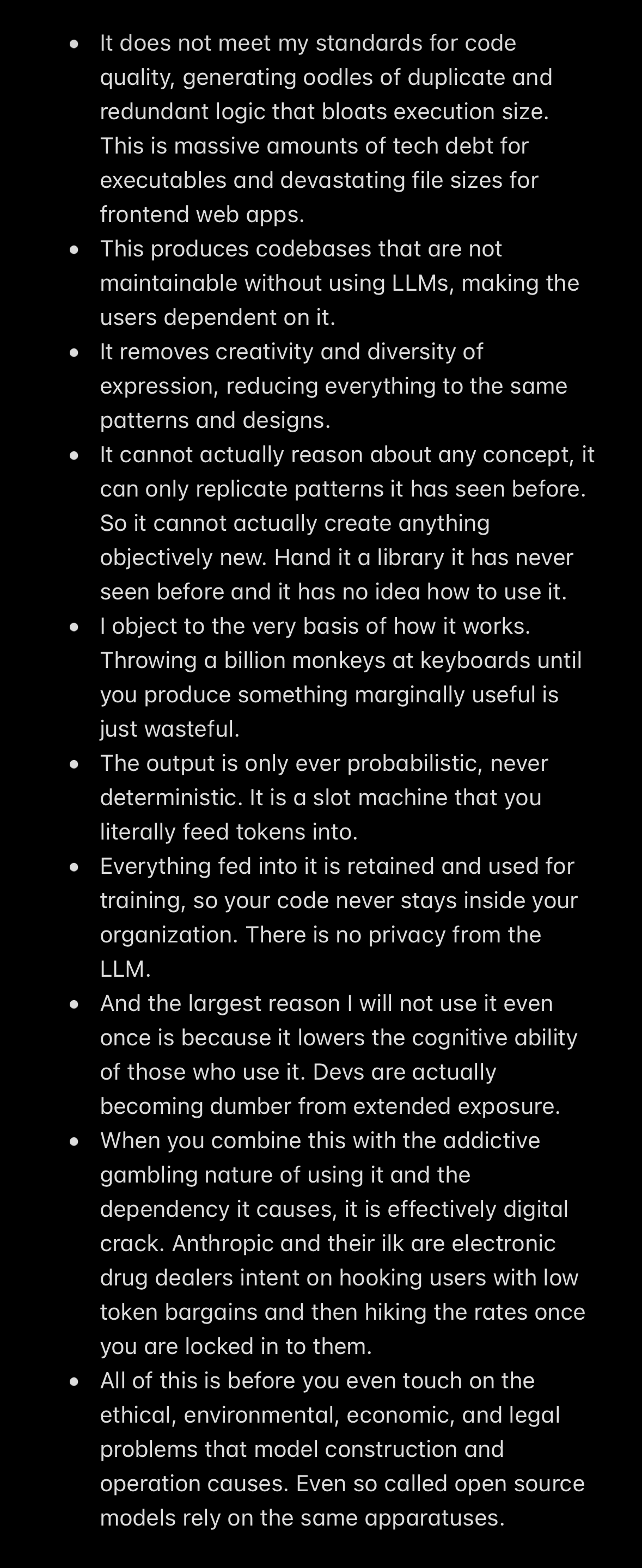

















@timbray @mitsuhiko That is me. I have no doubt that there is real utility to coding agents (although I think it's probably slightly less than is commonly believed), but I avoid them for personal use on ethical grounds and due to the tendency to degrade the ability to think deeply and critically.