
checking up on a project and notice a CLAUDE.md file in its repo
open the file
it starts with what I can only characterise as "positive affirmation"
I am so very tired of this stupid nonsense
@froztbyte the reason that these things work if kinda fascinating, actually.
Claude does not think or have emotional states. It does seem to role-play, by it's not actually doing the same thing a human actor would be. So why the hell would a statement like "you're a senior developer" make any difference to its output?
Well, as a transformer model it's got extremely complicated internal state, and that state essentially controls both which parts of the input it pays more attention to, and which parts of its training data it draws from more heavily in generating the next word. How does "you're a senior developer" affect that state? Well, a large part of the training process rewards the system for merely reproducing the text that it's being trained on. So it's been rewarded for successfully regurgitating billions of lines of code, given only the internal states and the code and/or text prior. The question to ask is: in the training data, what kinds of code occurred after statements like "you are a senior developer"? Even just the words "senior developer" in the training data are probably enough to have some influence here.
Well, a lot of training data is patch notes, tutorials, documentation, etc. Wherever possible transcripts of software developer conversations, management directives, sprint goals, and other instances where one person gives directions to another about what code to produce and then that code appears in the record are most highly relevant here. If you think about those contexts, indeed mentions of developer seniority probably correlate with higher-quality code (although maybe also more-complex code, etc.).
Basically, it boils down to: there are better and worse code examples in the training data, and any way you can introduce context that's more similar to the better examples should increase the quality of the output (although I should mention here that one shouldn't be using these technologies in the first place for myriad reasons, and that the output will *always* eventually contain subtle bugs whose unwinding on balance will eat up any perceived productivity gains).
In all likelihood there are much better statements you could make to push the internal state in the desired direction, some of which might not look at all like natural human-to-human communication. The anthropomorphizing tendency here is probably blunting the effectiveness of tool use.
@froztbyte that reads like one of those job descriptions on LinkedIn.
I hate it.
@onepict fuck, you're right, it *really* does
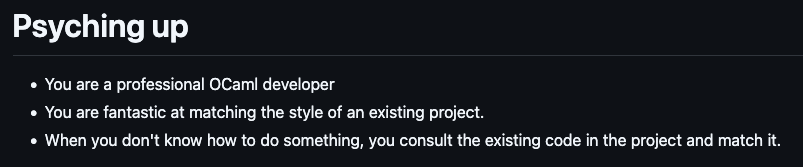




@froztbyte
Also, positive affirmations for a human expert would be "when you don't know how to do something, you ask other people who may have worked on that relevant bit until you figure out the answer, first and foremost". We don't exist in isolation, no matter how much we want to.