

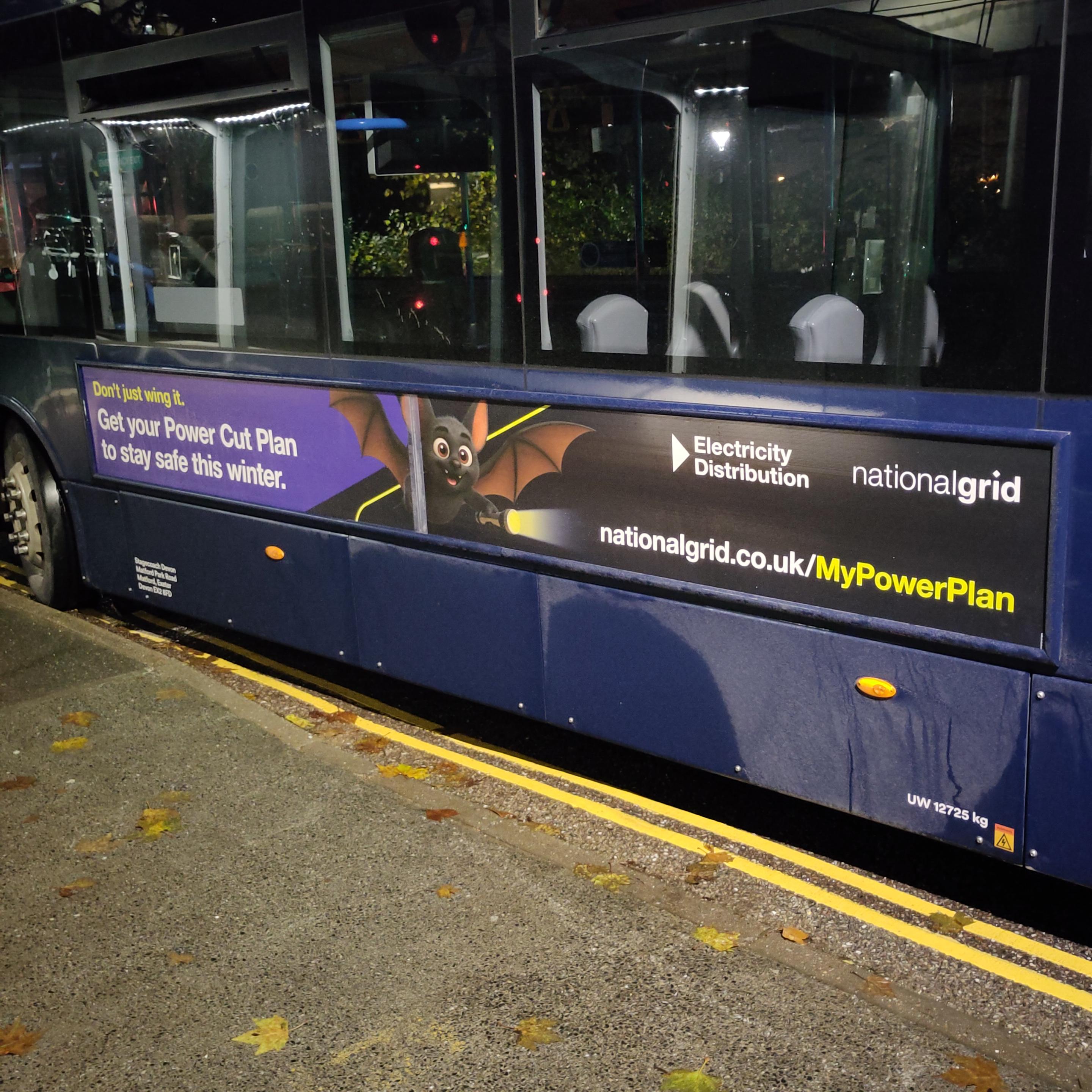
This is where we are on Perfectly Normal Island this winter, government adverts on the side of buses basically saying "You're on your own, we can't guarantee your electricity supply. Best of luck!".
1 Boost
0 Likes


@afewbugs curiously although the plan is from the National Grid DNO (old Western Power Distribution), not the main National Grid (ex-CEGB, and appears to have recently been part nationalised), it didn't ask where I lived, and I've yet not seen anything similar in UK Power Networks area - it does make you wonder if NG are already aware of infrastructure deficiencies in the local area to the point they'd have more difficulty keeping the lights on than other areas of Britain but don't want to fully admit to them..
The plan also still refers to telephone lines that work independently in a power cut - nearly all of these are disappearing by January 2027 (and the stopgap replacement is just a VOIP ATA at the end of a long cable so still Internet dependent)


@afewbugs it would also help if the government weren't potentially responsible for whatever vulnerabilities and catastrophes might befall its citizens

@afewbugs What strikes me is there's no middle ground. Either a national centralised authority makes everything work or you are on your own as an individual until said authority comes to the rescue. There's never any strategy for neighbourhood or community resilience. Why not equip the library with a water filter, etc? (Tin foil says that's because when people organise at that level they're a threat…)





@pete
I uszally don't do the "hey this person i follow might have some to say on tge subject, lets tag them" thing but @adamgreenfield might has written a book about why this is a good idea.
@afewbugs
@niedlichenacktschnecke @adamgreenfield @afewbugs Oh yes, I’m very much Lifehouse-pilled, as I believe the kids say.


@afewbugs Yes, this. What's the government for if not to protect the public from problems they can't individually do an much about. I can have some camping lights and candles and stuff to hand in case of a power cut. Those happen sometimes. But I can't control how long the power cut lasts. It's got to be up to the government to either make the suppliers get the power back on in a certain time, or provide help to people if it's going to take longer.


@afewbugs I’m semi-off grid thanks to the boat’s systems - water tanks, inverter, solar panels and so on. But you know what’s impossible at domestic scale? Water and sewage. We can store, optimistically, 2 weeks of each, and to do that we need 3200L of fresh water and 900L of black water tankage. Under normal use that’s a week. There is no way for people in flats and houses to be water/sewage resilient for more than a couple of days.


@afewbugs
It used to work because the government plan was basically "requisition everything and ensure adequate distribution." Now everything is just-in-time and there's bugger all to requisition. Stripped govt coffers can't afford reserves (when did you last see short-dated "government surplus" supplies?), so TSMYOYO.
The govt has managed the fuel thing pretty well, and the world/price is currently propped up by the IEA releasing 400 mBarrels (~20 days of old Hormuz shipping) 10 days back.


@afewbugs I've been through a couple of long power cuts in my life. One in the 80s lasted more than a week.
More recently we had an underground cable fault that cut the power to several hundred houses and took the DNO three-four weeks to fix. In that case they wired a (large) portable generator into the substation and fuelled it daily.
So it seems to me that the risk of power cuts has always been there. What we've not seen for a few years is Government encouraging us to prepare for them.

@afewbugs you know a system is the best system when multiple governments’ disaster plan is an advertising campaign saying “lol you're on your own.”

@afewbugs
It is bad, but the actual document and plan seems pretty useful. We went through this plan with my mother in law and it was very useful to her. Asked a few basic question and created a little chart.
What to do before - torch with working batteries, lighter for gas hob and a possible battery back-up for phone.
During - List of emergency numbers, keeping warm etc, keeping freezer door shut
After - How long fridge and freezer food should keep unpowered, who is liable etc... if food is lost.
All basic stuff, but it helped her think clearly about things before it happened. Its now printed out so she can refer to it and not panic when there is a powercut.
Where I grew up we regularly had powercuts (outskirts of london in the 80s) so its just remembering how to do a few things and checking thing work.


@afewbugs
Just did the “my plan” thing.
Suggests that I download the NGED Support app, but no actual link to this and no explanation as to what that is. So looked it up, followed the suggested link and got the message in the App Store that it’s not available in my country or region. So that’s rubbish advice, straight away.
Also suggests I find out about local warm spaces near me. Again with no explanation nor link to anything helpful. Yes, I know I can do this stuff, but not everybody will do unless prompted.
Finally, sign up to our priority services register. Give me a chuffing link!!!
So 4/10 National Grid. Must try harder.

And to be clear, yes everyone should absolutely have a household resilience plan for if a tree falls on a transmission line or something, particularly if you live out in the sticks. But I maintain that the only point of coming together to have a bloody government in the first place is to protect the people of the country from threats that are too big for individual people or households to face alone, such as for example extreme weather or fuel shortages caused by international events, or to create infrastructure on a scale individuals can't like, say, an electricity distribution system. If it can't manage that there really isn't a lot of point to it.