
"Brick territories" experiment.
Try it here : https://bleuje.com/js_sketches/brick-territories/
A gif from Jagarikin in 2021 was already showing a similar experiment with 2 balls.
15
Replies
2
Boosts

*AI shill voice* our k-means clustering algorithm became self aware and breached containment

@bleuje This reminds me of a mobile game I used to play called Contranoid that's sadly not available anymore IIRC.


I was surprised by the experiment's stability. Then I realised: the smaller a territory, the more often its ball strikes a boundary and enlarges the territory. Small territories grow faster than large ones, and so they all tend to stay at about the same size.
@CppGuy those that touch the border have an advantage: they receive less attacks. I might add a torus world setting.


all i see is a congressional district map
@bleuje This is cool. I can imagine a full game where you play as one of the colors and select upgrades for your empire every few seconds. A new ball, speed, impact strength. Traps for enemy balls. love it.


@bleuje Amazing; I saw the two-ball version a couple years ago, but this is crazy, a whole bunch more computation involved.
I was inspired to port the two-ball version to Commodore 64, and finished the write-up around how it was done just a couple months ago: https://imrannazar.com/articles/c64-pongwars

@Two9A wow, thanks for sharing!

@bleuje wow this is super cool!


@bleuje this is super fascinating. It's like a kinetic voronoi diagram. I would love to see a time lapse of where the average ball position is and what the voronoi diagram at that point would be.


@bleuje sooo cool! VORONOI!
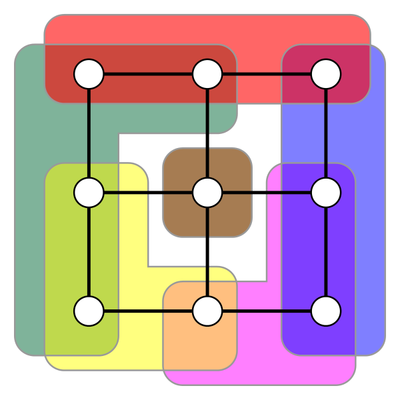
@Otimsis @bleuje I think not exactly Voronoi. My intuition is that you are not going to get cells defined by closeness to some center point (Voronoi, but where is the center?) nor even equal-area cells, but rather cells that equalize perimeter * mean free path length (which controls the rate at which the boundary is replenished).