I am rereading my beloved “Lathe of Heaven” (1971) for the first time in quite awhile. 70 degrees in March, George Orr’s Portland is suffering beneath the Greenhouse Effect, and “it would take several centuries for the CO2 to clear out of the air, if it ever did”; in the Middle East there is war between Israel and Iran “and it keeps spreading.” 😳
10
Replies
0
Boosts

@adamgreenfield i made a sound installation inspired by lathe of heaven a few years ago. still happy with the piece :)
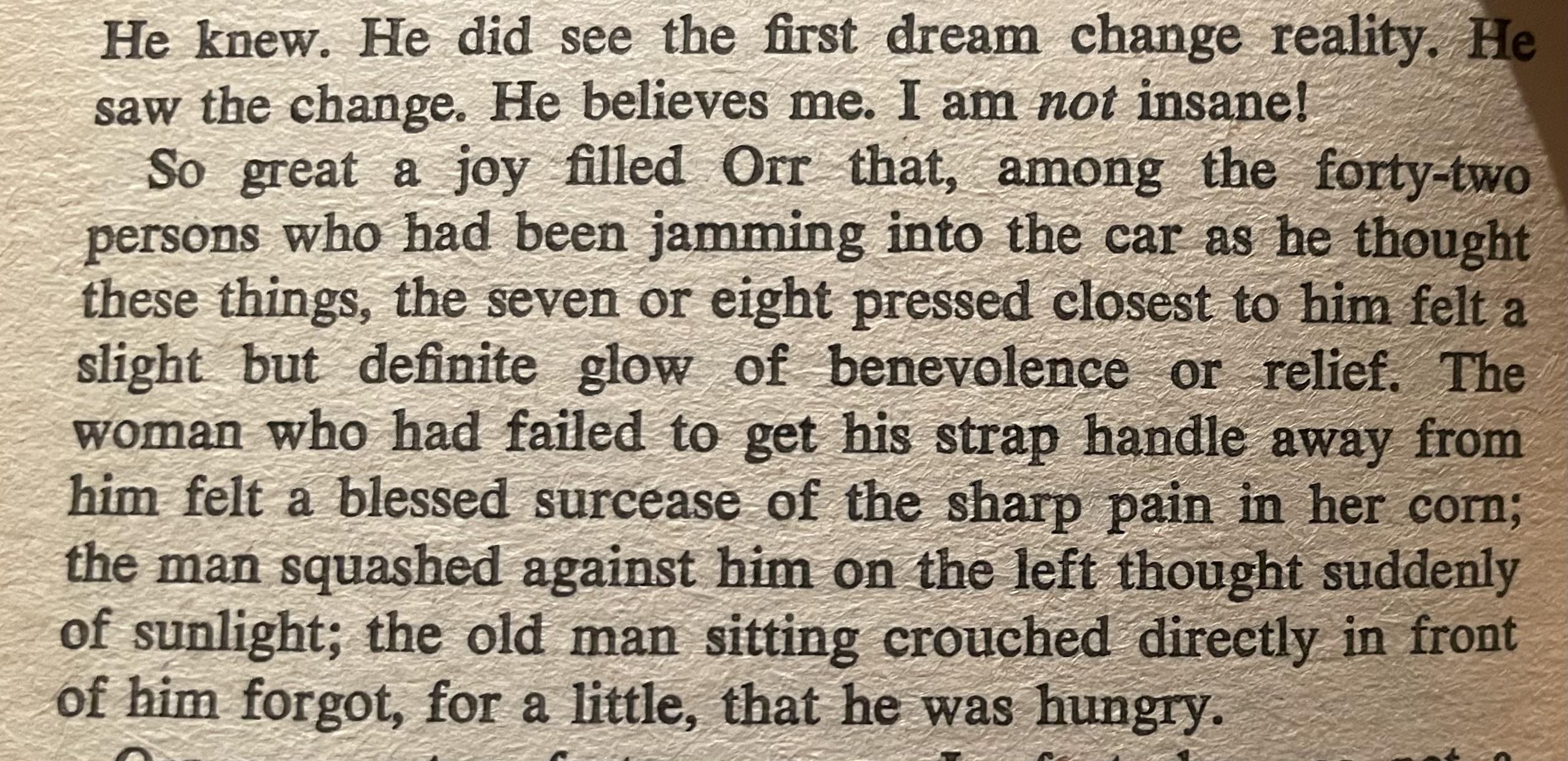
This is one of my two favorite passages in all of literature. I’ll share the other, somewhat longer, with you tomorrow.
And this is my other favorite passage in all of literature, the Christmas scene in “Gravity’s Rainbow.” (There are admittedly more writerly fireworks being set off here than in the LeGuin, though oddly the first paragraph of “The Lathe of Heaven” may just edge it on that account.) https://www.reddit.com/r/ThomasPynchon/comments/efkexz/a_gravitys_rainbow_christmas_thomas_pynchon/
OK, just finished rereading “The Lathe of Heaven” for the first time in many years, and though I certainly didn’t understand LeGuin fully at the time, I’m just *floored* to realize how much of who I eventually became had its origins in this book.
It’s so beautiful, so full of love, even richer in wisdom than I’d remembered.
And here, in Heather Lelache’s musing, is a prompt toward a way of being I still aspire to:
“Are there really people without resentment, without hate? she wondered. People who never go cross-grained to the universe? Who recognize evil, and resist evil, and yet are utterly unaffected by it? Of course there are. Countless, the living and the dead.”
Rereading this for the first time in so long unlocks something for me, actually.
And here’s what it unlocks, with apologies if either framing or phrasing aren’t as elegant as they could be:
Attention is a choice, and our choices of what and who we attend to tend to color subsequent choices downstream of them. And I just don’t like what it does to me when I attend overlong to those – however closely aligned we may be in our politics or other grounding beliefs – who have not overcome their rage at evil.
Note what LeGuin has Heather Lelache perceive: that *it is possible to see and to counter evil without succumbing to rage*, without letting that rage become your personality. This is who I want to be. These are the people I want to be around. These are the voices I want in my life.
This does imply a hygiene: that of no longer attending to articulations that come from a place of rage, ressentiment or revenge. And that’s where I am.


@adamgreenfield I'm re-reading the much more lowbrow "A Spectre is Haunting Texas" by Fritz Leiber. Fun but hardly profound. You have inspired me, I need to read more Le Guin again too.


@adamgreenfield I am still in awe of the banana bread passage.


@adamgreenfield I once read this scene out loud for a set of curated recordings, my favourite too! It is quite extraordinary.


@adamgreenfield ok, i know what thats from and i read it around 40 years ago so it definitely made an impact :-)