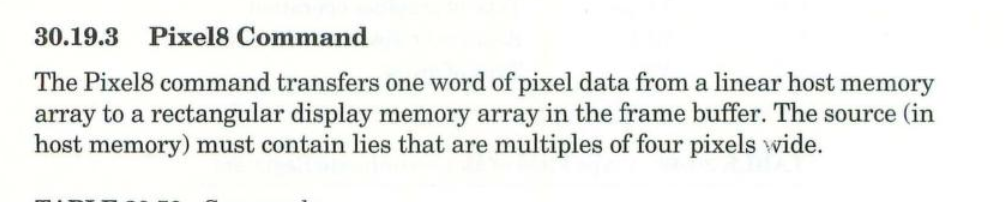

oh god I'm looking up how to program an 2D SVGA accelerator from 1993 and it involves writing special graphical operations to a queue, 4 bytes to "each of the four planes".
PLANAR INSTRUCTION QUEUE
Discussion
oh god I'm looking up how to program an 2D SVGA accelerator from 1993 and it involves writing special graphical operations to a queue, 4 bytes to "each of the four planes".
PLANAR INSTRUCTION QUEUE
Remember to make sure your lies are multiple of 4 wide
I'm reading this to figure out how to program the Weitek P9000/P9100 2D accelerators, as used on the Diamond Viper VLB/PCI cards
sadly it doesn't look like any emulators support this accelerator so I'd need to go get one of the VLB cards like some kind of caveman to code for it
@foone that sounds like a precision nerd-snipe for @gloriouscow
@foone I didn't realise any SVGA cards used planes at all, I'd assumed it was linear frame buffers all the way.
Just been writing planar drawing routines as it happens but for a more expected 80s/90s platform. Converting data to it from VGA chunky format too, which somehow feels like a regression.
Electronics can compute in parallel without living in sequential world of single-threaded imperative programming, it's a matter of physics. Memory was too slow to draw so many pixels on screen sequentially, so it made immediate sense to parallelise how you write to display memory.
Those were the immediate precursors to modern GPUs, which began to emerge a little later in the 1990s.
Yeah. What I mean is that it wasn't an aesthetic choice, or something that had the most mathematically elegant algorithm in mind. It was simple leverage of physics daeling with the physical world, without which high resolution graphics would have never been possible.
It just surprises me how far removed are our modern instincts from that.

Install bonfire.cafe
Get the full app experience