

A fascinating thread…
https://mstdn.jp/@landley/117136387125760084
5
Replies
0
Boosts
…that (like every other sector of modernity) needs to be placed in its broader context.
Philippe Bihouix will help you do that
…Courtesy of @cityroler https://kuber.studio/cookie/ entered my timeline this morning. It’s pretty sobering. Not news to me but good to have it reflected back so starkly.
In its report on my phone and network context it has the below to say, which I’m jumping on as a useful point of leverage to return to what I heard Philippe Bihioux narrate a couple of days ago.
And what Philipppe says is much more stark about “this economy”. Some extracts to follow later
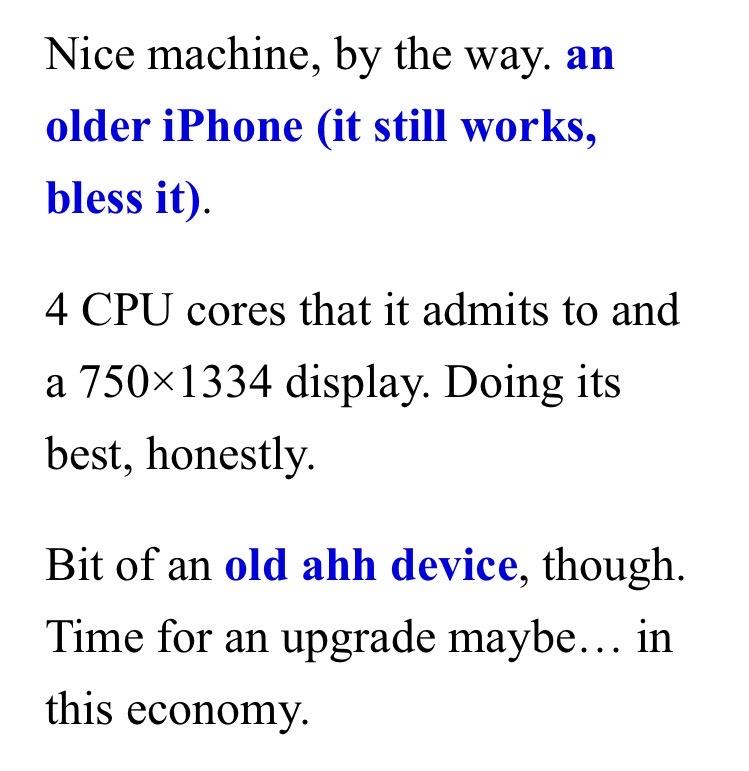
…I should just upgrade my phone, right? Well…
Philippe makes clear that “every smartphone that we build today will be a resource which is *not available* for a radiologist, for a surgeon, or for any kind of medical device”.
This is of course just one pointed example of how our economy is dissipative of the resources it consumes, in particular its metals.
Philippe talks through how diverse the extent of recyclability is with respect to different metals…
“You can take a copper cable and melt it and produce another copper cable and it’s still perfectly okay and 99.999% purity and you you will conduct electricity without any problem. So the metals don’t lose their characteristics.
…
It is in theory true, but it is completely false when we look at the way we are implementing the metals and the way we are designing our objects. Let’s take a couple of examples…
…“Titanium is really a great metal. It is expensive because of its high melting point – more than 2,000°C for sure, and it’s quite well recycled.
But 95% of titanium is used as titanium dioxide, which is the universal white dye that you find everywhere: in cosmetics, in sun creams, in toothpaste, in paper, in paint.
You are just dispersing [an extraordinarily valuable metal]…