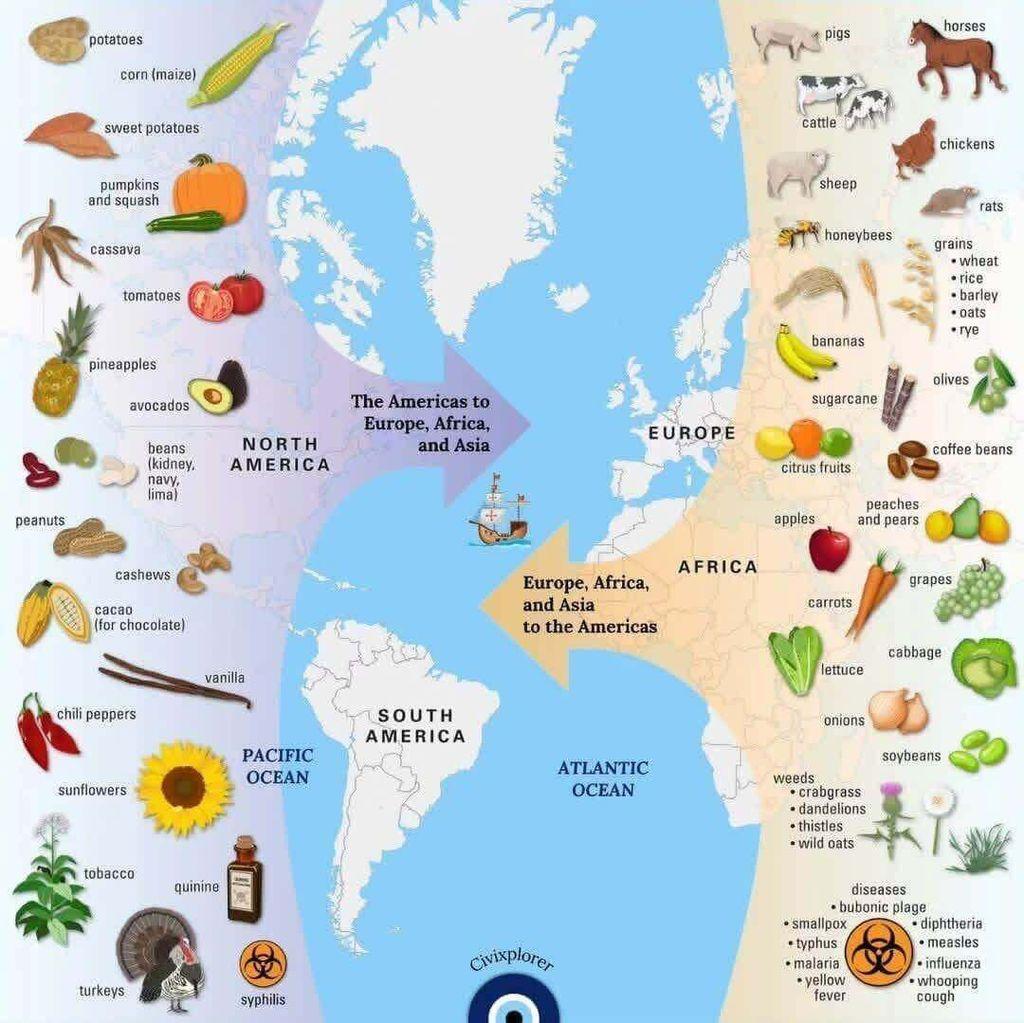
This educational infographic illustrates the Columbian Exchange—the transfer of plants, animals, diseases, and crops between the Americas and the Old World (Europe, Africa, and Asia) following 1492. A world map centers on the Atlantic Ocean, with arrows showing bidirectional exchange: a purple arrow labeled “The Americas to Europe, Africa, and Asia” points eastward from the Americas, and a yellow arrow labeled “Europe, Africa, and Asia to the Americas” points westward. On the left (Americas), illustrated items include potatoes, corn (maize), sweet potatoes, pumpkins, cassava, tomatoes, pineapples, avocados, beans, peanuts, cashews, cacao, vanilla, chili peppers, sunflowers, tobacco, quinine, turkeys, and syphilis (marked with a biohazard symbol). On the right (Old World), items include pigs, horses, cattle, chickens, sheep, rats, honeybees, grains (wheat, rice, barley, oats, rye), bananas, sugarcane, olives, citrus fruits, coffee beans, apples, peaches, pears, carrots, grapes, lettuce, cabbage, onions, soybeans, weeds (crabgrass, dandelions, thistles, wild oats), and diseases (bubonic plague, smallpox, typhus, malaria, yellow fever, diphtheria, measles, influenza, whooping cough), the last grouped under a biohazard icon. A small ship graphic sits at the center of the Atlantic, symbolizing the transoceanic voyages enabling this exchange. The image is credited to Civixplorer at the bottom.