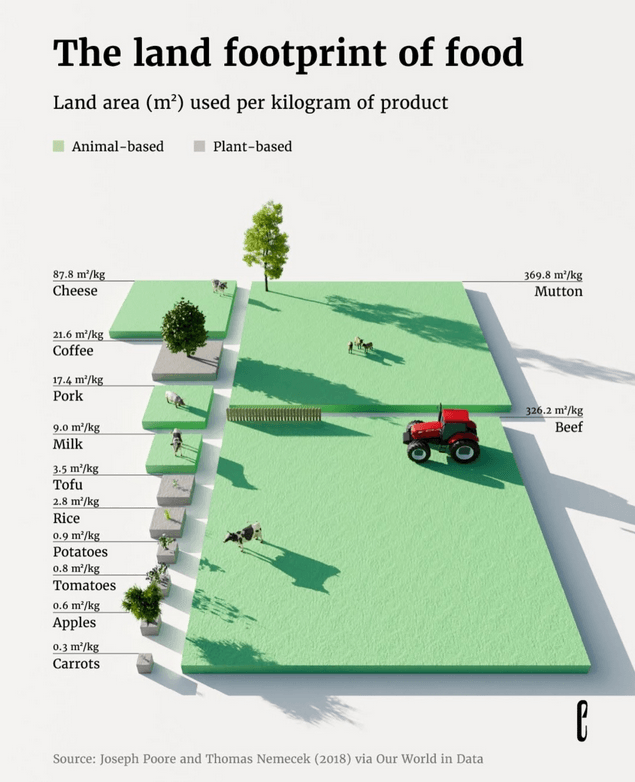

The land footprint of food
Source: https://ourworldindata.org/environmental-impacts-of-food
by @EurCorrespond
Post
The land footprint of food
Source: https://ourworldindata.org/environmental-impacts-of-food
by @EurCorrespond
@infobeautiful Giving absoluite numbers is highly questionable. Cows may live in cages or on pastures. Pigs can even live in multi-story buildings, but I know them living in little styes. Is their food counted in? What if the food is human food scraps? A lot of questionmarks here.
@infobeautiful surprised not to see chicken on there
@infobeautiful I'm not against the message, but I don't think this particular infographic works really well.
A kg. of, say, carrots is in no way comparable to kg. of coffee or beef when looking at calories and nutrients.
So what's the message supposed to be?
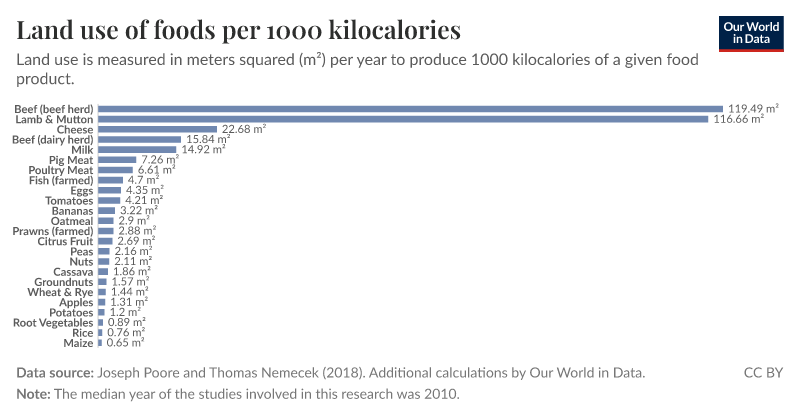
@Kir @infobeautiful yeah. Maybe calories would be a better metric, if the goal is to compare (but that would make coffee meaningless). Hard to capture all in a single image.
@wortezimmer @Kir @infobeautiful thanks! That's less creative but a lot more informative. Thank you!
@signaleleven @wortezimmer @Kir @infobeautiful
But it was cheese that stuck in my throat - because it's so diverse - it's made from both cow's and sheep/goat milk, you can make one cheese from curds and another from whey - and in any case all of the milk that makes cheese gets used in other foods - so how can a single land area for all 'cheese' be at all accurate ?
I am at present cutting out cow's milk - for medical not environmental reasons - but I wonder if sheep/goats cheese is in fact better environmentally ?
@GeofCox
I think it's slightly better, because it's bot being produced on the same industrial level as cow's milk. Yet.
But it's harmful for the animals in the same degree, as they're constantly impregnated, giving birth just to be separated from their offspring which is being killed or raised to experience the same fate if female.

Install bonfire.cafe
Get the full app experience