
Discussion
Loading...

Post

Log in
  • About
  • Code of conduct
  • Privacy
  • Users
  • Instances
  • About Bonfire
AlexCrimi
AlexCrimi
@AlexCrimi@mstdn.social  ·  activity timestamp 12 hours ago

🧠Our New preprint:
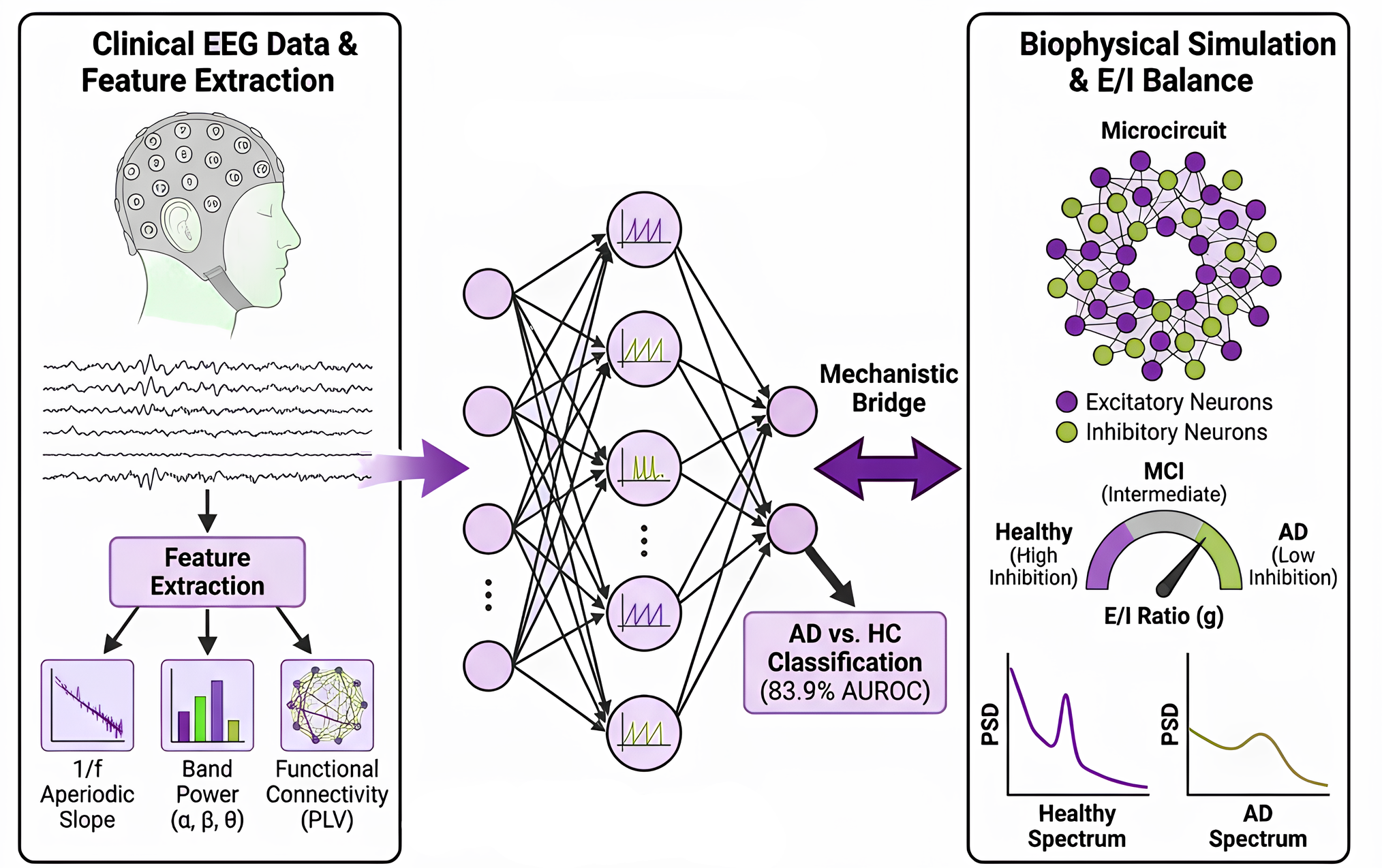
We propose a “neuro-bridge” framework linking #spiking neural networks with biophysical brain simulations for Alzheimer’s detection from #EEG.
📉 1/f slope as key biomarker (E/I balance)
🔁 ML predictions ↔ circuit mechanisms #NeuroAI
https://arxiv.org/abs/2602.07010
Sorry, no caption provided by author
arXiv.org

Learning Alzheimer's Disease Signatures by bridging EEG with Spiking Neural Networks and Biophysical Simulations

As the prevalence of Alzheimer's disease (AD) rises, improving mechanistic insight from non-invasive biomarkers is increasingly critical. Recent work suggests that circuit-level brain alterations manifest as changes in electroencephalography (EEG) spectral features detectable by machine learning. However, conventional deep learning approaches for EEG-based AD detection are computationally intensive and mechanistically opaque. Spiking neural networks (SNNs) offer a biologically plausible and energy-efficient alternative, yet their application to AD diagnosis remains largely unexplored. We propose a neuro-bridge framework that links data-driven learning with minimal, biophysically grounded simulations, enabling bidirectional interpretation between machine learning signatures and circuit-level mechanisms in AD. Using resting-state clinical EEG, we train an SNN classifier that achieves competitive performance (AUC = 0.839) and identifies the aperiodic 1/f slope as a key discriminative marker. The 1/f slope reflects excitation-inhibition balance. To interpret this mechanistically, we construct spiking network simulations in which inhibitory-to-excitatory synaptic ratios are systematically varied to emulate healthy, mild cognitive impairment, and AD-like states. Using both membrane potential-based and synaptic current-based EEG proxies, we reproduce empirical spectral slowing and altered alpha organization. Incorporating empirical functional connectivity priors into multi-subnetwork simulations further enhances spectral differentiation, demonstrating that large-scale network topology constrains EEG signatures more strongly than excitation-inhibition balance alone. Overall, this neuro-bridge approach connects SNN-based classification with interpretable circuit simulations, advancing mechanistic understanding of EEG biomarkers while enabling scalable, explainable AD detection.
  • Copy link
  • Flag this post
  • Block

bonfire.cafe

A space for Bonfire maintainers and contributors to communicate

bonfire.cafe: About · Code of conduct · Privacy · Users · Instances
Bonfire social · 1.0.2-alpha.7 no JS en
Automatic federation enabled
Log in
  • Explore
  • About
  • Members
  • Code of Conduct